Posted on Leave a comment

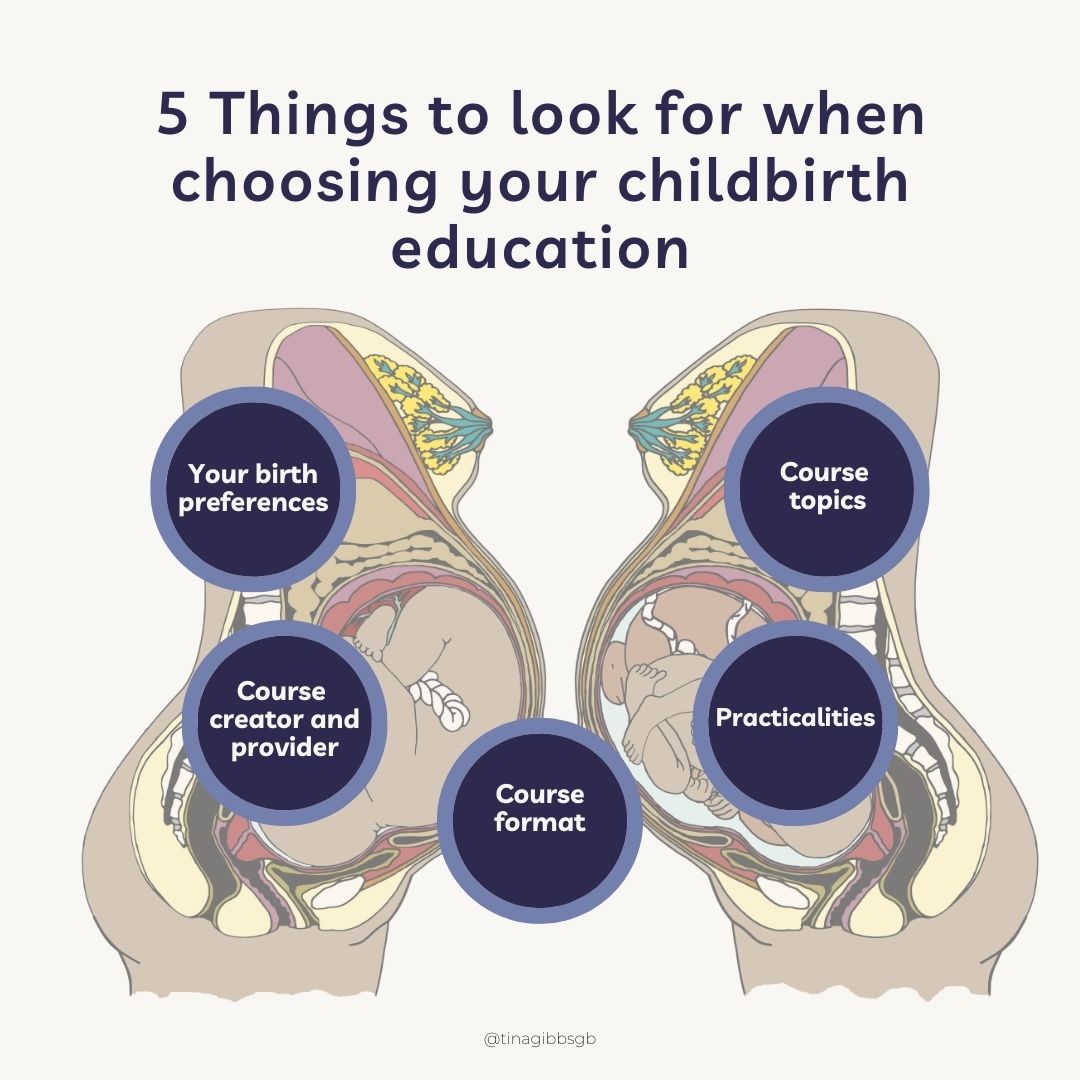
5 Things to look for when choosing your childbirth education

5 things to look for when choosing your childbirth education

You want to be prepared to for the birth of your baby or babies. Here are 5 Things to look for when choosing your childbirth education!

As the birth of your baby approaches, you may have a lot of questions. What does a contraction wave feel like? How will I know when to call the midwife? What kind of breathing techniques can I use? How do I know when it is time to push?

You may also experience a range of emotions such as excitement, nervousness, stress, and even anxiety. The good news are, you can ease your fears and gain confidence in birthing your child when you prepare for the birth of your child. Choosing the right type of childbirth course for you (and your partner) is crucial. Your childbirth preparation course should give you practical knowledge about the physiology of birth as well as where to find practical and emotional support.

5 Things to look for when choosing your childbirth education

1. Does the course agree with your idea on childbirth?

Whether you are you planning for a vaginal birth, caesarean birth, waterbirth, homebirth, etc… you want to ensure that your chosen childbirth education course supports your wishes and preferences. How you choose to give birth is up to you.

Knowing the general philosophy of the birth course you are considering is essential. The techniques that you’ll be learning should be something that you can see yourself doing and something that you believe in. The techniques should support you to achieve the birth you are aiming for.

2. Which topics are covered during the course?

If this is your first birth experience, your childbirth preparation course should cover everything your need to know about your options and what to expect. If you have given birth before, then you may wish to choose a refresher course for you. You may also wish to prepare the older sibling(s) for the birth of their little brother or sister. Learning the about childbirth may lessen your anxiety and help you make informed choices when birthing your baby. Choosing the wrong type of course for you may increase anxieties, so choose your childbirth course and their leader carefully.

3. Who created the course?

Who created the childbirth preparation course? Are they a medical professional or a teacher? Are they an expert in childbirth education? Check their certifications and experience! You want the person and organisation offering your childbirth preparation course to be established and reputable. Ask them to show you proof of their qualification(s).

4. What format is the course in?

Check the format of the course. You may prefer a course which focuses on the birth only, or one that includes practical baby care. If you are interested in hypnobirthing, does the course include hypnobirthing or maybe you prefer a stand-alone hypnobirthing course.

Are partners also coming to the classes or learn anything during the course or is the course for mothers/birthing folks only? Which format do you prefer?

5. Practical things to consider

  • Where and when is the course held? Are the dates, time and venue convenient for you?
  • What is your budget? What are your options at your budget?
  • For an in-person course
    • is there parking available or is it easily accessible via public transport?
    • Is the venue clean and spacious?
    • What are the chair/seating arrangements like? Do you want/need to bring a birthing ball, cushions etc.?
    • Are refreshments included?
    • Accessibility of the venue (where needed)
  • For an online course
    • are you confident in using the platform the course is being offered on?
    • is it a live course or has live elements or is it fully self-paced? – for live elements: are they recorded? If not can you make all the sessions?
    • Is your internet connection reliable?
    • Have you got a pc or laptop to access the course on? This will make your online course a more positive experience.
    • Have I got a comfortable (seating) setup where I can join the online childbirth preparation course?

What type/style of childbirth preparation course you choose is entirely up to you! Use your B.R.A.I.N. acronym when choosing the right course for you:

Brain acronym

What are the benefits, risks (or repercussion), alternatives (for each option)? Trust your gut, your intuition. And think about how you might feel if you do nothing, i.e. you don’t choose a childbirth preparation course?

If you are looking for a childbirth preparation course (1:1) in Nottinghamshire, check out my offers. I also have a fully self-paced online course for just £35. Including hypnobirthing, mp3s and much, much more!

Online Birth Preparation Course only £35!

Please also check out my online course! No videos, just text and images to learn in your own time. Includes hypnobirthing mp3s, scripts, workbook, handouts, infographics and much more! Lots and lots of information at your fingertips! Includes:

  • hypnobirthing mp3s
  • hypnobirthing scripts
  • written information
  • infographics and other imagery
  • printable handouts
  • printable workbook/journal

Posted on Leave a comment

Free Pregnancy Checklist

You are pregnant! Congratulations. Now is the time to get organised. This pregnancy checklist is a gentle reminder of your options, recommendations and appointments…

WhatWhen
The recommendation is to start taking Folic Acid and Vitamin D supplementsAs soon as you found out that you are pregnant
Register with your community midwife. Check with your GP surgery on how to do that.Before week 7
Booking appointment (First appointment) with your community midwifeBetween 8-12 weeks
Get and sign your maternity exemption certificate (free prescriptions and dental appointments)At your booking appointment
Ask your midwife about Healthy Start Vouchers and check if you are eligibleAt booking appointment
First ultrasound offered (dating scan)Around 12 weeks
Second ultrasound offered (anomaly scan)Around 20 weeks
Book your antenatal classesBetween 12 and 22 weeks
Get your Mat-B1 certificate from your community midwifeBetween 22-25 weeks
If you are employed: Inform your employer in writing incl. your Mat-B1 certificate about your maternity leave plans If you are unemployed or self-employed: Find out if you’re eligible for Maternity AllowanceMust be 15 weeks before your due date – Between 22-25 weeks
Find out if you are eligible for a sure start maternity grantAround 29 weeks
Check out your local maternity services. See if you can book a visit or if they have a virtual tour…Around 30 weeks
Start writing your birth preferences and include some “what if…” options (birth plan)Around 30 weeks
Start packing your birth bagsFrom 30 weeks
Start practising your hypnobirthing techniques at least once a dayFrom 30 weeks
Arrange care plans for pets and older siblings or any other care commitmentsFrom 30 weeks
Create your important contact lists and contact preferences and share with your (birth) partner or doula (where applicable)From 32 weeks
Create your birth playlistFrom 34 weeks
Create your birth vision boardFrom 34 weeks
Create your birth affirmationsFrom 34 weeks

Contact your midwife or healthcare professional if you

  • think your contractions have started
  • feel that your waters have broken
  • experience any bleeding in pregnancy
  • feel a change in your baby’s usual movements
  • want reassurance about anything in your pregnancy

Download your free printable Pregnancy Checklist

Newsletter for expectant and new parents

Online Birth Preparation Course only £35!

Please also check out my online course! No videos, just text and images to learn in your own time. Includes hypnobirthing mp3s, scripts, workbook, handouts, infographics and much more! Lots and lots of information at your fingertips! Includes:

  • hypnobirthing mp3s
  • hypnobirthing scripts
  • written information
  • infographics and other imagery
  • printable handouts
  • printable workbook/journal
Posted on 1 Comment

6 ways to include solo parents in antenatal classes

include solo parents in antenatal classes

When you’re used to facilitating your antenatal classes for couples, you might find solo parents attending daunting. So here are 6 ways or ideas on how to include solo parents in your antenatal classes.

Language

Watch your language. Take the solo parent’s lead. How do they introduce themselves to you and the group. Are they calling themselves single parent, sole parent, solo parent…? Mirror that language.

Self massage

It is always a good idea to facilitate and teach about self-massage and self-hypnosis. Here are some self-massage techniques…

Self-massage techniques to include solo parents in antenatal classes

Images

Include images of solo parents to your antenatal classes. Images of a single person in a labour and birth position, a mother or father holding their baby, etc. Check your visual aids to see if they include images of labouring people on their own. My positions for labour and birth poster as well as the cards include images of solo parents.

Storytelling

Include stories about solo parents you know (use their names with their consent only). You could say something like “A solo parent from a previous course found XYZ really helpful.”

Hypnobirthing

Hypnobirthing or self-hypnosis for birth is a very popular choice amongst solo parents. They regular practice of the techniques enables the birthing parent to be “in the zone” and focus on their body and baby.

Mindfulness

Just like hypnobirthing, mindfulness techniques have recently gained popularity especially with solo parents. The focus on the here and now, themselves, their body and their baby works wonders during labour and birth.

Inclusion of solo attendees as standard in your classes

Make the inclusion of solo parents to your antenatal classes something you do every time. Even if everyone in the room has a birthing partner, you never know if the birthing partner can make it to the birth. Explain to expectant parents, that there is like to be a time when the birthing mother/person/parent is on their own at least for a short time.

Posted on 1 Comment

Top 9 Childbirth Affirmations

positive birth affirmations

Before I share my personal top 9 childbirth affirmations, I’d like to explain a little bit more about them.

What are affirmations?

Affirmations, aka positive affirmations, are phrases that you repeat to yourself over and over again to change your mindset. You can say them out loud our in your head. Receive them as part of treatment with your hypnotherapist or other therapist. Most commonly they help you to change a negative into a positive thought or negative into positive thinking.

Affirmations can help you feel more in control and empowered during your birth experience.

Affirmations can improve your ability to problem-solve and decision-making while under stress such as during labour and birth. Making the right decisions for you and your birth enables you to feel empowered while birthing your baby!

My top 9 affirmations for childbirth are:

Writing your childbirth affirmations

Remember, that our conscious and subconscious usually only process the key words. Words such as “don’t” or “no” get lost in the process. So rather than saying to yourself “I mustn’t forget to take my keys” say “I must REMEMBER to take my keys”. For example, if I ask you to NOT think about pink elephants, all you can do is think about just them, the pink elephants. The elephants in the room. So, when you are writing your affirmations for birth, remember to pick statements and trades that are true and important to you.

Now, you are all set up to write your affirmations!

I also have a hypnobirthing affirmation script (including recording) available from my shop. The script has room for your own affirmations and tick-boxes for the ones that you like!

Please also check out my online course! No videos, just text and images to learn in your own time. Includes hypnobirthing mp3s, scripts, workbook, handouts, infographics and much more! Lots and lots of information at your fingertips! Includes:

  • hypnobirthing mp3s
  • hypnobirthing scripts
  • written information
  • infographics and other imagery
  • printable handouts
  • printable workbook/journal

Sources and Further Reading

Posted on Leave a comment

Teaching about induction

Teaching about augmentation and induction of labour as part of childbirth education classes has become an essential topic. Expectant parents need to know the pros and cons, different options and reasons for the recommended induction of labour.

In my opinion, teaching about induction and augmentation of labour means to explore:

  • Common reasons for the recommendation, and why the recommendations are made, how important the reason is, what evidence there is to support the recommendation
  • Different options of for induction and augmentation, i.e. membrane sweep, drip, etc
  • Timeline of induction and augmentation of labour – what may be offered when and why
  • Options of “self-induction” – how can we encourage labour to start on its own?
  • Reputable sources of information to support informed decision-making (some are listed below)
  • Their Birthrights (Human Rights in Childbirth)
  • How to feel empowered once/if they’ve agreed to an induction (support, informed decision making, best for them and their baby in their individual situation…)
  • How to adapt their birth plan

Teaching about induction and augmentation of labour ideas

Discussion

Have a discussion in class about reasons, ways and pros and cons of inducing labour. My induction discussion prompt cards are a visual way to encourage expectant parents to discuss the topic. They are also available as ready printed version and both versions include full instructions including links and references.

Timeline

Explore what methods of induction and augmentation may be offered/happening when, using one of my labour timeline banners.

timeline banner - induction and augmentation of labour

Informed Decision Making Game

One of my personal favourites is an informed decision making scenario game. This also works for teaching about induction and augmentation of labour! The way it works is that you start off with one scenario and give two or more options. Let participants choose one of the options. Each option/choice develops the story further. You’ll get different outcomes when making different choices. Some are choices others are chance as you roll a die or two. This is a fun way to explore how different choices may impact your birth experience. This game works in a in-person class, virtual class as well as for homework.

I also offer workshops on how to write and build your own interactive informed decision making game!

Teaching about induction of labour using visuals

To help include all different learning styles and your clients’ preferences use a mixture of visuals, taktile interactions as well as the written word! I have a range of visual learning aids ready printed as well as digital downloads available from my shop.

Posters

I like to use posters and hang them up on the wall or in the windows during sessions. Posters support the information and retention during the course. I have created these beautiful posters on “self-induction” called “How to encourage childbirth/labour to start”. They are a very recent (2023) addition to my shop and classes and are very positively received by clients as well as birth workers!

Workbooks/Journals/Worksheets

I also provide my clients with a journal/workbook the workbook includes images and information about childbirth and infant feeding. They can take it home and recap and/or take notes during the workshop.

I can also create personalised workbooks, activities, posters and powerpoints for you to fit your branding and content preferences. Please get in touch!

Posted on Leave a comment

Hypnosis and Mindset Iceberg

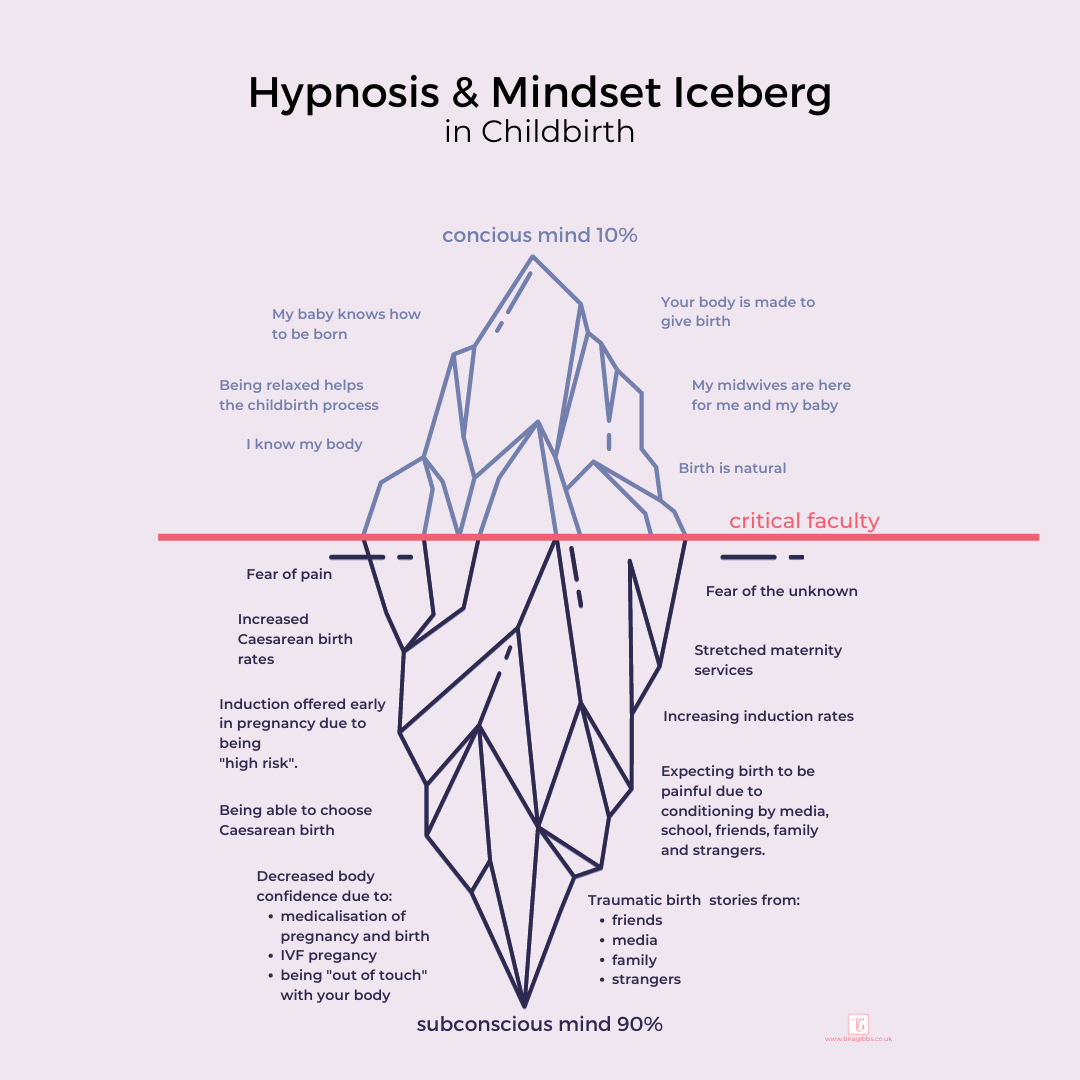
The Hypnosis and Mindset Iceberg. The conscious and subconscious mind and the critical faculty. How does that apply to childbirth?

Let’s think about that. When you look at an iceberg and you can see the tip of it, you can only see a small part of it. The majority is hiding underwater. So now how does that apply to hypnosis and your mindset for childbirth?

Consciously you know, that childbirth is a natural process and the majority of babies can be born without assistance. We know that when we relax, more oxytocin flows, which gives helps the birthing process along by giving you strong regular contraction waves. So why do so many expectant parents struggle to relax during the birth or even during their pregnancy? Because throughout our lives we hear and start to believe that childbirth is painful. The media, family or friends are telling us so. When you are pregnant tests, appointments, scans, precautions etc reinforce the believe that birth needs interference. You sometimes even hear a traumatic birth story from a stranger while waiting at the checkout!

So your conscious mind is the tip of the iceberg and your subconscious mind is the base. This is your Hypnosis and Mindset Iceberg:

Overcoming the Iceberg

When you practise self-hypnosis and mindfulness during your pregnancy, you can use these techniques to help to turn down or off your subconscious mind. It’ll help you to focus on the here and now and make the right decisions for and during your birth experience! Remember, practice and reinforcement of the techniques is the key to an empowered birth experience!

Book your 1:1 mindful hypnobirthing experience with me to learn your techniques to combat the Hypnosis and Mindset Iceberg.

Please also check out my online course! No videos, just text and images to learn in your own time. Includes hypnobirthing mp3s, scripts, workbook, handouts, infographics and much more! Lots and lots of information at your fingertips! Includes:

  • hypnobirthing mp3s
  • hypnobirthing scripts
  • written information
  • infographics and other imagery
  • printable handouts
  • printable workbook/journal

For perinatal educators:

The “Hypnosis and Mindset Iceberg” poster shows an image of an iceberg, where you can see the tip of the iceberg as well as the underwater base of the iceberg. Use it in antenatal or parenting classes to explore expectant parents’ feelings. Where they come from and how the subconscious can influence your decision-making, mindset as well as birth, feeding or parenting experience. An excellent resource for your perinatal education setting!

Hypnosis Iceberg Sources and Further Reading

All were accessed on the 24th January 2023.

Please note that I am in no affiliation with the owners of the websites above.

Posted on Leave a comment

Teaching about Waterbirth

Teaching about Waterbirth Teaching ideas for birthworkers

Teaching about Waterbirth has become one of my favourite topics in recent years. As waterbirth has many benefits and few downsides it is a popular choice among birthing families in the UK.

Teaching about waterbirth in your antenatal preparation classes:

Paperchase – benefits for mother, father, baby, midwife

Split the group into 4 groups. Each group gets one piece of flipchart paper. Four headings: mother/birthing person, father/partner, baby/babies, midwife. Each group brainstorms the benefits/advantages of waterbirth for their person. Move along to the next chart after 1 minute, fill in that chart. Keep going until each group had a minute for each chart. Share the findings in the big group afterwards. This activity takes around 10-15 minutes.

Dry run with inflatable pool

A great way to teach about waterbirth is to do a dry run with an inflatable pool. I usually have the partners set up the pool and time it how long it takes to inflate the pool, add the cover etc. Meanwhile the birthing mothers/people explore some pictures of different pool birth environments and positions in the pool. Once the pool is set up, we discuss how long it may take to fill the pool, along with some things that they may need. Every family can then try out the pool to get a feel for the size. Be careful, when trying out positions as the empty pool will tip over if someone leans over the edge. Always position yourself or someone else at the opposite end to keep the pool steady.

Brainstorm practicalities home vs hospital

This activity is suitable for big group or some smaller groups. You’ll need a piece of flipchart paper for each group. Divide each paper into two sections. Have families compare the practicalities of waterbirth at home vs the hospital or maternity unit.

Pictures – why did you pick…

I lay out a selection of photos and positions cards. Including photos of equipment families may need/choose for their waterbirth. I ask each person/family (depending on group size) to pick one picture. Then in the large group we share: Why have you chosen the picture, what can we see in the picture, how does the picture make you feel, any questions about the image…. I usually do this as an icebreaker as an information leveller…

How to you teach about waterbirth? Please share your ideas with me!

Have you seen my waterbirth video collection? You can find that here!

Posted on Leave a comment

Birth Partner Do’s and Don’ts

Birth Partner do's and don'ts

You are going to be a birth partner? Here are some Birth Partner Do’s and Don’ts! Well do’s really. You’ll get the don’ts from looking at them!

To be a supportive, confident and well-informed birth partner try the following:

  • Attending childbirth preparation classes with your partner will help with your understanding of what is going on and what she is talking about. There is also some new vocabulary you may wish to learn.
  • Be available by phone, especially closer to the due date.
  • Have your own hospital or homebirth bag including: change of clothes, swimming trunks to wear in the birthing pool, your own drinks and snacks (please don’t drink/eat hers!) and maybe some comfortable shoes or slippers.
  • Make sure you know how to fit the car seat and keep it in the car.
  • Be familiar with the route to the hospital or birth unit and that your car is filled up with petrol regularly.
  • Make sure you know where her maternity notes are.
  • Discuss who to tell and when to tell them that your baby was born. Make a list of contact details.
  • Make sure your camera is charged and the memory card is empty or a new film is in it – maybe have it ready in your bag!
  • Support your partner where you can and try to take over some tasks like shopping, cooking, laundry, cleaning to give her some time to rest before and after the birth of you baby.
  • Make sure that you know and understand your partner’s wishes in her birth plan and add your wishes, too. Or even better: write the birth plan together!
  • If this is not your first baby or you have pets, make sure you know who will look after the older one(s) / pets and how to contact them.
  • If it is not your first baby, wherever you can, take over looking after / entertaining the older one(s) to give mum a break before and after the birth.
  • To practice for labour and birth offer a massage and / or slow dance twice a week before the birth of your baby.  Use these techniques during labour to make your partner more comfortable.
  • Practice some affirmations with your partner. You can download free affirmations here and there are some examples below! Alternatively, you can purchase and download some mp3s here.

I hope you find these ideas useful. If you have already been a birth partner, share with us what worked for you and your partner. We’d love to know!

My Birth Preparation Course (online) is for Birth Partners, too!

Please also check out my online course! No videos, just text and images to learn in your own time. Includes hypnobirthing mp3s, scripts, workbook, handouts, infographics and much more! Lots and lots of information at your fingertips! Includes:

  • hypnobirthing mp3s
  • hypnobirthing scripts
  • written information
  • infographics and other imagery
  • printable handouts
  • printable workbook/journal
Posted on Leave a comment

How long does labour last?

How long does labour last?

How long does labour last? What is the average time for labour & childbirth?

In medical terms labour is divided into three stages:

  • 1st stage – where your uterus and body are getting ready. Your cervix is softening and will begin to open until it is fully open (dilated). It is sometimes referred to as the “up stage” because the sensations are pulling/moving upwards. .
  • 2nd second – the second stage begins when you’ll feel the urge to push. It is sometimes referred to as the “pushing stage” or “down stage” because the sensations are pushing downwards. At the end of this stage, your baby will be here.
  • 3rd stage – the birth of the placenta. After your baby is born, you’ll have to give birth to the placenta. This is what is happening in the 3rd and final stage of labour.

So, how long does labour last? According to the NHS, the average first labour lasts between 8-12 hours and subsequent births will be significantly quicker (approx. 5 hours). However, your midwives will only record the timing from when you are considered to be in established labour, which is when your cervix is already around 4cm dilated (open). That means that the contractions and sensations that you are experiencing until then are not officially ‘counted or measured’. However, birthing folk themselves will usually add that time on when they describe their experience. It will take hours or sometimes days (first birth) from your baby dropping (lightening) to the beginning of established labour (4cm). Use this time to rest when you can, hydrate and keep your positive energy up!

Although the NHS and other healthcare providers divide labour and birth into three stages, it is not always that simple… Each medical stage can itself be divided into further smaller steps and stages. When speaking to women and people who have given birth and/or attended births, they describe the birthing process in many more steps. Milli Hill, for example, divides the birth into 15 steps in her Positive Birth Book (affiliate link).

Here is a graphic to show a timeline of childbirth:

How long does labour last?
Childbirth/labour timeline

Posted on 2 Comments

Informed decision-making for birth

Why is Informed decision-making for birth so important?

Often, pregnancy is a woman’s or pregnant person’s first significant introduction to the healthcare system. Suddenly, you have to make all sorts of decisions for you, your baby and your family unit. You’ll be faced with difficult choices around your healthcare during your pregnancy and birth. Often you’ll be influenced by healthcare professionals, your family and friends, media, social media, books, memories, etc. All claiming to know what’s best for you and your baby and in the end leaving you torn…

Whatever choices you are contemplating, you can positively impact your ability to make informed choices you’ll be happy with and you’ll feel empowered by. You can help yourself making informed decisions for your birth.

One frequently used acronym in childbirth education or hypnobirthing classes is BRAIN(S) or BRIAN. Here is a visual to help you remember it:

meet brian

BRIAN aka BRAIN is a simple acronym to help you in gathering all the information you need to make informed decisions about your own and your baby’s health care. When you join my hypnobirthing classes you’ll get to meet BRIAN (my weighted baby doll). We will help you with your informed decision-making for birth! 

Alternatively, if you prefer a self-paced online course, you can now enrol in my online childbirth preparation course. The online course includes all my antenatal mp3 recordings, the scripts as well as a 20 page printable workbook!

Benefits:
What are the benefits of the treatment/procedure/etc? Is this what is usually done? How do the usual benefits apply to your personal, individual care?

Risks:
Are there any risks? What risks are there with the treatment/procedure/etc? Is this what is usually done? How do these apply to your personal and individual care?

Intuition:
How do you feel about the treatment/procedure/etc. offered? What does your gut tell you?

Alternatives:
What are the alternatives? Where can I get a second/third opinion?

Nothing:
What would happen if I do nothing? Is it an emergency? How much time have we got to think about it? Do we have to make a decision now?

With this simple and memorable acronym you can make informed decisions without having to memorise or read all the available statistics and research. You will feel more in control of the birth as well as more empowered and happier with your individual birth experience.

And that’s why informed decision-making for childbirth is so important.