Posted on Leave a comment

When to do a hypnobirthing class?

When to do a hypnobirthing class

What is hypnobirthing? When to do a hypnobirthing class? What are the benefits of hypnobirthing?

What is hypnobirthing?

Hypnobirthing is a type of childbirth education. It focuses on relaxation techniques and self-hypnosis to help expectant mothers experience a more calm and comfortable birth. In addition to that, hypnobirthing, especially Mindful Hypnobirthing can help you deal and come to terms with (sudden) changes during your pregnancy and childbirth journey. Hypnobirthing teaches you techniques to calm your body and mind in any situation helping you achieve a more satisfying (birth) experience.

When to do a hypnobirthing class?

Basked in the warmth of expectant anticipation, the journey of pregnancy holds boundless possibilities. Embracing this transformative phase, hypnobirthing serves as a gentle beacon, guiding you towards a serene and empowering birth experience. By attending your hypnobirthing class between 21-30 weeks, you gracefully intertwine knowledge and practice, nurturing a profound connection with your body, baby, and the birthing process.

During these immersive sessions, you will delve into the intricacies of hypnobirthing techniques, equipping yourself with a rich toolbox of relaxation exercises, visualization practices, and deep breathing methods. This precious time devoted to learning and self-discovery ensures that you absorb the wisdom imparted by your course, allowing sensations of tranquility and confidence to take root within you.

As you embark on this path, make the conscious decision to prioritize self-care and integration. Carve out moments in your schedule to indulge in self-reflection, savoring the invaluable opportunity to unwind and surrender to the present moment. Remember, practice is the key to unlocking the full potential of hypnobirthing. By dedicating time to honing your skills, you cultivate an innate sense of calmness and resilience, ready to embrace the birthing journey with unwavering grace.

As you honour your body’s innate wisdom and the innate wisdom of your baby, embrace the affirmations that flow through hypnobirthing. Enveloped in an atmosphere of love, trust, and empowerment, you harness the strength of your mind and spirit, harmoniously co-creating a positive childbirth experience.

Embrace this transformative passage, for it is an invitation to embark on a sacred and empowering journey. Through the art of hypnobirthing, discover newfound serenity, reclaim your inner power, and paint an exquisite portrait of birth, woven with love and grace.

What are the benefits of hypnobirthing classes?

The benefits of attending a hypnobirthing class are numerous. During a group hypnobirthing class you’ll meet like-minded people embarking on their journey to parenthood at a similar time. By learning effective relaxation and breathing techniques, hypnobirthing can help reduce anxiety, fear, and tension during labour, making the experience more positive and enjoyable.

In a hypnobirthing class, you can expect to learn various techniques such as deep relaxation, visualization, affirmations, and self-hypnosis. These techniques are designed to help you achieve a state of deep relaxation and promote a more efficient and comfortable labour. The classes are typically taught by certified hypnobirthing practitioners who guide you through the process and provide ongoing support throughout your pregnancy journey.

It’s important to note that hypnobirthing classes are beneficial for all types of births, whether you are planning a natural birth or have opted for medical interventions. The techniques learned in hypnobirthing can be applied in any birthing scenario and can help you stay calm, focused, and in control.

If you’re considering attending a hypnobirthing class, it’s recommended to do your research and find a reputable practitioner in your area. Many classes offer both in-person and online options, allowing you to choose the format that suits you best. Remember, hypnobirthing is not just about the birthing day but also about preparing mentally, emotionally, and physically throughout your pregnancy for a positive birthing experience. So, take the time to explore this wonderful approach to childbirth and embrace a more relaxed and empowered journey into motherhood.

Online Birth Preparation Course only £35!

Please also check out my online course! No videos, just text and images to learn in your own time. Includes hypnobirthing mp3s, scripts, workbook, handouts, infographics and much more! Lots and lots of information at your fingertips! Includes:

  • hypnobirthing mp3s
  • hypnobirthing scripts
  • written information
  • infographics and other imagery
  • printable handouts
  • printable workbook/journal
Posted on Leave a comment

Floppy Face Floppy Fanny

“Floppy Face Floppy Fanny” a magic technique to make childbirth easier, more enjoyable and reduces tearing. How?

During childbirth, the process of delivering a baby can be both physically and emotionally intense for the expecting mother. It is natural to feel some level of fear, tension, or discomfort during this journey. However, there is an intriguing technique that some believe can help make the birthing experience easier, more enjoyable, and even reduce the likelihood of tearing. This technique is known as “Floppy Face Floppy Fanny.” The phrase was first said by American midwife Ina May Gaskin.

The concept behind Floppy Face Floppy Fanny is based on the interconnectedness of our facial muscles with those in our pelvic floor, vagina, and vulva. According to this technique, when the face is relaxed, especially the muscles around the mouth and jaw, it has a profound impact on the relaxation of the pelvic area as well. By consciously relaxing the face, the woman aims to create a ripple effect, allowing the muscles in her birthing canal to also relax, making it easier for the baby to pass through.

The idea of linking facial relaxation with childbirth may sound unconventional, but proponents of this technique suggest that it can have a significant impact on the overall birthing experience. By practicing deep breathing exercises, visualization, and consciously relaxing the facial muscles, women may find increased comfort, reduced pain, and a smoother delivery process.

It’s important to note that its effectiveness may vary from person to person. Every woman’s/birthing person’s experience with childbirth is unique, and there are many factors involved in the ease and outcome of the process. It is always recommended to consult with a healthcare professional or midwife for personalized guidance and support during pregnancy and childbirth.

So why am I saying Floppy Face, Floppy Fanny rather than relax your mouth and jaw? To make it more memorable for expectant parents. I’ve also been using the “loose lips, loose hips”.

Here are some flashcards for breathing techniques to help you to keep your jaw, lips and mouth relaxed. One of the most memorable but simple technique is “horse lips”.

Online Birth Preparation Course only £35!

Please also check out my online course! No videos, just text and images to learn in your own time. Includes hypnobirthing mp3s, scripts, workbook, handouts, infographics and much more! Lots and lots of information at your fingertips! Includes:

  • hypnobirthing mp3s
  • hypnobirthing scripts
  • written information
  • infographics and other imagery
  • printable handouts
  • printable workbook/journal

Sources and Further Reading

  • Emmer, Helene et al. “Obstructive sleep apnea syndrome is associated with overactive bladder and urgency incontinence in men.” Sleep vol. 32,2 (2009): 271-5. doi:10.1093/sleep/32.2.271
  • Fischer MJ, Riedlinger K, Gutenbrunner C, Bernateck M. Influence of the temporomandibular joint on range of motion of the hip joint in patients with complex regional pain syndrome. J Manipulative Physiol Ther. 2009 Jun;32(5):364-71. doi: 10.1016/j.jmpt.2009.04.003. PMID: 19539119
  • Dr Lauren Keller: https://drlaurenkeller.com/blog/2022/5/23/5xlrzq50dx7n127nsavetabxr7jseg
  • Mamastefit: https://mamastefit.com/breathing-our-pelvic-floor-and-labor/
  • Talasz H, Kremser C, Talasz HJ, Kofler M, Rudisch A. Breathing, (S)Training and the Pelvic Floor-A Basic Concept. Healthcare (Basel). 2022 Jun 2;10(6):1035. doi: 10.3390/healthcare10061035. PMID: 35742086; PMCID: PMC9222935.
  • Van der Velde, J., & Everaerd, W. (2001). The relationship between involuntary pelvic floor muscle activity, muscle awareness and experienced threat in women with and without vaginismus. Behaviour Research and Therapy, 39(4), 395–408. doi:10.1016/s0005-7967(00)00007-3
  • Van der Velde, J., Laan, E., & Everaerd, W. (2000). Vaginismus, a component of a general defensive reaction. An investigation of pelvic floor muscle activity during exposure to emotion inducing film excerpts in women with and without vaginismus. Submitted
  • WombWisdom: https://www.wombseedwisdom.com/
Posted on Leave a comment

5 Things to look for when choosing your childbirth education

5 things to look for when choosing your childbirth education

You want to be prepared to for the birth of your baby or babies. Here are 5 Things to look for when choosing your childbirth education!

As the birth of your baby approaches, you may have a lot of questions. What does a contraction wave feel like? How will I know when to call the midwife? What kind of breathing techniques can I use? How do I know when it is time to push?

You may also experience a range of emotions such as excitement, nervousness, stress, and even anxiety. The good news are, you can ease your fears and gain confidence in birthing your child when you prepare for the birth of your child. Choosing the right type of childbirth course for you (and your partner) is crucial. Your childbirth preparation course should give you practical knowledge about the physiology of birth as well as where to find practical and emotional support.

5 Things to look for when choosing your childbirth education

1. Does the course agree with your idea on childbirth?

Whether you are you planning for a vaginal birth, caesarean birth, waterbirth, homebirth, etc… you want to ensure that your chosen childbirth education course supports your wishes and preferences. How you choose to give birth is up to you.

Knowing the general philosophy of the birth course you are considering is essential. The techniques that you’ll be learning should be something that you can see yourself doing and something that you believe in. The techniques should support you to achieve the birth you are aiming for.

2. Which topics are covered during the course?

If this is your first birth experience, your childbirth preparation course should cover everything your need to know about your options and what to expect. If you have given birth before, then you may wish to choose a refresher course for you. You may also wish to prepare the older sibling(s) for the birth of their little brother or sister. Learning the about childbirth may lessen your anxiety and help you make informed choices when birthing your baby. Choosing the wrong type of course for you may increase anxieties, so choose your childbirth course and their leader carefully.

3. Who created the course?

Who created the childbirth preparation course? Are they a medical professional or a teacher? Are they an expert in childbirth education? Check their certifications and experience! You want the person and organisation offering your childbirth preparation course to be established and reputable. Ask them to show you proof of their qualification(s).

4. What format is the course in?

Check the format of the course. You may prefer a course which focuses on the birth only, or one that includes practical baby care. If you are interested in hypnobirthing, does the course include hypnobirthing or maybe you prefer a stand-alone hypnobirthing course.

Are partners also coming to the classes or learn anything during the course or is the course for mothers/birthing folks only? Which format do you prefer?

5. Practical things to consider

  • Where and when is the course held? Are the dates, time and venue convenient for you?
  • What is your budget? What are your options at your budget?
  • For an in-person course
    • is there parking available or is it easily accessible via public transport?
    • Is the venue clean and spacious?
    • What are the chair/seating arrangements like? Do you want/need to bring a birthing ball, cushions etc.?
    • Are refreshments included?
    • Accessibility of the venue (where needed)
  • For an online course
    • are you confident in using the platform the course is being offered on?
    • is it a live course or has live elements or is it fully self-paced? – for live elements: are they recorded? If not can you make all the sessions?
    • Is your internet connection reliable?
    • Have you got a pc or laptop to access the course on? This will make your online course a more positive experience.
    • Have I got a comfortable (seating) setup where I can join the online childbirth preparation course?

What type/style of childbirth preparation course you choose is entirely up to you! Use your B.R.A.I.N. acronym when choosing the right course for you:

Brain acronym

What are the benefits, risks (or repercussion), alternatives (for each option)? Trust your gut, your intuition. And think about how you might feel if you do nothing, i.e. you don’t choose a childbirth preparation course?

If you are looking for a childbirth preparation course (1:1) in Nottinghamshire, check out my offers. I also have a fully self-paced online course for just £35. Including hypnobirthing, mp3s and much, much more!

Online Birth Preparation Course only £35!

Please also check out my online course! No videos, just text and images to learn in your own time. Includes hypnobirthing mp3s, scripts, workbook, handouts, infographics and much more! Lots and lots of information at your fingertips! Includes:

  • hypnobirthing mp3s
  • hypnobirthing scripts
  • written information
  • infographics and other imagery
  • printable handouts
  • printable workbook/journal

Posted on 1 Comment

Top 9 Childbirth Affirmations

positive birth affirmations

Before I share my personal top 9 childbirth affirmations, I’d like to explain a little bit more about them.

What are affirmations?

Affirmations, aka positive affirmations, are phrases that you repeat to yourself over and over again to change your mindset. You can say them out loud our in your head. Receive them as part of treatment with your hypnotherapist or other therapist. Most commonly they help you to change a negative into a positive thought or negative into positive thinking.

Affirmations can help you feel more in control and empowered during your birth experience.

Affirmations can improve your ability to problem-solve and decision-making while under stress such as during labour and birth. Making the right decisions for you and your birth enables you to feel empowered while birthing your baby!

My top 9 affirmations for childbirth are:

Writing your childbirth affirmations

Remember, that our conscious and subconscious usually only process the key words. Words such as “don’t” or “no” get lost in the process. So rather than saying to yourself “I mustn’t forget to take my keys” say “I must REMEMBER to take my keys”. For example, if I ask you to NOT think about pink elephants, all you can do is think about just them, the pink elephants. The elephants in the room. So, when you are writing your affirmations for birth, remember to pick statements and trades that are true and important to you.

Now, you are all set up to write your affirmations!

I also have a hypnobirthing affirmation script (including recording) available from my shop. The script has room for your own affirmations and tick-boxes for the ones that you like!

Please also check out my online course! No videos, just text and images to learn in your own time. Includes hypnobirthing mp3s, scripts, workbook, handouts, infographics and much more! Lots and lots of information at your fingertips! Includes:

  • hypnobirthing mp3s
  • hypnobirthing scripts
  • written information
  • infographics and other imagery
  • printable handouts
  • printable workbook/journal

Sources and Further Reading

Posted on Leave a comment

Hypnosis and Mindset Iceberg

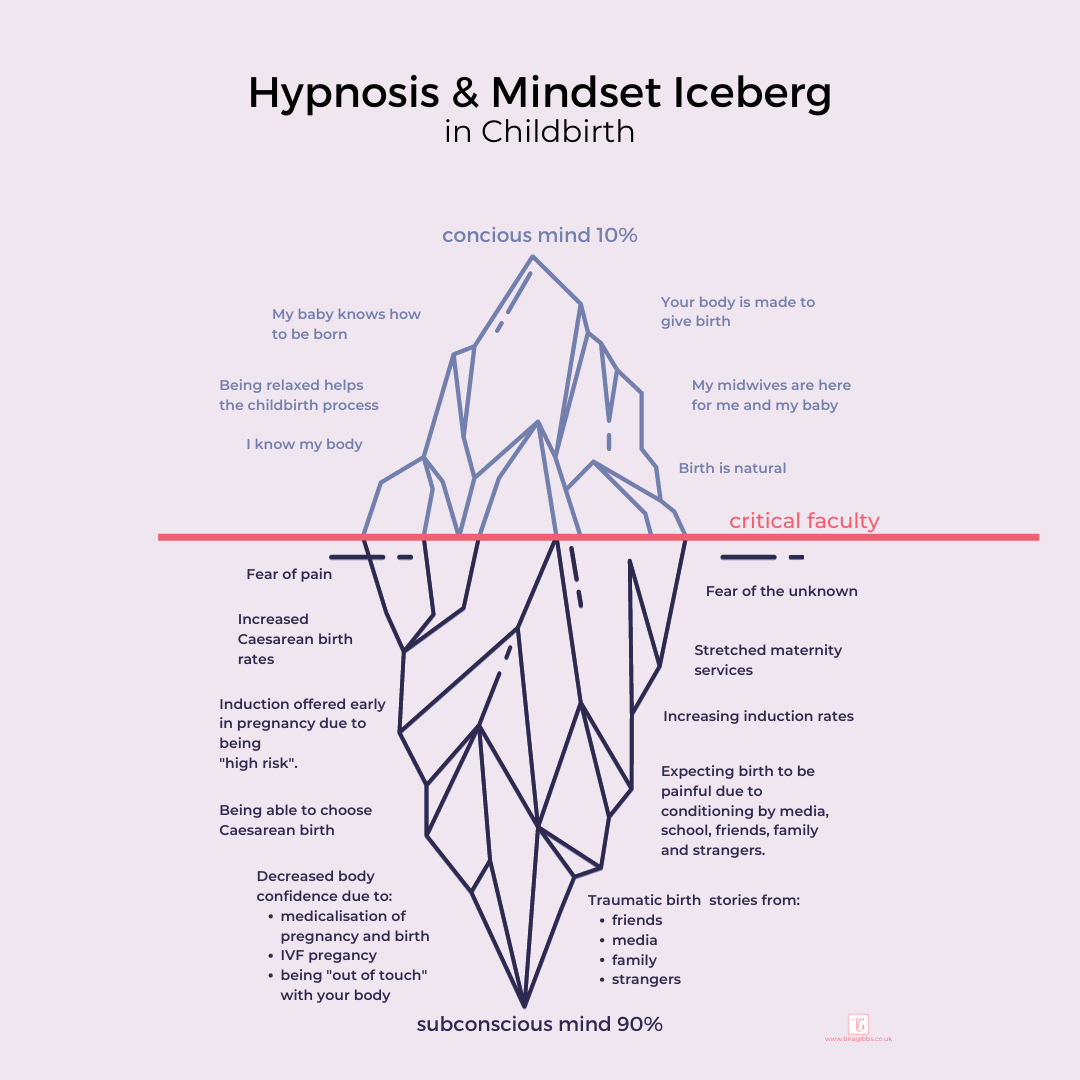
The Hypnosis and Mindset Iceberg. The conscious and subconscious mind and the critical faculty. How does that apply to childbirth?

Let’s think about that. When you look at an iceberg and you can see the tip of it, you can only see a small part of it. The majority is hiding underwater. So now how does that apply to hypnosis and your mindset for childbirth?

Consciously you know, that childbirth is a natural process and the majority of babies can be born without assistance. We know that when we relax, more oxytocin flows, which gives helps the birthing process along by giving you strong regular contraction waves. So why do so many expectant parents struggle to relax during the birth or even during their pregnancy? Because throughout our lives we hear and start to believe that childbirth is painful. The media, family or friends are telling us so. When you are pregnant tests, appointments, scans, precautions etc reinforce the believe that birth needs interference. You sometimes even hear a traumatic birth story from a stranger while waiting at the checkout!

So your conscious mind is the tip of the iceberg and your subconscious mind is the base. This is your Hypnosis and Mindset Iceberg:

Overcoming the Iceberg

When you practise self-hypnosis and mindfulness during your pregnancy, you can use these techniques to help to turn down or off your subconscious mind. It’ll help you to focus on the here and now and make the right decisions for and during your birth experience! Remember, practice and reinforcement of the techniques is the key to an empowered birth experience!

Book your 1:1 mindful hypnobirthing experience with me to learn your techniques to combat the Hypnosis and Mindset Iceberg.

Please also check out my online course! No videos, just text and images to learn in your own time. Includes hypnobirthing mp3s, scripts, workbook, handouts, infographics and much more! Lots and lots of information at your fingertips! Includes:

  • hypnobirthing mp3s
  • hypnobirthing scripts
  • written information
  • infographics and other imagery
  • printable handouts
  • printable workbook/journal
For perinatal educators:

The “Hypnosis and Mindset Iceberg” poster shows an image of an iceberg, where you can see the tip of the iceberg as well as the underwater base of the iceberg. Use it in antenatal or parenting classes to explore expectant parents’ feelings. Where they come from and how the subconscious can influence your decision-making, mindset as well as birth, feeding or parenting experience. An excellent resource for your perinatal education setting!

Hypnosis Iceberg Sources and Further Reading

All were accessed on the 24th January 2023.

Please note that I am in no affiliation with the owners of the websites above.

Posted on Leave a comment

How long does labour last?

How long does labour last?

How long does labour last? What is the average time for labour & childbirth?

In medical terms labour is divided into three stages:

  • 1st stage – where your uterus and body are getting ready. Your cervix is softening and will begin to open until it is fully open (dilated). It is sometimes referred to as the “up stage” because the sensations are pulling/moving upwards. .
  • 2nd second – the second stage begins when you’ll feel the urge to push. It is sometimes referred to as the “pushing stage” or “down stage” because the sensations are pushing downwards. At the end of this stage, your baby will be here.
  • 3rd stage – the birth of the placenta. After your baby is born, you’ll have to give birth to the placenta. This is what is happening in the 3rd and final stage of labour.

So, how long does labour last? According to the NHS, the average first labour lasts between 8-12 hours and subsequent births will be significantly quicker (approx. 5 hours). However, your midwives will only record the timing from when you are considered to be in established labour, which is when your cervix is already around 4cm dilated (open). That means that the contractions and sensations that you are experiencing until then are not officially ‘counted or measured’. However, birthing folk themselves will usually add that time on when they describe their experience. It will take hours or sometimes days (first birth) from your baby dropping (lightening) to the beginning of established labour (4cm). Use this time to rest when you can, hydrate and keep your positive energy up!

Although the NHS and other healthcare providers divide labour and birth into three stages, it is not always that simple… Each medical stage can itself be divided into further smaller steps and stages. When speaking to women and people who have given birth and/or attended births, they describe the birthing process in many more steps. Milli Hill, for example, divides the birth into 15 steps in her Positive Birth Book (affiliate link).

Here is a graphic to show a timeline of childbirth:

How long does labour last?
Childbirth/labour timeline

Posted on Leave a comment

Make some noise during childbirth

Make some noise during childbirth

Make some noise during childbirth or not? What do you think is more helpful or beneficial for the birthing process?

The Mirror, recently printed an article about a mother who had shared on social media that her doctor told her to be quiet when giving birth. She felt that that was rude, which prompted me to write this post…

Make some noise during childbirth

Now, make some noise during childbirth? Yes, make some noise during childbirth!

Most women and birthing people will make some noise when they are birthing their baby or babies. You can use the noise to your advantage! Especially, lower, deeper abdominal noise and sounds can be helpful! If in doubt, any noise is better than holding your breath! Here are some examples of noised I’ve heard when attending births:

Growling/roaring – Occurs most likely and often during pushing, when a woman must summon up all of her strength to push out baby.

Low grunting – deep sounding noise from inside your abdomen, can help the birth process. It’s most often heard during the second stage (pushing) of labour. When making those deep, low sounds, you are using your diaphragm which helps the ‘pushing stage’.

Mantra/Affirmations/repeating words – another helpful way to stay calm, strong and focused during birth is to repeat a helpful mantra, affirmations or some words. The use of affirmations or mantra’s for birth is very common. You can sing them, say them out loud, say them in your head and/or read them. Here are some free affirmations for you to chose from/print or make your own. I have a recorded affirmation mp3 for which includes the script, so that your doula or partner can read them to you. They recording is available with and without background music.

Screaming – Unlike what you see in movies, screaming is actually uncommon during childbirth. However, if you observe the birthing woman or person screaming, it’s most likely that they are panicking and need some assistance/support to ground themselves, calm down and relax. A shoulder/touch anchor can be very helpful in this situation. To learn more about anchors for childbirth, join a hypnobirthing class!

Were you surprised about the noises you made while giving birth or you heard when someone was giving birth? Tell us in the comments!

Posted on Leave a comment

Hypnobirthing FAQ

Hypnobirthing FAQ

Who is a hypnobirthing course for?

My hypnobirthing workshops are aimed at anyone who wants to give their baby a gentle and loving start in life. If you want a positive experience of birth that you can look back and treasure – for the rest of your life, then my workshops are for you. Suitable for all types of birth including induction and caesarean birth. Expectant parents are bombarded with images, videos and stories of childbirth as a negative event. During my hypnobirthing workshops we’ll explore your thoughts, fears and experiences and help you regain your faith in your body and choices. Empowering you to make the right choices for your positive birth experience; and look forward to your birth experience.

When should I go to a hypnobirthing course?

Hypnobirthing courses are suitable from 20 weeks of gestation. Ideally, you’d like to give yourself and your partner some time to practice the techniques you learn during the course. The more you practice, the better it’ll work for you. However, most expectant parents join a class around 32-35 weeks of pregnancy.

Does my birth partner have to attend the course?

I strongly encourage birth partners to attend the course. Your birth partner is an essential part of your day and they’ll benefit from learning about your options and challenges during birth. It’ll help them to be more confident in supporting you.

Do I have to have a birth partner?

That’s up to you. Some mothers decide to have their partner or/and a doula or friend present at the birth, others chose to be on their own. It can be beneficial for the birthing process to have a familiar face in the room to keep you grounded, calm and comfortable. If you do have a birth partner, please encourage them to come along to the workshop!

I have experienced a birth trauma/negative birth experience – is hypnobirthing for me?

I am a trauma-informed doula and hypnobirthing practitioner. Hypnobirthing is your chance to do things differently this time, and maximise your body’s ability to have a positive and satisfying birth experience. Depending on whether you have or not dealt with your experience, you may also benefit from my birth trauma services before you are giving birth or trying to conceive.

What if I had a previous caesarean birth?

My hypnobirthing workshops can help you towards a VBAC (vaginal birth after caesarean) by helping you to stay calm and confident throughout the birth. I have worked with many clients towards a positive VBAC experience. If you would like another caesarean birth this time, my hypnobirthing workshop can help you towards a gentle caesarean birth.

Does hypnobirthing replace medical pain relief options?

The short answer is no. The techniques you learn can be used instead of or alongside medical pain management options. However, using hypnobirthing techniques does increase your chances of using fewer pharmaceutical pain management options.

How does hypnobirthing work?

See my post “how does hypnobirthing work?”

What do midwives think about hypnobirthing?

That depends of course on the midwife… However, many midwives are also trained in hypnobirthing and teach hypnobirthing. If your midwife is not supportive, ask for a different one!

Do I have to have a homebirth?

No. Hypnobirthing is suitable for any birth environment.

Does hypnobirthing work for subsequent births?

Yes. Hypnobirthing works (if you practice!) for any birth.

How can my partner support me with hypnobirthing?

Coming along to the hypnobirthing workshop is a great start! Your partner may also wish to read up about hypnobirthing but that’s not essential. Have a look at my blog post “How does hypnobirthing work?” to find out about the science of hypnobirthing.

Posted on 2 Comments

How does hypnobirthing work?

How does Hypnobirthing work and what is the difference between hypnobirthing and mindful hypnobirthing?

Hypnobirthing is a method to help women and birthing people to keep calm during pregnancy and childbirth.

There is not much research around hypnobirthing available. However, from my experience of giving birth to my four children and supporting families since 2010, I would encourage any family to explore hypnobirthing.

So how does hypnobirthing work? Do you have to be a Hippie?

Hypnobirthing [Hypnosis] works with the power of suggestion. Your practitioner works with you using affirmations, visualisations and suggestion to help you [the birthing mother/person] to relax your body and mind, guide your thoughts as well as control your breathing. Your practitioner does not need to be present during the birth, but you’ll have to practice your techniques thoroughly to fully benefit from them and for hypnobirthing to work for you!

You can learn the techniques during an in-person workshop, or online in a group or a private 1:1 setting. Some parents chose to simply do a self-paced online course or read a book.

Benefits of Hypnobirthing

  • Alternative for anyone who is looking for a non-medical pain relief method
  • Can be used alongside medical and other pain management methods
  • Non-invasive
  • Accessible to anyone who practices
  • No adverse health outcomes / side-effects known
  • Inexpensive
  • The skills learnt are transferrable

Disadvantages of Hypnobirthing

  • Learning the techniques takes time and effort and requires practice
  • The language used in a hospital setting may disrupt the hypnotic state
  • Not provided by the NHS
  • Not everyone can afford a workshop or practitioner
  • Families [mostly first-time parents] have reported that their relaxed state was misinterpreted by medical professionals [midwives] at arrival at the hospital and seen as not ‘far along enough to stay’.
  • May not meet your expectations
Hypnosis + Mindfulness = Magic

WHAT IS HYPNOBIRTHING?

Hypnobirthing is a range of hypnosis techniques to help keep you calm and relaxed during the birth.

Why is being calm and relaxed during birth so important?

Well, it’s pretty basic. Our survival instinct makes it important!

Naturally and instinctively, all mammals – including humans – have a fight or flight response when in danger. So when we are scared or anxious our bodies produce stress hormones to help us deal with the situation. Some situations will require us to run and act quickly and the stress hormones help us do so. These protective stress hormones (including adrenaline) block any non-essential systems such as our digestive system and raise our blood pressure and heart rate. Our blood is diverted away from our brain, uterus etc. into our legs and arms.

Adrenaline, while it is a life-guard hormone also slows down labour by inhibiting the hormone oxytocin…

Oxytocin is the hormone of love, labour and lactation. It gives us uterine contraction but also clouds our perception of the intensity. Your natural oxytocin makes you feel better, happier and let’s your body-own pain killers (endorphins) thrive, too.

Nobody wants to give birth in an uncomfortable or unsafe environment

The way our body responds to the environment around us is rooted in the basic survival instinct that we used thousands of years ago. Of course we all know know that your midwives and other healthcare professionals won’t hurt your baby, but we are still ‘triggered’ by the ‘strangers’ in the room and/or the unfamiliar environment. These triggers make us feel out of control and maybe unable to birth our babies without fear and pain taking over. Hypnobirthing techniques aim to deal with your anxieties around childbirth, and to help you create a ‘safe place’ inside your head that you can retreat to at anytime. Other techniques include the toning down of unwanted sensations and thoughts.

What is Mindful Hypnobirthing?

Mindful Hypnobirthing was first introduced by Sophie Fletcher in her book Mindful Hypnobirthing. Sophie Fletcher was the first to combine Hypnosis with Mindfulness for Childbirth.

Hypnosis

Hypnosis is the being in a state of consciousness in which one seemingly loses the power of voluntary action. Furthermore they are highly responsive to suggestion or direction. The recipient is always in control of how deep the hypnosis goes and will only accept suggestions/changes which they are willing to make.

Mindfulness

Mindfulness is a state of mind where you are aware and live ‘in the moment’. You are paying attention to the here and now. Your awareness is in the present moment while you are calmly acknowledging and accepting your feelings, thoughts, and sensations.

Mindful Hypnobirthing combines both self-hypnosis as well as mindfulness techniques to enable you and your partner to have an empowered, calm and positive birth experience. I am offering 1:1 mindful hypnobirthing sessions online and in the comfort of your own home.

Mindful Hypnobirthing in Bingham and online with Tina Gibbs
positive birth affirmations
Posted on Leave a comment

A-Z of self-help during childbirth


How to be more comfortable during the birth of your baby or babies? Here are 26 things to try… Your A-Z of self-help during childbirth. Have a look through the images, try out some of the things below at home and see how they make you feel. Pick and chose, write your own. Your body, your baby, your birth!

Here are some of my suggestions

  • Aromatherapy: A strong anchor, that increases relaxation and comfort, reduces anxiety and supports the birth process.
  • Breathing Techniques: Focus on your out-breath, deep breathing. Deep breathing = more oxygen for your baby. Soft, relaxed lips = soft relaxed pelvic floor.
  • Candles: and/or dimmed soft lighting in the room can increase the sense of privacy, comfort and safety.
  • Doula: Emotional and practical support. Information giving and signposting. Supporting informed-choice.
  • Endorphins: Your body’s feel-good hormone and one of your body’s own coping mechanisms for discomfort or pain.
  • Fan: It is often very hot in a birthing room. A fan can provide you with some welcome air and coolness. Why not add a drop of your favourite aromatherapy oil to it?
  • Gas & Air: 50% Oxygen and 50% Nitrous oxide (laughing gas). Quick acting, self-administered and popular during childbirth – at least in the UK
  • Hypnobirthing: Improves satisfaction with the birth experience. Whether you are planning a home or hospital birth, vaginal or caesarean birth, either way, hypnobirthing helps you stay in control. Focus on what you can control.
  • Imagination: Imagine your safe place, imagine your baby moving down the birth canal or being born by caesarean birth. Imagine you melt an ice cube with your breath….
  • Joke around: Jokes and a sense of humour are highly recommended during childbirth. After all, you cannot be tense if you’re laughing!
  • Knees in heels out: Opens and increases the space in your pelvis, making it easier for your baby to be born. On your knees, move your knees together and your heels out. In a squat, keep knees parallel to your hips and feet/toes pointing forward.
  • Loo: Empty your bladder every 45 – 60 minutes to optimize available space for your baby to be born.
  • Massage: Massage can help you relax. The double hip squeeze offering counter-pressure may help you be more comfortable during the birth.
  • Nourishment: Have some food and drink available. Keep hydrated and eat while you feel like it to keep your energy up.
  • Oxygen: The deeper and calmer you breathe, the more oxygen will be circulating to your baby but also to your uterus. The uterus is a muscle and works more effectively when well-oxygenated.
  • Pause: Sometimes you need to pause for a moment. To reset your energy and re-focus yourself.
  • Questions: Question what you don’t understand. Question why your healthcare provider suggests xx and ask for more information and/or alternatives.
  • Relax: The more relaxed you are, the easier, quicker, more comfortable and more enjoyable your birth will be.
  • Shower: The gentle trickle or stronger stream of water over your belly can be soothing during childbirth.
  • Tens Machine: Provides an element of control, and some distraction and helps to stimulate your body’s endorphins.
  • UFO: Upright, Forward and Open (pelvis) positions are beneficial for the birth process.
  • Vocalize: Make some noise. Deep belly or abdominal noises use your diaphragm. This can be beneficial for the birthing process, especially during the ‘pushing’ stage. You may sound a little bit like a cow… moooooo….
  • Waterbirth: Submerging your belly in water such as a birth pool is very soothing and a well-known form of pain management during labour and birth.
  • Kisses: Kisses, hugs, touch, being close to a loved one… These things help your body release oxytocin. Oxytocin is the hormone of love, labour and lactation. Beneficial for birth, breastfeeding and bonding!
  • You: Your body, your baby, your choices, your birth! Make informed choices for you, your family, your birth and your journey into parenthood. This is about YOU!
  • Zzzzz Sleep: Doze off in between contractions. Even easier when you have an epidural…

See my @tinagibbsgb on instagram for more info on each of the suggestions.

If you would like to write your own, here is a free template (see the four designs below)!

This and many more top tips are included in your self-paced online childbirth preparation course!

Please also check out my online course! No videos, just text and images to learn in your own time. Includes hypnobirthing mp3s, scripts, workbook, handouts, infographics and much more! Lots and lots of information at your fingertips! Includes:

  • hypnobirthing mp3s
  • hypnobirthing scripts
  • written information
  • infographics and other imagery
  • printable handouts
  • printable workbook/journal