Posted on — Leave a comment

When to do a hypnobirthing class?

When to do a hypnobirthing class

What is hypnobirthing? When should you take a hypnobirthing class? And what are the benefits?

What is hypnobirthing?

Hypnobirthing is a type of birth preparation that focuses on relaxation techniques and self-hypnosis to help you have a calmer, more comfortable birth. Some approaches, such as Mindful Hypnobirthing, also help you cope with sudden changes during pregnancy and birth. Hypnobirthing teaches you techniques to calm your body and mind in any situation, helping you feel more positive about your birth experience, however it unfolds.

When should you take a hypnobirthing class?

Many teachers recommend starting a hypnobirthing course somewhere between 20 and 30 weeks of pregnancy. This gives you time to learn the techniques and, just as importantly, to practise them regularly before the birth.

During the course you will build a toolbox of relaxation exercises, visualisations and breathing techniques. Practice is the key to getting the most out of hypnobirthing, so try to set aside a little time each day to listen to relaxation tracks, rehearse your breathing and read your affirmations. The more familiar the techniques feel, the easier they are to use when labour begins.

What are the benefits of hypnobirthing classes?

In a group class you’ll meet like-minded people who are becoming parents at a similar time. By learning relaxation and breathing techniques, hypnobirthing can help reduce anxiety, fear and tension during labour, making the experience feel more positive.

You can expect to learn deep relaxation, visualisation, affirmations and self-hypnosis. These techniques are designed to help you stay relaxed, which may make labour more comfortable. Classes are usually taught by trained hypnobirthing teachers who guide you through the process.

Hypnobirthing is useful for all kinds of birth, whether you are hoping for an unmedicated birth, planning an epidural or having a caesarean. The techniques can help you stay calm, focused and in control in any birth scenario.

If you are thinking about a hypnobirthing class, do some research to find a reputable, trained teacher in your area. Some NHS trusts offer free hypnobirthing sessions, so ask your midwife, and many independent teachers offer both in-person and online courses. Remember, hypnobirthing isn’t just about the day itself; it is about preparing mentally, emotionally and physically throughout your pregnancy for a positive birth and a calmer start to parenthood.

Online Birth Preparation Course only £35!

Please also check out my online course! No videos, just text and images to learn in your own time. Includes hypnobirthing mp3s, scripts, workbook, handouts, infographics and much more! Lots and lots of information at your fingertips! Includes:

  • hypnobirthing mp3s
  • hypnobirthing scripts
  • written information
  • infographics and other imagery
  • printable handouts
  • printable workbook/journal
Posted on — Leave a comment

5 Things to look for when choosing your childbirth education

5 things to look for when choosing your childbirth education

Want to feel prepared for the birth of your baby (or babies)? Here are 5 things to look for when choosing your childbirth education.

As the birth of your baby approaches, you may have a lot of questions. What does a contraction wave feel like? How will I know when to call the midwife? What kind of breathing techniques can I use? How do I know when it is time to push?

You may also feel a mix of emotions – excitement, nervousness, stress, even anxiety. The good news is that preparing for the birth can ease your fears and build your confidence. Choosing the right childbirth course for you (and your partner) is key: it should give you practical knowledge about the physiology of birth, and tell you where to find practical and emotional support.

5 Things to look for when choosing your childbirth education

1. Does the course agree with your idea on childbirth?

Whether you’re planning a vaginal birth, caesarean birth, waterbirth, home birth or something else, make sure your chosen course supports your wishes and preferences. How you give birth is up to you.

Knowing the general philosophy of the birth course you are considering is essential. The techniques that you’ll be learning should be something that you can see yourself doing and something that you believe in. The techniques should support you to achieve the birth you are aiming for.

2. Which topics are covered during the course?

If this is your first baby, your course should cover everything you need to know about your options and what to expect. If you’ve given birth before, you may prefer a refresher course – and you may also want to prepare older siblings for the arrival of their little brother or sister. Learning about childbirth can ease anxiety and help you make informed choices, but the wrong type of course can increase anxiety, so choose your course and its leader carefully.

3. Who created the course?

Who created the childbirth preparation course? Are they a medical professional or a teacher? Are they an expert in childbirth education? Check their certifications and experience! You want the person and organisation offering your childbirth preparation course to be established and reputable. Ask them to show you proof of their qualification(s).

4. What format is the course in?

Check the format of the course. You may prefer a course which focuses on the birth only, or one that includes practical baby care. If you are interested in hypnobirthing, does the course include hypnobirthing or maybe you prefer a stand-alone hypnobirthing course.

Can partners come along too, or is the course for birthing parents only? Which format would you prefer?

5. Practical things to consider

  • Where and when is the course held? Are the dates, time and venue convenient for you?
  • What is your budget? What are your options at your budget?
  • For an in-person course
    • is there parking available or is it easily accessible via public transport?
    • Is the venue clean and spacious?
    • What are the chair/seating arrangements like? Do you want/need to bring a birthing ball, cushions etc.?
    • Are refreshments included?
    • Accessibility of the venue (where needed)
  • For an online course
    • are you confident in using the platform the course is being offered on?
    • is it a live course or has live elements or is it fully self-paced? – for live elements: are they recorded? If not can you make all the sessions?
    • Is your internet connection reliable?
    • Have you got a pc or laptop to access the course on? This will make your online course a more positive experience.
    • Have I got a comfortable (seating) setup where I can join the online childbirth preparation course?

What type/style of childbirth preparation course you choose is entirely up to you! Use your B.R.A.I.N. acronym when choosing the right course for you:

Brain acronym

What are the benefits, risks (or repercussion), alternatives (for each option)? Trust your gut, your intuition. And think about how you might feel if you do nothing, i.e. you don’t choose a childbirth preparation course?

If you’d like to prepare at your own pace, my fully self-paced online childbirth preparation course includes hypnobirthing, mp3s and much, much more! You can read more about the BRAIN acronym in The BRAIN Acronym for Childbirth.

Online Birth Preparation Course only £35!

Please also check out my online course! No videos, just text and images to learn in your own time. Includes hypnobirthing mp3s, scripts, workbook, handouts, infographics and much more! Lots and lots of information at your fingertips! Includes:

  • hypnobirthing mp3s
  • hypnobirthing scripts
  • written information
  • infographics and other imagery
  • printable handouts
  • printable workbook/journal

Posted on — 4 Comments

7 ways to personalise your Caesarean birth

7 ways to personalise your Caesarean birth

Are you having a caesarean birth? Here are 7 ways to personalise it and plan the birth you want and deserve!

1. Hypnobirthing

Yes, you can use hypnobirthing, meditation, mindfulness and relaxation to your advantage before and during a caesarean birth. Practise calm breathing techniques, positive affirmations and bonding with your baby. The calmer you are, the more oxygen reaches your baby (or babies), and the better your recovery is likely to be. Hypnosis also has a positive effect on your mental wellbeing in pregnancy and after the birth.

2. Skin-to-skin

Immediate skin-to-skin with a parent helps your baby regulate their temperature, spreads good bacteria and much more – it’s beneficial all round! The good news is that most UK hospitals support immediate skin-to-skin between birthing parent and baby after any type of birth, as long as it’s safe. So if you and your baby are well (and the cord is long enough – it usually is!), you can have immediate skin-to-skin.

3. Optimal (delayed) cord clamping

Optimal or delayed cord clamping allows your baby’s blood to flow from the placenta back to them. This can improve their Apgar scores and their immediate and longer-term health. Most UK hospitals support optimal cord clamping for all types of birth, including caesareans.

4. Adapt the environment

Have your partner or doula with you (some hospitals allow two birth partners in theatre) and choose your music. Some birthing parents wear headphones to block out the sounds of surgery, listen to their hypnobirthing tracks, or have their partner repeat their affirmations with them.

5. Stay calm

Use whatever helps you stay calm – your partner, your doula, your relaxations, your music, or a photo of a loved one or pet. Being calm may help reduce blood loss, means more oxygen for your baby, and can improve your recovery.

6. Vaginal seeding and your baby’s microbiome

Vaginal seeding means transferring vaginal fluids – using a sterile gauze or swab placed in the vagina about an hour before the caesarean – to the newborn’s mouth, nose or skin, to pass on the mother’s vaginal flora. Some parents ask about it, but the evidence is still limited and it isn’t routinely recommended in the UK, so discuss it with your care provider. Other ways to support your baby’s microbiome are lots of skin-to-skin and breastfeeding.

7. Ask about a gentle (family-centred) caesarean

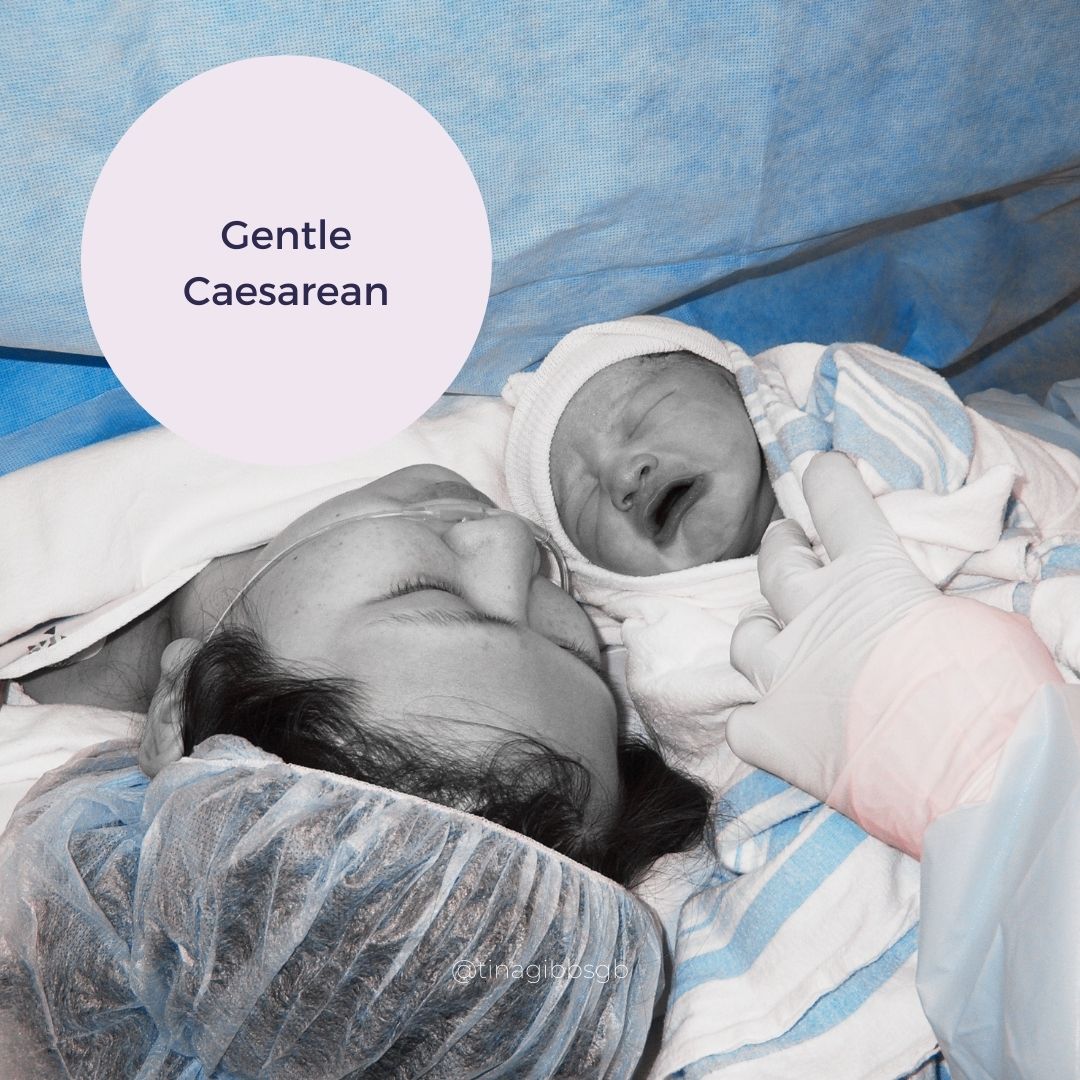
Many UK hospitals offer gentle or family-centred caesareans. Rather than the obstetrician pulling the baby out, the baby is born more slowly, helped by the uterus contracting (aided by synthetic oxytocin). It’s usually accompanied by immediate skin-to-skin and optimal cord clamping. Read more in What is a gentle caesarean birth?

Here is an article about a gentle caesarean birth story: The Guardian

And here is a video of a gentle caesarean at one of my local hospitals in Nottinghamshire:

Knowledge is power

Knowing your options and what happens during a caesarean helps you plan the right experience for you. Discuss skin-to-skin, optimal cord clamping and adapting the birth environment with your healthcare provider, and write them into your birth plan.

The video below shows how many people are usually present during a caesarean birth.

These are just 7 ways to personalise your caesarean birth – I’m sure you can think of more! Please share your ideas and experiences in the comments. You might also find Recovery after Caesarean Birth helpful.

Online Birth Preparation Course only £35!

Please also check out my online course! No videos, just text and images to learn in your own time. Includes hypnobirthing mp3s, scripts, workbook, handouts, infographics and much more! Lots and lots of information at your fingertips! Includes:

  • hypnobirthing mp3s
  • hypnobirthing scripts
  • written information
  • infographics and other imagery
  • printable handouts
  • printable workbook/journal

Sources and further reading:

Caesarean Birth and VBAC Information

Ginandes C, Brooks P, Sando W, Jones C, Aker J. Can medical hypnosis accelerate post-surgical wound healing? Results of a clinical trial. Am J Clin Hypn. 2003 Apr;45(4):333-51. doi: 10.1080/00029157.2003.10403546. PMID: 12722936.

Hourigan SK, Dominguez-Bello MG, Mueller NT. Can maternal-child microbial seeding interventions improve the health of infants delivered by Cesarean section? Cell Host Microbe. 2022 May 11;30(5):607-611. doi: 10.1016/j.chom.2022.02.014. PMID: 35550663; PMCID: PMC9237654.

Smith J, Plaat F, Fisk NM. The natural caesarean: a woman-centred technique. BJOG. 2008 Jul;115(8):1037-42; discussion 1042. doi: 10.1111/j.1471-0528.2008.01777.x. PMID: 18651885; PMCID: PMC2613254.

Wilson, Brooke C. et al. (2021) Oral administration of maternal vaginal microbes at birth to restore gut microbiome development in infants born by caesarean section: A pilot randomised placebo-controlled trial. eBioMedicine, Volume 69, 103443. Available at: https://www.thelancet.com/journals/ebiom/article/PIIS2352-3964(21)00236-X/fulltext [accessed 3 April 2023]

Posted on — 2 Comments

What is a gentle Caesarean Birth?

What is a gentle caesarean birth, and why should expectant parents know about it?

A gentle caesarean mimics some of the natural processes of a vaginal birth:

  • A drug to encourage uterine contractions can be given, so that your baby is gently ‘pushed’ out by your uterus rather than pulled out by the obstetrician.
  • A better view of the birth: you can ask for clear drapes, or for the drapes to be lowered, so you can see your baby being born.
  • Immediate skin-to-skin contact (most NHS trusts offer and encourage this for every birth, if your baby is well).
  • Optimal (delayed) cord clamping – waiting until the umbilical cord stops pulsating.
  • Less restrictive equipment: your IV line can go in your non-dominant hand, leaving your dominant hand free to hold your baby, and the ECG leads can be placed on your back or lower chest so they don’t get in the way of skin-to-skin (most NHS trusts offer this for any caesarean birth).
  • Dimmer lighting, especially at the moment of birth (offered by most NHS trusts).
  • Less noise, and background music of your choice (offered by most NHS trusts).
A gentle caesarean at Nottingham City Hospital. Note: because it shows some graphic content, the video is age-restricted, so you’ll need to log in to YouTube and watch it there.

A gentle caesarean can feel less like major abdominal surgery and more like a vaginal birth. However, while it is gentler for the baby, recovery for the mother is the same – it is still major abdominal surgery.

Who is in the theatre during a gentle caesarean birth?

As you can see in the video above, there are usually quite a few people in the room, and they will all introduce themselves with their name and role. The video below shows one example of how an operating theatre might be set up.

Whether you’re planning a caesarean birth from the start, or something has come up during pregnancy that makes a caesarean the safest option, it’s worth exploring your options. What choices do you have? Which parts of your birth can you control? For more ideas, read 7 ways to personalise your caesarean birth.