Posted on Leave a comment

Can I have a waterbirth in Nottingham?

can I have a waterbirth in Nottingham

Can I have a waterbirth in Nottingham Queens Medical Centre (QMC) and City Hospital?

When considering a waterbirth, you may be wondering if it’s possible to have one in Nottingham at either the Queens Medical Centre (QMC) or City Hospital. Nottingham offers excellent healthcare facilities, and both hospitals have maternity units that provide a range of birthing options, including waterbirths.

The QMC is a renowned teaching hospital and one of the largest in the UK. It has a dedicated maternity unit that offers a compassionate and supportive environment for expectant parents. While they prioritize safety and the well-being of both mother and baby, they also strive to accommodate individual preferences for birthing experiences, including waterbirths.

Similarly, City Hospital, located in the heart of Nottingham, also has a maternity unit that recognizes the benefits of waterbirths. Waterbirths can offer relaxation, pain relief, and a gentle transition for the baby from the womb to the outside world.

It’s important to note that while both hospitals offer waterbirths, availability may vary depending on factors such as the stage of your pregnancy, your medical history, and any complications that may arise. To explore the possibility of having a waterbirth at either hospital, it is recommended that you discuss your preferences with your midwife or healthcare provider during your antenatal appointments. They will be able to provide detailed information and guidance based on your specific circumstances.

You can find out more about current options and recommendations at the NUH Maternity website.

In addition to the Nottingham University Hospitals (NUH) there are a couple of additional birth places nearby. St. Mary’s Maternity Hospital in Melton Mowbray and Kingsmill Hospital (Sherwood Forest Hospitals).

When planning for the birth of your baby and your birth experience, it is important to check out all your options. If you’d like to have some help with planning your birth or would like to learn more about birth and your options, get in touch for a 1:1 antenatal class with me!

Online Birth Preparation Course only £35!

Please also check out my online course! No videos, just text and images to learn in your own time. Includes hypnobirthing mp3s, scripts, workbook, handouts, infographics and much more! Lots and lots of information at your fingertips! Includes:

  • hypnobirthing mp3s
  • hypnobirthing scripts
  • written information
  • infographics and other imagery
  • printable handouts
  • printable workbook/journal
Posted on Leave a comment

5 Things to look for when choosing your childbirth education

5 things to look for when choosing your childbirth education

You want to be prepared to for the birth of your baby or babies. Here are 5 Things to look for when choosing your childbirth education!

As the birth of your baby approaches, you may have a lot of questions. What does a contraction wave feel like? How will I know when to call the midwife? What kind of breathing techniques can I use? How do I know when it is time to push?

You may also experience a range of emotions such as excitement, nervousness, stress, and even anxiety. The good news are, you can ease your fears and gain confidence in birthing your child when you prepare for the birth of your child. Choosing the right type of childbirth course for you (and your partner) is crucial. Your childbirth preparation course should give you practical knowledge about the physiology of birth as well as where to find practical and emotional support.

5 Things to look for when choosing your childbirth education

1. Does the course agree with your idea on childbirth?

Whether you are you planning for a vaginal birth, caesarean birth, waterbirth, homebirth, etc… you want to ensure that your chosen childbirth education course supports your wishes and preferences. How you choose to give birth is up to you.

Knowing the general philosophy of the birth course you are considering is essential. The techniques that you’ll be learning should be something that you can see yourself doing and something that you believe in. The techniques should support you to achieve the birth you are aiming for.

2. Which topics are covered during the course?

If this is your first birth experience, your childbirth preparation course should cover everything your need to know about your options and what to expect. If you have given birth before, then you may wish to choose a refresher course for you. You may also wish to prepare the older sibling(s) for the birth of their little brother or sister. Learning the about childbirth may lessen your anxiety and help you make informed choices when birthing your baby. Choosing the wrong type of course for you may increase anxieties, so choose your childbirth course and their leader carefully.

3. Who created the course?

Who created the childbirth preparation course? Are they a medical professional or a teacher? Are they an expert in childbirth education? Check their certifications and experience! You want the person and organisation offering your childbirth preparation course to be established and reputable. Ask them to show you proof of their qualification(s).

4. What format is the course in?

Check the format of the course. You may prefer a course which focuses on the birth only, or one that includes practical baby care. If you are interested in hypnobirthing, does the course include hypnobirthing or maybe you prefer a stand-alone hypnobirthing course.

Are partners also coming to the classes or learn anything during the course or is the course for mothers/birthing folks only? Which format do you prefer?

5. Practical things to consider

  • Where and when is the course held? Are the dates, time and venue convenient for you?
  • What is your budget? What are your options at your budget?
  • For an in-person course
    • is there parking available or is it easily accessible via public transport?
    • Is the venue clean and spacious?
    • What are the chair/seating arrangements like? Do you want/need to bring a birthing ball, cushions etc.?
    • Are refreshments included?
    • Accessibility of the venue (where needed)
  • For an online course
    • are you confident in using the platform the course is being offered on?
    • is it a live course or has live elements or is it fully self-paced? – for live elements: are they recorded? If not can you make all the sessions?
    • Is your internet connection reliable?
    • Have you got a pc or laptop to access the course on? This will make your online course a more positive experience.
    • Have I got a comfortable (seating) setup where I can join the online childbirth preparation course?

What type/style of childbirth preparation course you choose is entirely up to you! Use your B.R.A.I.N. acronym when choosing the right course for you:

Brain acronym

What are the benefits, risks (or repercussion), alternatives (for each option)? Trust your gut, your intuition. And think about how you might feel if you do nothing, i.e. you don’t choose a childbirth preparation course?

If you are looking for a childbirth preparation course (1:1) in Nottinghamshire, check out my offers. I also have a fully self-paced online course for just £35. Including hypnobirthing, mp3s and much, much more!

Online Birth Preparation Course only £35!

Please also check out my online course! No videos, just text and images to learn in your own time. Includes hypnobirthing mp3s, scripts, workbook, handouts, infographics and much more! Lots and lots of information at your fingertips! Includes:

  • hypnobirthing mp3s
  • hypnobirthing scripts
  • written information
  • infographics and other imagery
  • printable handouts
  • printable workbook/journal

Posted on Leave a comment

Teaching about Waterbirth

Teaching about Waterbirth Teaching ideas for birthworkers

Teaching about Waterbirth has become one of my favourite topics in recent years. As waterbirth has many benefits and few downsides it is a popular choice among birthing families in the UK.

Teaching about waterbirth in your antenatal preparation classes:

Paperchase – benefits for mother, father, baby, midwife

Split the group into 4 groups. Each group gets one piece of flipchart paper. Four headings: mother/birthing person, father/partner, baby/babies, midwife. Each group brainstorms the benefits/advantages of waterbirth for their person. Move along to the next chart after 1 minute, fill in that chart. Keep going until each group had a minute for each chart. Share the findings in the big group afterwards. This activity takes around 10-15 minutes.

Dry run with inflatable pool

A great way to teach about waterbirth is to do a dry run with an inflatable pool. I usually have the partners set up the pool and time it how long it takes to inflate the pool, add the cover etc. Meanwhile the birthing mothers/people explore some pictures of different pool birth environments and positions in the pool. Once the pool is set up, we discuss how long it may take to fill the pool, along with some things that they may need. Every family can then try out the pool to get a feel for the size. Be careful, when trying out positions as the empty pool will tip over if someone leans over the edge. Always position yourself or someone else at the opposite end to keep the pool steady.

Brainstorm practicalities home vs hospital

This activity is suitable for big group or some smaller groups. You’ll need a piece of flipchart paper for each group. Divide each paper into two sections. Have families compare the practicalities of waterbirth at home vs the hospital or maternity unit.

Pictures – why did you pick…

I lay out a selection of photos and positions cards. Including photos of equipment families may need/choose for their waterbirth. I ask each person/family (depending on group size) to pick one picture. Then in the large group we share: Why have you chosen the picture, what can we see in the picture, how does the picture make you feel, any questions about the image…. I usually do this as an icebreaker as an information leveller…

How to you teach about waterbirth? Please share your ideas with me!

Have you seen my waterbirth video collection? You can find that here!

Posted on Leave a comment

How long does labour last?

How long does labour last?

How long does labour last? What is the average time for labour & childbirth?

In medical terms labour is divided into three stages:

  • 1st stage – where your uterus and body are getting ready. Your cervix is softening and will begin to open until it is fully open (dilated). It is sometimes referred to as the “up stage” because the sensations are pulling/moving upwards. .
  • 2nd second – the second stage begins when you’ll feel the urge to push. It is sometimes referred to as the “pushing stage” or “down stage” because the sensations are pushing downwards. At the end of this stage, your baby will be here.
  • 3rd stage – the birth of the placenta. After your baby is born, you’ll have to give birth to the placenta. This is what is happening in the 3rd and final stage of labour.

So, how long does labour last? According to the NHS, the average first labour lasts between 8-12 hours and subsequent births will be significantly quicker (approx. 5 hours). However, your midwives will only record the timing from when you are considered to be in established labour, which is when your cervix is already around 4cm dilated (open). That means that the contractions and sensations that you are experiencing until then are not officially ‘counted or measured’. However, birthing folk themselves will usually add that time on when they describe their experience. It will take hours or sometimes days (first birth) from your baby dropping (lightening) to the beginning of established labour (4cm). Use this time to rest when you can, hydrate and keep your positive energy up!

Although the NHS and other healthcare providers divide labour and birth into three stages, it is not always that simple… Each medical stage can itself be divided into further smaller steps and stages. When speaking to women and people who have given birth and/or attended births, they describe the birthing process in many more steps. Milli Hill, for example, divides the birth into 15 steps in her Positive Birth Book (affiliate link).

Here is a graphic to show a timeline of childbirth:

How long does labour last?
Childbirth/labour timeline

Posted on Leave a comment

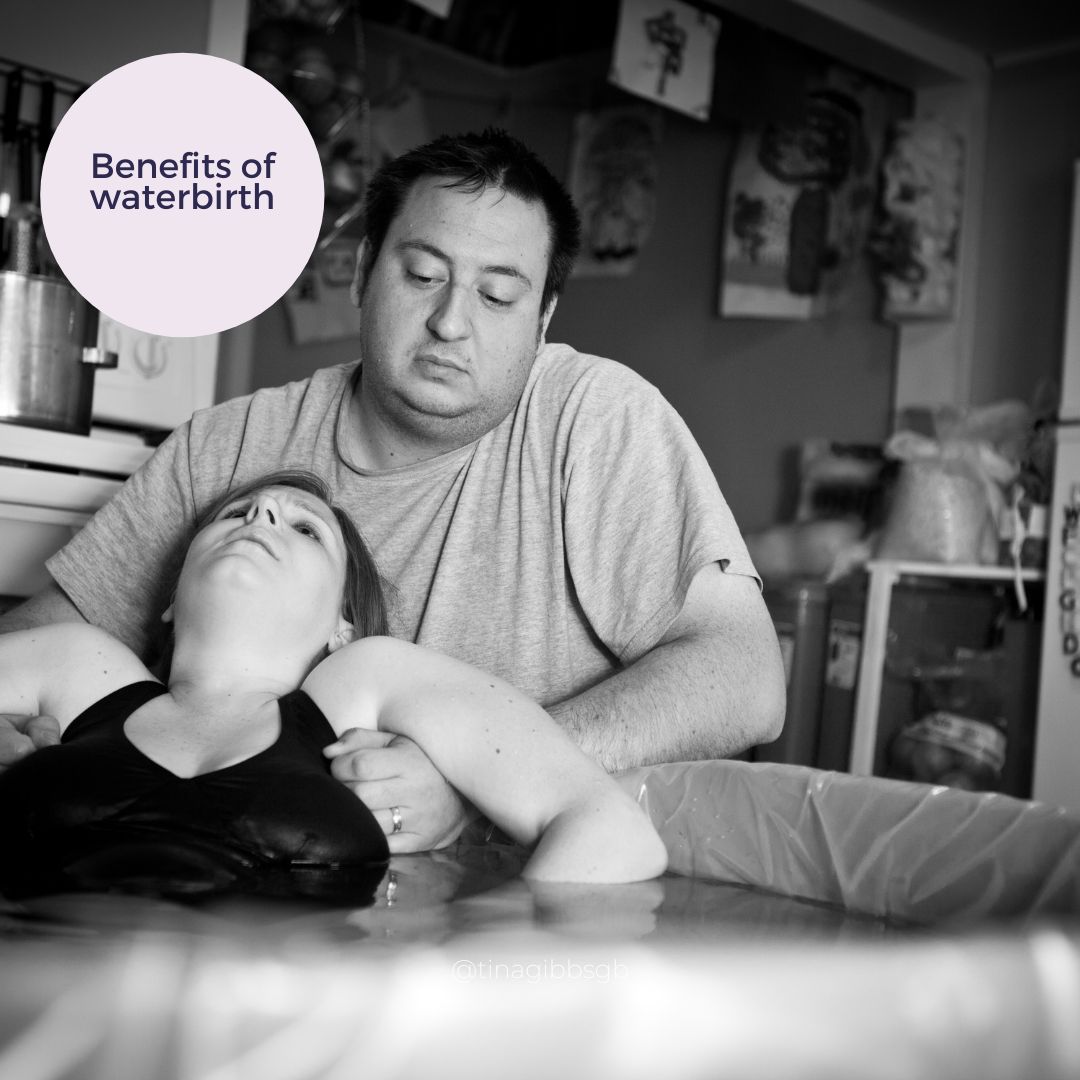
Benefits of Waterbirth

benefits of waterbirth

Due to it’s benefits, waterbirth has become increasingly popular with expectant families in the recent years. Let’s explore the benefits and possible disadvantages as well as practicalities a little further.

The Benefits of waterbirth:

  • Contractions will more comfortable
  • No known side effects on baby or mum
  • The warm water helps you to relax
  • Being relaxed helps your body to produce more endorphins (natural pain killers)
  • Being relaxed helps your body to produce more oxytocin (makes your contractions more efficient)
  • Less need for medical pain relief
  • Less need for drugs that accelerate labour
  • Shorter labour
  • Added privacy
  • Water supports your weight and makes you feel more comfortable and it will be easier for you to move and change positions.
  • You are more likely to achieve an unassisted vaginal birth
  • The birth is more gentle for your baby
  • Breastfeeding can be encouraged immediately
  • Reduced tearing as the water relaxes you and softens the perineum (the area between your vagina and anus).
  • A more enjoyable experience of labour and birth

Other comfort measures which can be used alongside/inside the pool:

Possible disadvantages:

  • Not suitable for everyone—under certain circumstances using water for labour / birth may not be recommended
  • Not available everywhere—your local birth unit or hospital may have limited or no pools
  • To hire or buy a birth pool for a homebirth can be expensive
  • Your home / hot water system may not be suitable for a pool

Other comfort measures which CANNOT be used inside the pool:

  • Tens machine – however, you can use your tens machine until you enter the pool!
  • Epidural
  • Opioids

Buying or hiring a pool for your homebirth?

There are many different suppliers and manufacturers. In my over 10 years of experiences in the birth world, I found that the pools from ‘Birth Pool in a box’ get the best reviews. Seek out your local homebirth group (if there is one). They may have a free or reduced-cost pool hire scheme. If you are looking to buy a birth pool or have hired or borrowed one and need further equipment, get 10% off everything at the Birth Pool in a Box shop! (Please note, this is an affiliate -sponsored- link!)

Online Birth Preparation Course only £35!

Please also check out my online course! No videos, just text and images to learn in your own time. Includes hypnobirthing mp3s, scripts, workbook, handouts, infographics and much more! Lots and lots of information at your fingertips! Includes:

  • hypnobirthing mp3s
  • hypnobirthing scripts
  • written information
  • infographics and other imagery
  • printable handouts
  • printable workbook/journal

References and further reading:

Posted on Leave a comment

Waterbirth at home

waterbirth at home

You are pregnant and are planning a waterbirth at home? You are not quite sure how to sell the idea to your partner? Read this! Here is a ‘guide on how to persuade your partner to have a waterbirth at home 😉

My husband wrote about the birth of our second baby for one of the NCT (national childbirth trust) newsletters back in 2011. He wanted to write the story from the mother’s point of view, so he did.

Persuading the Hubby – Part 2 ‘Waterbirth in the kitchen’.

If you were lucky enough to delve between the covers of the last [blog post], you may remember the challenge I set myself persuading a sceptical Mr Hubby of the values of re-usable nappies.  Persuading the hubby can sometimes be like riding a bike uphill in a stiff wind, but just like the equally stiff wind encountered so often at changing time, it can all be overcome with a deep breath and a firm mind set to the task!  By comparison to the reusable nappies issue however, my next challenge was a veritable Tour de France in the uphill cycling stakes! 

The idea quite literally surfaced as we were swimming in the local pool.  It was towards the end of my second pregnancy and I was floating around in the water experiencing the sheer bliss that only a pregnant mother can feel as the weight of 8 months hard pregnancy was lifted off my feet.  Mr Hubby was throwing our youngest in the air and they were splashing around wildly filling the air with giggles.  My youngest was two years old now and he’d clearly come such a long way since his traumatic hospital-induced birth 24 months earlier.  It suddenly struck me how relaxed I felt, in the water with my family around me and I made the decision right there and then, that I was going to transfer that feeling of tranquillity to my next birth experience!  “I’m going to have a waterbirth in the kitchen!” I exclaimed!  My sudden outburst caught poor Mr Hubby completely unawares and he just stood there mid-throw in stunned bewilderment as our little bundle of joy spiralled through the air and hit the water with a resounding splosh!  Without the “1-2-3 breathe” that they’d been practicing at baby-swimming, the little mite came up coughing and spluttering, and despite him being quite ok, a pool life guard had already blown his whistle and a number of youthful pool attendants were diving athletically into the pool!  By the time we’d towelled off, and thanked the life guards for their diligence, and meekly smiled at the other swimmers who were looking at us as if we were completely incompetent parents, Mr Hubby finally pulled himself together and managed to reel off an immeasurably long list of reasons why he thought the whole ‘waterbirth in the kitchen’ concept was a terrible idea!  “Surely giving birth at home would create a right mess all over the place?”, “What if I was in labour at home and something went wrong?”, “Where on earth would we get a pool?”,  “Was I seriously thinking of the kitchen?”, “What if I got in to the pool and a wave of water went all over the place?”, “Was I going to cope without pain relief?”, “Was it going to be massively expensive?”, and finally “Could we do it on the cheap using little ones paddling pool and filling it with our leaky garden hose?!”.

Well, I’m all for trying to win my man round with a bit of frugalism, but after a stint of research on Google and the NHS Choices website it soon became apparent that the paddling pool and garden hose idea wasn’t going to fly.  Home birthing pools needed to be sterile, deep enough to immerse your body and strong enough to hold your weight as you hang over the side gasping for breath after an endless contraction.  Luckily though, I did find some options to save forking out gazillions of pounds on a birth pool.  First there was the hiring option – with pools available from around £80 for 5 weeks, but in the end I got a second hand one of ebay, complete with sterile hose for just £24.  All I needed then was a new pool liner for £25 and my set up was complete!  Now all this did come to around £50 in total, but as I pointed out to mr hubby (when the postman came to the door with an inflatable birthing pool under his arm), the hospital parking at the last birth came to over £30 anyway and this time round we would have need a baby sitter for our little tike as well, so I reckon we made a saving!

Mr Hubbys other concerns over the dangers of home birth were addressed by a couple of interesting encounters.  The first was with a very kindly midwife who visited us at home and reminded us that giving birth was a completely natural process and that we just had to trust my body.  In addition she promised to bring round plenty of gas-and-air and furthermore said that if we gave birth at home it would really help her meet her home-birth targets.  She seemed so nice that we could hardly say no, and the idea was sealed later that day with the second interesting encounter which was a chance conversation over the fence with the elderly lady who lives next door, who told Mr Hubby that in her day there was no such thing as a hospital and that kitchen births were quite the norm.  After an hour of listening through the fence to stories about birth in times gone-by, Mr Hubby was quite dazed and in no capacity to argue about the issue any further.

Despite my immaculate preparation, the one thing I did forget, and I would strongly advise against forgetting, was a decent pump.  My labour started a few days before my due date, and as Mr Hubby will tell you, home birthing pools are very, very, large.  Very large.  With his small bike pump, he needed a good hour of frantic pumping to get the thing inflated, and halfway through when he was at his lowest ebb and his right arm really was very nearly dropping off, two very stern midwives arrived just in time to whip him back into action.  Eventually he crossed the finish line and I stepped in to the warm soothing waters, and all my cares drifted away.  Mr hubby was clearly exhausted and looked rather like he’d been in labour himself, but before he’d had time to even catch his breath one of the stern midwives spun on her heels and told him in no short order that his next task was to keep the temperature of the pool within a degree of 36 Celsius and given that it was already down to 34, he’d better get cracking! At this point Mr Hubby was required to race back and forwards across the kitchen carrying saucepan-fulls of water from the pool and topping it up with hot water from the tap.  Back and forwards he went at ten to the dozen for a good three hours, spurred on by the hawkish glare of the midwives, which provided me with excellent entertainment during contractions.  In fact, it occurred to me that the whole situation was rather like a modern-day equivalent of “Why don’t you go and get some warm towels ready” and it kept him nicely occupied for the duration of the labour.

Before I really knew it my second child was born. My contractions were eased by the warm water, my tender regions were softened and I avoided the dreaded stitches. It was such a soothing entry to the world I will never forget the experience.  And neither will Mr Hubby, for his pumping arm has never been the same to this day!

If you are toying with the idea of a waterbirth at home or in the hospital but are not sure where to start, please get in touch and we can arrange a 1:1 birth planning session or waterbirth/homebirth workshop! I also offer other 1:1 and group antenatal workshops!