Posted on Leave a comment

When to do a hypnobirthing class?

When to do a hypnobirthing class

What is hypnobirthing? When to do a hypnobirthing class? What are the benefits of hypnobirthing?

What is hypnobirthing?

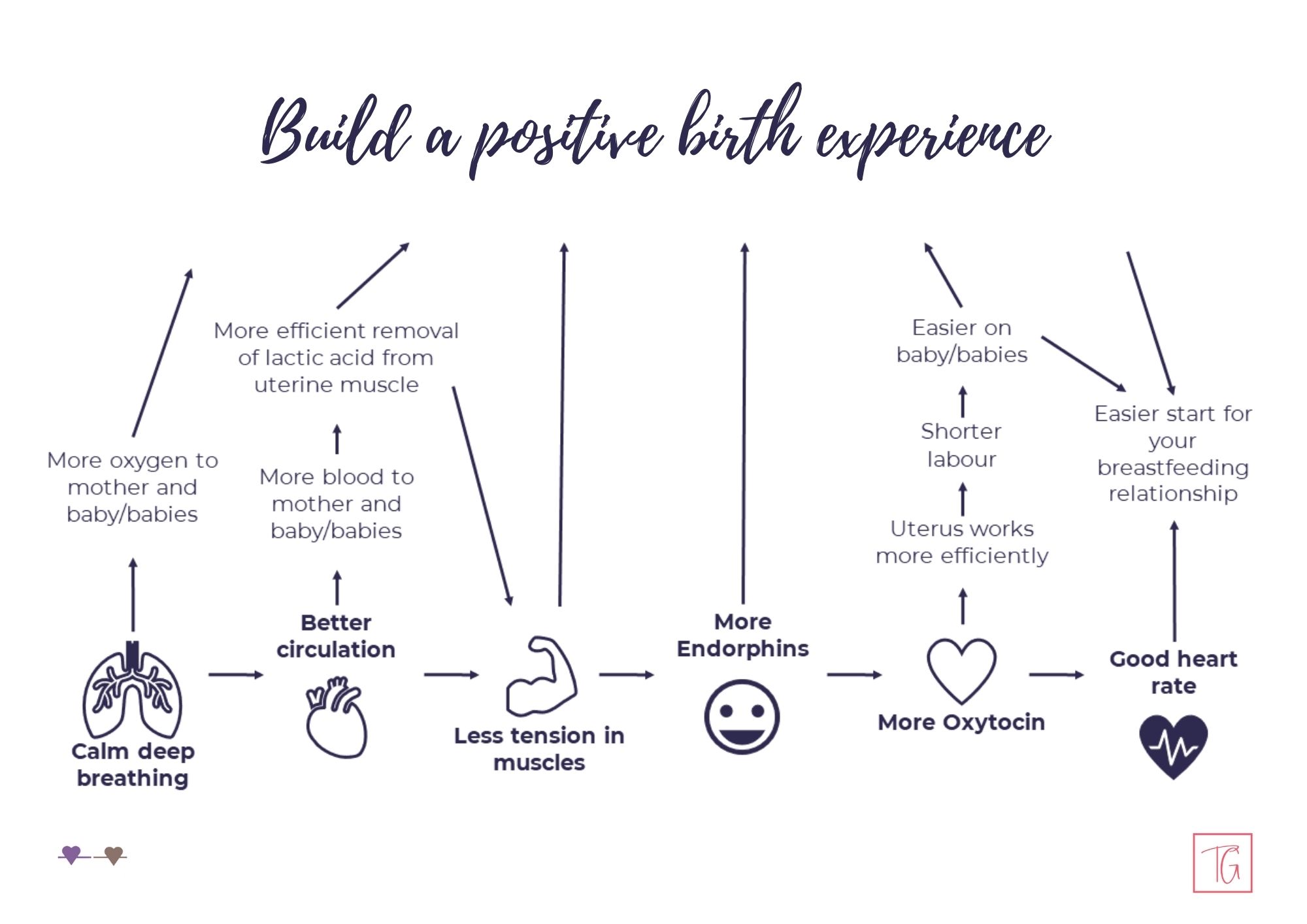
Hypnobirthing is a type of childbirth education. It focuses on relaxation techniques and self-hypnosis to help expectant mothers experience a more calm and comfortable birth. In addition to that, hypnobirthing, especially Mindful Hypnobirthing can help you deal and come to terms with (sudden) changes during your pregnancy and childbirth journey. Hypnobirthing teaches you techniques to calm your body and mind in any situation helping you achieve a more satisfying (birth) experience.

When to do a hypnobirthing class?

Basked in the warmth of expectant anticipation, the journey of pregnancy holds boundless possibilities. Embracing this transformative phase, hypnobirthing serves as a gentle beacon, guiding you towards a serene and empowering birth experience. By attending your hypnobirthing class between 21-30 weeks, you gracefully intertwine knowledge and practice, nurturing a profound connection with your body, baby, and the birthing process.

During these immersive sessions, you will delve into the intricacies of hypnobirthing techniques, equipping yourself with a rich toolbox of relaxation exercises, visualization practices, and deep breathing methods. This precious time devoted to learning and self-discovery ensures that you absorb the wisdom imparted by your course, allowing sensations of tranquility and confidence to take root within you.

As you embark on this path, make the conscious decision to prioritize self-care and integration. Carve out moments in your schedule to indulge in self-reflection, savoring the invaluable opportunity to unwind and surrender to the present moment. Remember, practice is the key to unlocking the full potential of hypnobirthing. By dedicating time to honing your skills, you cultivate an innate sense of calmness and resilience, ready to embrace the birthing journey with unwavering grace.

As you honour your body’s innate wisdom and the innate wisdom of your baby, embrace the affirmations that flow through hypnobirthing. Enveloped in an atmosphere of love, trust, and empowerment, you harness the strength of your mind and spirit, harmoniously co-creating a positive childbirth experience.

Embrace this transformative passage, for it is an invitation to embark on a sacred and empowering journey. Through the art of hypnobirthing, discover newfound serenity, reclaim your inner power, and paint an exquisite portrait of birth, woven with love and grace.

What are the benefits of hypnobirthing classes?

The benefits of attending a hypnobirthing class are numerous. During a group hypnobirthing class you’ll meet like-minded people embarking on their journey to parenthood at a similar time. By learning effective relaxation and breathing techniques, hypnobirthing can help reduce anxiety, fear, and tension during labour, making the experience more positive and enjoyable.

In a hypnobirthing class, you can expect to learn various techniques such as deep relaxation, visualization, affirmations, and self-hypnosis. These techniques are designed to help you achieve a state of deep relaxation and promote a more efficient and comfortable labour. The classes are typically taught by certified hypnobirthing practitioners who guide you through the process and provide ongoing support throughout your pregnancy journey.

It’s important to note that hypnobirthing classes are beneficial for all types of births, whether you are planning a natural birth or have opted for medical interventions. The techniques learned in hypnobirthing can be applied in any birthing scenario and can help you stay calm, focused, and in control.

If you’re considering attending a hypnobirthing class, it’s recommended to do your research and find a reputable practitioner in your area. Many classes offer both in-person and online options, allowing you to choose the format that suits you best. Remember, hypnobirthing is not just about the birthing day but also about preparing mentally, emotionally, and physically throughout your pregnancy for a positive birthing experience. So, take the time to explore this wonderful approach to childbirth and embrace a more relaxed and empowered journey into motherhood.

Online Birth Preparation Course only £35!

Please also check out my online course! No videos, just text and images to learn in your own time. Includes hypnobirthing mp3s, scripts, workbook, handouts, infographics and much more! Lots and lots of information at your fingertips! Includes:

  • hypnobirthing mp3s
  • hypnobirthing scripts
  • written information
  • infographics and other imagery
  • printable handouts
  • printable workbook/journal
Posted on Leave a comment

Can I have a waterbirth in Nottingham?

can I have a waterbirth in Nottingham

Can I have a waterbirth in Nottingham Queens Medical Centre (QMC) and City Hospital?

When considering a waterbirth, you may be wondering if it’s possible to have one in Nottingham at either the Queens Medical Centre (QMC) or City Hospital. Nottingham offers excellent healthcare facilities, and both hospitals have maternity units that provide a range of birthing options, including waterbirths.

The QMC is a renowned teaching hospital and one of the largest in the UK. It has a dedicated maternity unit that offers a compassionate and supportive environment for expectant parents. While they prioritize safety and the well-being of both mother and baby, they also strive to accommodate individual preferences for birthing experiences, including waterbirths.

Similarly, City Hospital, located in the heart of Nottingham, also has a maternity unit that recognizes the benefits of waterbirths. Waterbirths can offer relaxation, pain relief, and a gentle transition for the baby from the womb to the outside world.

It’s important to note that while both hospitals offer waterbirths, availability may vary depending on factors such as the stage of your pregnancy, your medical history, and any complications that may arise. To explore the possibility of having a waterbirth at either hospital, it is recommended that you discuss your preferences with your midwife or healthcare provider during your antenatal appointments. They will be able to provide detailed information and guidance based on your specific circumstances.

You can find out more about current options and recommendations at the NUH Maternity website.

In addition to the Nottingham University Hospitals (NUH) there are a couple of additional birth places nearby. St. Mary’s Maternity Hospital in Melton Mowbray and Kingsmill Hospital (Sherwood Forest Hospitals).

When planning for the birth of your baby and your birth experience, it is important to check out all your options. If you’d like to have some help with planning your birth or would like to learn more about birth and your options, get in touch for a 1:1 antenatal class with me!

Online Birth Preparation Course only £35!

Please also check out my online course! No videos, just text and images to learn in your own time. Includes hypnobirthing mp3s, scripts, workbook, handouts, infographics and much more! Lots and lots of information at your fingertips! Includes:

  • hypnobirthing mp3s
  • hypnobirthing scripts
  • written information
  • infographics and other imagery
  • printable handouts
  • printable workbook/journal
Posted on Leave a comment

Birthing the placenta: What you really need to know.

Birthing the placenta

What you really need to know about birthing your placenta:

  1. What happens during the third stage (birth of the placenta)?
  2. What are your options?
  3. What are the NICE guideline recommendations?
  4. What can I do with my placenta after birthing it?

What happens during the third stage?

Giving birth to your placenta involves your uterus/womb to continue to contract. Your placenta will begin to detach from the inside of your uterus/womb and be born through the birth canal. It is beneficial for the birthing process to choose an upright position to encourage your placenta to come out. Nipple stimulation, skin-to-skin contact with your baby or loved ones, some aromatherapy and a calm environment are also supportive of the birthing process. Your midwife will monitor your blood loss and keep you and your baby warm. You may feel the urge to push your placenta out once it has separated and moved down to your vagina.

What are your options?

During a vaginal birth, you’ll have two options. Either wait for your placenta to be born on it’s own account also known as “physiological third stage” or you can opt for the “managed third stage” where you’ll receive a drug to encourage the birth of the placenta to happen more quickly.

What are the NICE Guideline recommendations?

The NICE guidelines recommend a managed third stage.

What can I do with my placenta after birthing it?

You can leave your placenta with your midwife and they will safely dispose of it. Some parents choose to keep their placenta and turn it into a smoothie, art, encapsulate it etc. If this is of interest for you, research the topic and and check for local service providers. Your local doula(s) will usually be able to recommend someone.

Online Birth Preparation Course only £35!

Please also check out my online course! No videos, just text and images to learn in your own time. Includes hypnobirthing mp3s, scripts, workbook, handouts, infographics and much more! Lots and lots of information at your fingertips! Includes:

  • hypnobirthing mp3s
  • hypnobirthing scripts
  • written information
  • infographics and other imagery
  • printable handouts
  • printable workbook/journal

Posted on Leave a comment

Free Pregnancy Checklist

You are pregnant! Congratulations. Now is the time to get organised. This pregnancy checklist is a gentle reminder of your options, recommendations and appointments…

WhatWhen
The recommendation is to start taking Folic Acid and Vitamin D supplementsAs soon as you found out that you are pregnant
Register with your community midwife. Check with your GP surgery on how to do that.Before week 7
Booking appointment (First appointment) with your community midwifeBetween 8-12 weeks
Get and sign your maternity exemption certificate (free prescriptions and dental appointments)At your booking appointment
Ask your midwife about Healthy Start Vouchers and check if you are eligibleAt booking appointment
First ultrasound offered (dating scan)Around 12 weeks
Second ultrasound offered (anomaly scan)Around 20 weeks
Book your antenatal classesBetween 12 and 22 weeks
Get your Mat-B1 certificate from your community midwifeBetween 22-25 weeks
If you are employed: Inform your employer in writing incl. your Mat-B1 certificate about your maternity leave plans If you are unemployed or self-employed: Find out if you’re eligible for Maternity AllowanceMust be 15 weeks before your due date – Between 22-25 weeks
Find out if you are eligible for a sure start maternity grantAround 29 weeks
Check out your local maternity services. See if you can book a visit or if they have a virtual tour…Around 30 weeks
Start writing your birth preferences and include some “what if…” options (birth plan)Around 30 weeks
Start packing your birth bagsFrom 30 weeks
Start practising your hypnobirthing techniques at least once a dayFrom 30 weeks
Arrange care plans for pets and older siblings or any other care commitmentsFrom 30 weeks
Create your important contact lists and contact preferences and share with your (birth) partner or doula (where applicable)From 32 weeks
Create your birth playlistFrom 34 weeks
Create your birth vision boardFrom 34 weeks
Create your birth affirmationsFrom 34 weeks

Contact your midwife or healthcare professional if you

  • think your contractions have started
  • feel that your waters have broken
  • experience any bleeding in pregnancy
  • feel a change in your baby’s usual movements
  • want reassurance about anything in your pregnancy

Download your free printable Pregnancy Checklist

Newsletter for expectant and new parents

Online Birth Preparation Course only £35!

Please also check out my online course! No videos, just text and images to learn in your own time. Includes hypnobirthing mp3s, scripts, workbook, handouts, infographics and much more! Lots and lots of information at your fingertips! Includes:

  • hypnobirthing mp3s
  • hypnobirthing scripts
  • written information
  • infographics and other imagery
  • printable handouts
  • printable workbook/journal
Posted on 1 Comment

Top 9 Childbirth Affirmations

positive birth affirmations

Before I share my personal top 9 childbirth affirmations, I’d like to explain a little bit more about them.

What are affirmations?

Affirmations, aka positive affirmations, are phrases that you repeat to yourself over and over again to change your mindset. You can say them out loud our in your head. Receive them as part of treatment with your hypnotherapist or other therapist. Most commonly they help you to change a negative into a positive thought or negative into positive thinking.

Affirmations can help you feel more in control and empowered during your birth experience.

Affirmations can improve your ability to problem-solve and decision-making while under stress such as during labour and birth. Making the right decisions for you and your birth enables you to feel empowered while birthing your baby!

My top 9 affirmations for childbirth are:

Writing your childbirth affirmations

Remember, that our conscious and subconscious usually only process the key words. Words such as “don’t” or “no” get lost in the process. So rather than saying to yourself “I mustn’t forget to take my keys” say “I must REMEMBER to take my keys”. For example, if I ask you to NOT think about pink elephants, all you can do is think about just them, the pink elephants. The elephants in the room. So, when you are writing your affirmations for birth, remember to pick statements and trades that are true and important to you.

Now, you are all set up to write your affirmations!

I also have a hypnobirthing affirmation script (including recording) available from my shop. The script has room for your own affirmations and tick-boxes for the ones that you like!

Please also check out my online course! No videos, just text and images to learn in your own time. Includes hypnobirthing mp3s, scripts, workbook, handouts, infographics and much more! Lots and lots of information at your fingertips! Includes:

  • hypnobirthing mp3s
  • hypnobirthing scripts
  • written information
  • infographics and other imagery
  • printable handouts
  • printable workbook/journal
Sources and Further Reading

Posted on Leave a comment

Hypnosis and Mindset Iceberg

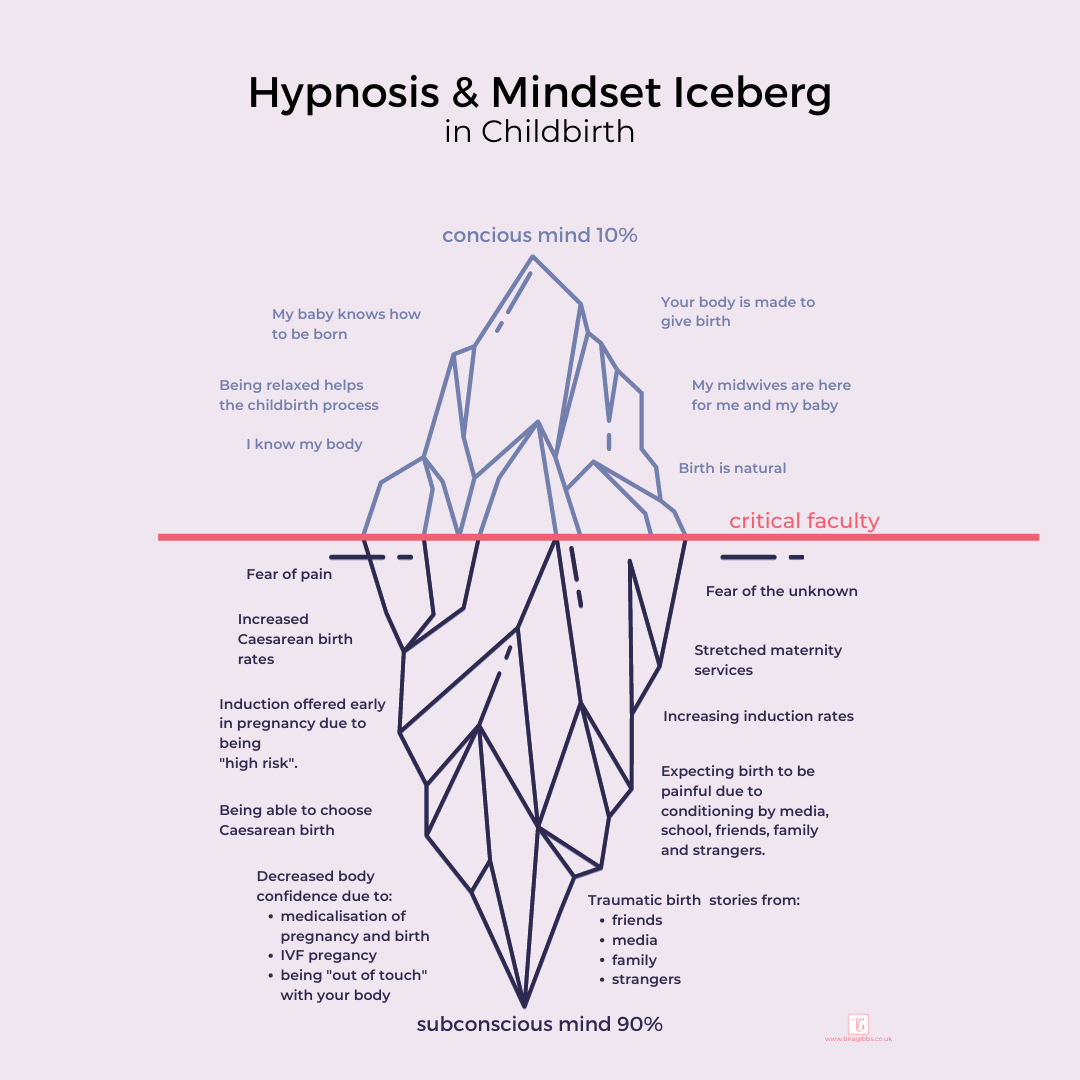
The Hypnosis and Mindset Iceberg. The conscious and subconscious mind and the critical faculty. How does that apply to childbirth?

Let’s think about that. When you look at an iceberg and you can see the tip of it, you can only see a small part of it. The majority is hiding underwater. So now how does that apply to hypnosis and your mindset for childbirth?

Consciously you know, that childbirth is a natural process and the majority of babies can be born without assistance. We know that when we relax, more oxytocin flows, which gives helps the birthing process along by giving you strong regular contraction waves. So why do so many expectant parents struggle to relax during the birth or even during their pregnancy? Because throughout our lives we hear and start to believe that childbirth is painful. The media, family or friends are telling us so. When you are pregnant tests, appointments, scans, precautions etc reinforce the believe that birth needs interference. You sometimes even hear a traumatic birth story from a stranger while waiting at the checkout!

So your conscious mind is the tip of the iceberg and your subconscious mind is the base. This is your Hypnosis and Mindset Iceberg:

Overcoming the Iceberg

When you practise self-hypnosis and mindfulness during your pregnancy, you can use these techniques to help to turn down or off your subconscious mind. It’ll help you to focus on the here and now and make the right decisions for and during your birth experience! Remember, practice and reinforcement of the techniques is the key to an empowered birth experience!

Book your 1:1 mindful hypnobirthing experience with me to learn your techniques to combat the Hypnosis and Mindset Iceberg.

Please also check out my online course! No videos, just text and images to learn in your own time. Includes hypnobirthing mp3s, scripts, workbook, handouts, infographics and much more! Lots and lots of information at your fingertips! Includes:

  • hypnobirthing mp3s
  • hypnobirthing scripts
  • written information
  • infographics and other imagery
  • printable handouts
  • printable workbook/journal

For perinatal educators:

The “Hypnosis and Mindset Iceberg” poster shows an image of an iceberg, where you can see the tip of the iceberg as well as the underwater base of the iceberg. Use it in antenatal or parenting classes to explore expectant parents’ feelings. Where they come from and how the subconscious can influence your decision-making, mindset as well as birth, feeding or parenting experience. An excellent resource for your perinatal education setting!

Hypnosis Iceberg Sources and Further Reading

All were accessed on the 24th January 2023.

Please note that I am in no affiliation with the owners of the websites above.

Posted on 2 Comments

Massage during labour and birth

man massaging his pregnant partner head and smiling

Massage Massage during labour and birth? What is massage and why might it be helpful during labour and birth?

Massage involves one person touching the other to manipulate their body’s soft tissues. It is often used to help relax tense muscles and can also help people to relax.

There are different massage techniques which may benefit different people during labour. For example, some people may prefer intense massage over their lower back helpful. Others may find light effleurage[1], or soothing strokes more relaxing and helpful.

You can practice your massage techniques while you’re pregnant, which helps you relax during pregnancy, too! If you need some guidance and ideas for simple massage techniques, you can purchase my massage worksheets from my shop!

Alternatively, you could join one of my hypnobirthing classes or join my fully self-paced online course!

massage techniques for childbirth

Research suggests that are different ways in which massage techniques may help during childbirth:

  • Massage might work by decreasing stress hormones and increasing levels of serotonin[2] and dopamine[3] in your brain.
  • Non-painful gentle massage may flood the body with pleasant sensations, so that the brain does not perceive the painful sensations as much.
  • Deep, intense, or painful massage acts on something called the Diffuse Noxious Inhibitory Control method of pain relief. The idea is that this stimulates our brain to release our body’s own pain-killers called endorphins. The body is then flooded with endorphins which helps to perceive less pain from contractions.
man massaging his pregnant partner head and smiling
Head massage with a hand-held scalp massager

Things to note if using massage (during labour and birth):

  • Aromatherapy: Essential oils can be powerful substances and can interfere with contractions if used incorrectly. Before using / buying essential oils, consult an accredited aromatherapist and your healthcare professional. Always dilute essential oils. Your midwife may also be trained in aromatherapy and may be able to advise you directly.
  • Communication: Communicate, whether the massage is helping you and how it could be made better i.e. firmer pressure, less pressure…
  • Continued touch: During massage always keep at least one hand on the recipient’s body.
  • Oils: Massage may be more comforting and soothing if non-scented massage oil is used. For example organic, cold-pressed sunflower oil. Do not use any oils on damaged skin.
  • One-handed massage: If massaging with only one hand rest the other on the recipient’s body. So they know they have your full attention and know where your other hand is.
  • Positions: The person being massaged may be kneeling, sitting, laying on their side or standing. Their birth partner needs to be comfortable too.
  • Previous injuries: Don’t massage places which have been affected by previous injuries. Consult your health care professional first.
  • Timing: Some women like massage during contractions; others prefer it in-between.

Further reading and sources:


[1] Effleurage: a form of massage involving a repeated circular stroking movement made with the palm of the hand.

[2] Serotonin: a compound present in blood platelets and serum, which constricts the blood vessels and acts as a neurotransmitter.

[3] Dopamine: a compound present in the body as a neurotransmitter and a precursor of other substances including adrenaline.

Posted on 1 Comment

Breathing techniques for childbirth

Breathing techniques for childbirth can be a useful tool to keep calm during the birth but also support the birthing process. Being calm and relaxed during childbirth can make the birth of your baby easier, quicker and more comfortable. There are many ways to help yourself or your partner to be calm during childbirth. Breathing techniques are just one of them.

How can breathing techniques help the birthing process?

Some researchers think there are a couple of different ways that breathing might support the birthing process by using the technique as a form of pain management. When you focus on your breathing, it may interrupt the transmission of pain/discomfort signals to your brain by giving you something else, more positive to focus on. Being aware of your breathing and focussing on it, may also work by stimulating the release of your body’s natural pain-relieving hormones endorphins.

Breathing techniques for childbirth are a useful tool to help you and your partner build a positive birth experience! There is a catch, though… to make the techniques work well for you, practise your techniques regularly. The more you practise, the easier and more effectively the breathing techniques will work for you during the birth of your child.

TOP TIP:

Practice the techniques as well as your comfortable breathing pattern together with your (birth) partner. When your birth partner is aware of your comfortable breathing pattern/speed, they can help you by counting you in/out or by keeping eye contact and breathing at your comfortable speed until you have reached your comfortable pattern again.

Download my breathing techniques worksheets today to start your birth prep!

Breathing Techniques for childbirth worksheets

The Breathing techniques worksheets are included in your self-paced online childbirth preparation course!

Please also check out my online course! No videos, just text and images to learn in your own time. Includes hypnobirthing mp3s, scripts, workbook, handouts, infographics and much more! Lots and lots of information at your fingertips! Includes:

  • hypnobirthing mp3s
  • hypnobirthing scripts
  • written information
  • infographics and other imagery
  • printable handouts
  • printable workbook/journal

Posted on 2 Comments

Informed decision-making for birth

Why is Informed decision-making for birth so important?

Often, pregnancy is a woman’s or pregnant person’s first significant introduction to the healthcare system. Suddenly, you have to make all sorts of decisions for you, your baby and your family unit. You’ll be faced with difficult choices around your healthcare during your pregnancy and birth. Often you’ll be influenced by healthcare professionals, your family and friends, media, social media, books, memories, etc. All claiming to know what’s best for you and your baby and in the end leaving you torn…

Whatever choices you are contemplating, you can positively impact your ability to make informed choices you’ll be happy with and you’ll feel empowered by. You can help yourself making informed decisions for your birth.

One frequently used acronym in childbirth education or hypnobirthing classes is BRAIN(S) or BRIAN. Here is a visual to help you remember it:

meet brian

BRIAN aka BRAIN is a simple acronym to help you in gathering all the information you need to make informed decisions about your own and your baby’s health care. When you join my hypnobirthing classes you’ll get to meet BRIAN (my weighted baby doll). We will help you with your informed decision-making for birth! 

Alternatively, if you prefer a self-paced online course, you can now enrol in my online childbirth preparation course. The online course includes all my antenatal mp3 recordings, the scripts as well as a 20 page printable workbook!

Benefits:
What are the benefits of the treatment/procedure/etc? Is this what is usually done? How do the usual benefits apply to your personal, individual care?

Risks:
Are there any risks? What risks are there with the treatment/procedure/etc? Is this what is usually done? How do these apply to your personal and individual care?

Intuition:
How do you feel about the treatment/procedure/etc. offered? What does your gut tell you?

Alternatives:
What are the alternatives? Where can I get a second/third opinion?

Nothing:
What would happen if I do nothing? Is it an emergency? How much time have we got to think about it? Do we have to make a decision now?

With this simple and memorable acronym you can make informed decisions without having to memorise or read all the available statistics and research. You will feel more in control of the birth as well as more empowered and happier with your individual birth experience.

And that’s why informed decision-making for childbirth is so important.