Posted on — Leave a comment

Positions for Childbirth

Positions for Childbirth

Learn about Positions for Childbirth. Which positions do women and birthing people use during birth? Positions which support the birthing process and can make the birth of your baby easier and go more smoothly.

Some examples of positions for childbirth. With and without a partner.

Changing positions and keeping active during childbirth can help the birthing process and reduce the need for interventions. Chose positions which feel comfortable to you.

Positions for childbirth explained
Walking sideways up and down the stairs can be helpful if your labour has slowed down or you’d like to speed it up a little.
The Lunge opens up your pelvis. Open up the pelvis and may help to speed up / bring back contractions when they have slowed down. Lunge during or between contractions or even both.
Rest. If you need a rest, try resting sitting backwards on a chair or sitting on a birthing ball. Keeping your feet lower than your bottom helps to keep your pelvis open. Massages may help you relax and rest, too.
Physical contact and massages. Close physical contact with your partner and/or being massaged may help you to relax and your body to release oxytocin.
A Rebozo can have many uses during labour and birth. A few examples are:
– to help realign and adjust your body to encourage your baby
– to rotate into a more favourable position
– to lift your belly to relieve back pressure during labour
– to wrap around the entire body like a hug, to offer you some comfort and ease anxiety
Side-Lying. Lie down on one side, preferably your left side. This is a great position to rest. To open up the pelvis a bit more, try to have your lower leg straight, and bend your upper knee as much as possible. Rest it on a pillow. With a birth partner, holding up your upper leg (see picture on the right), you can even give birth in this position making full use of the space in your pelvis.
Double hip squeeze. Have your birth partner press firmly into your buttocks with the palms of their hands, while their fingers point towards your spine. You might also like to try this with a hot or cold compress. A great exercise to relieve some of the pressure on your back during labour.
Stay upright and use gravity! Gravity is one of your best friends during labour! When you are in an upright position either standing, sitting or kneeling, the weight of your baby presses on your cervix. This encourages it to open. An upright position may also help get your baby into the best position for their birth.
Sitting on the ball allows you to take the weight off your legs and relax your lower back. Your birth partner can sit behind you and offer some massages, warmth or support. Also try: sitting cross-legged on the floor or your bed.
The Birthing Pool. Is great for pain relief and may help to relax you. You can sit in the pool or try kneeling and resting your body on the side of the pool.
The Birth Ball allows you to put your weight on the ball instead of your hands. The ball also encourages movement. Movement opens your pelvis to allow the baby to rotate. Also try: sitting backwards on a chair or toilet seat, leaning into a pillow. Being monitored doesn’t mean you have to stay in bed / lie down. You can still use upright positions and movement!
The Squat is a great position to give birth to your baby. This position opens up your pelvis and maximises the room for your baby to rotate and pass through the birth canal. You can use a ball, rebozo, chair, your birth partner as support.

If you are a birth worker such as a doula you can purchase these positions on cards (30 different positions for childbirth on individual cards) or as a poster from my shop.

Posted on — Leave a comment

SEO tips for birth workers

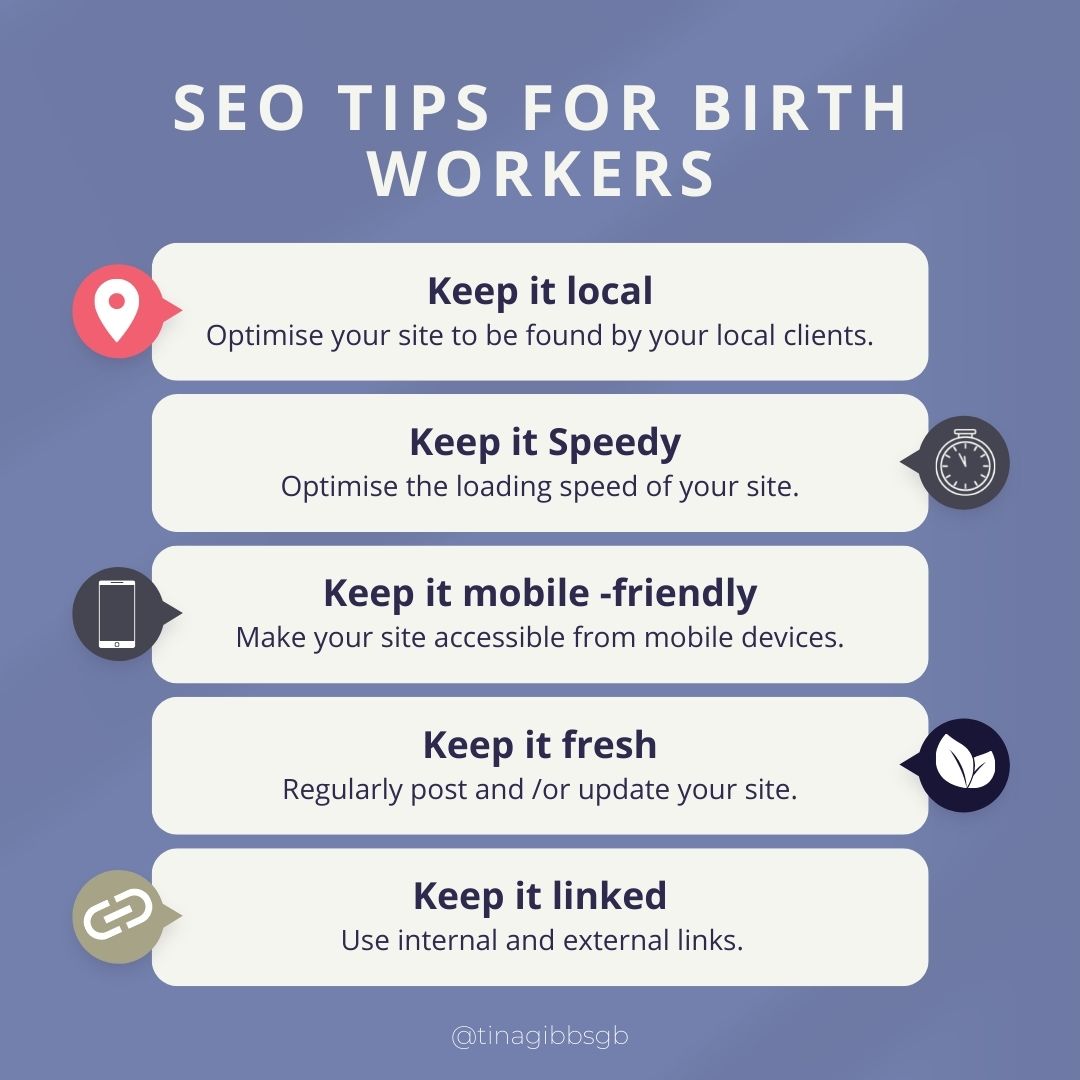
As a self-employed birth worker, it is essential that your potential clients can find you. Here are some SEO (search engine optimisation) tips for birth workers to get you started. Some may think that social media will do all the work for you, but does it?

You are a doula, antenatal teacher, hypnobirthing practitioner or other birth worker and have very short window of getting your clients’ attention and to book your services. We do rely on word of mouth, and us in the search results!

Where do you go when you look for a service? Do you check your social media or do you use an internet search engine?

4 out of 5 people use search for local services and businesses using search engines such as Google, Bing or Yahoo. Optimising your website for local search results can make a huge difference to the number of (potential) clients finding out about you and the services you offer. Even better, SEO is free!!

SEO tips for birth workers

Here are my top SEO tips for birth workers

Keep it local!

Optimise your about and services pages for local searches! Make sure to include your town, city, area you work in in your description.

To display your website to your (potential) clients, search engines need to understand three very important things,

  1. Who you are
  2. What you do
  3. Where you are

You can do that in one or two sentences, ensuring you include this information on your home, about as well as service pages!

Example: Hello I am <Your name >, a <job/role i.e. hypnobirthing practitioner> in <area you are working in>, I offer a local support/services including <add some examples>.

Keep it speedy!

Optimise the speed of your website. Search engines are more likely to suggest your site higher up in the search results when your site is loading faster. Here are some free tools to check the speed of your website:

Use Google’s Page Speed Insights Test to find out how quickly your website loads.

Keep it mobile-friendly!

The vast majority of internet users and your (potential) clients search and access information via their mobile phones or other mobile devices. Make sure, that you website is accessible and user-friendly for mobile phone/devices. Here is a free tool to check what your site looks like on mobile devices:

Use this google tool to find out if your website looks great on mobile devices.

Keep it fresh!

Nobody likes outdated content, so the search engines will check when you have last updated the information/anything on your website. They’ll show ‘fresher’ pages higher up in the results as they are more likely up-to-date. So simply, log on to your site now and again and write a blog post, or change a few things round. Keep it fresh!

Keep it linked!

Creating backlinks, is another important tool. If other local businesses or other birth workers are linking to your content, it is a little star for you. It makes you seem more ‘trustworthy’ in the eyes of a search engine at least! Careful! Use links/linkbacks to and from relevant and natural content. Think about swapping links with other local related businesses with the same or very similar audience, such as family photographers, holistic therapists, perinatal fitness, etc.

Now, get yourself a cuppa and optimise your SEO following my tips for birth workers above!

Posted on — Leave a comment

Pregnancy and new baby timeline – What to expect

pregnancy and new baby timeline

You are pregnant! Congratulations! Now you are wondering about the pregnancy and new baby timeline and what to expect before and after the birth of your new baby? Here is a rough guide of what to expect during your pregnancy, on the day of the birth of your baby and in the early few weeks as a new parent! This is a guide for expectant and new parents living, birthing and parenting in the UK.

During pregnancy
  • Start Pelvic Floor Exercises – here is a guide from the NHS on how to do your pelvic floor and other exercises during pregnancy!
  • Antenatal appointments with your midwife and consultant (where applicable) – here is an explanation on the NHS website.
  • Antenatal tests and scans
  • Health Visitor and/or Midwife visits your home
  • Book and attend your childbirth preparation courses (optional), such as hypnobirthing.
  • Look into hiring a birth and/or postnatal doula
  • Research and learn about your childbirth options and rights – Birthrights is a great place to find out more about your rights in childbirth
Day one – the day your baby is born
  • APGAR score for baby
  • Vitamin K offered to be given to your baby/babies
  • Midwife or a member of the paediatric team check your baby over before you’ll leave the hospital or midwife-led unit.
  • Newborn hearing screening – before you leave the hospital or within the first few weeks
  • Mum and baby/babies can leave the hospital. After a straightforward birth and with healthy mum and baby/babies they can leave the hospital on the same day. After a Caesarean Birth, you can usually leave 2 days after giving birth.
  • You’ll receive the red book for your baby’s growth charts and vaccination schedule etc. – some areas also offer an online red book.
Once at home – please note that the timescale varies in different parts of the UK
  • Mother and baby/babies will get midwife home visits for checks on day 1, 3 and 5. More often if necessary.
  • Mother on emotional high: days 1-3
  • Baby might develop jaundice: 2-3 days. Usually clears by week 2.
  • Milk comes in, days 3-5
  • Baby blues, days 3-5
  • Newborn blood spot test, day 5
  • Umbilical cord stump falls off, day 7
  • Lochia (postpartum blood loss) stops, 2-6 weeks
  • Discharged from midwifery care, between 10-28 days
  • Mother and baby postnatal check by GP: 6-8 weeks
  • Resume light exercise and sex: from after GP postnatal check, from 6-8 weeks

The dates are a rough guide and average only. This list does not give or replace medical advice. If you are concerned about yourself, your partner or your baby, please see your health care professional for help.

References and further reading:
Posted on — 2 Comments

Informed decision-making for birth

Why is Informed decision-making for birth so important?

Often, pregnancy is a woman’s or pregnant person’s first significant introduction to the healthcare system. Suddenly, you have to make all sorts of decisions for you, your baby and your family unit. You’ll be faced with difficult choices around your healthcare during your pregnancy and birth. Often you’ll be influenced by healthcare professionals, your family and friends, media, social media, books, memories, etc. All claiming to know what’s best for you and your baby and in the end leaving you torn…

Whatever choices you are contemplating, you can positively impact your ability to make informed choices you’ll be happy with and you’ll feel empowered by. You can help yourself making informed decisions for your birth.

One frequently used acronym in childbirth education or hypnobirthing classes is BRAIN(S) or BRIAN. Here is a visual to help you remember it:

meet brian

BRIAN aka BRAIN is a simple acronym to help you in gathering all the information you need to make informed decisions about your own and your baby’s health care. When you join my hypnobirthing classes you’ll get to meet BRIAN (my weighted baby doll). We will help you with your informed decision-making for birth! 

Alternatively, if you prefer a self-paced online course, you can now enrol in my online childbirth preparation course. The online course includes all my antenatal mp3 recordings, the scripts as well as a 20 page printable workbook!

Benefits:
What are the benefits of the treatment/procedure/etc? Is this what is usually done? How do the usual benefits apply to your personal, individual care?

Risks:
Are there any risks? What risks are there with the treatment/procedure/etc? Is this what is usually done? How do these apply to your personal and individual care?

Intuition:
How do you feel about the treatment/procedure/etc. offered? What does your gut tell you?

Alternatives:
What are the alternatives? Where can I get a second/third opinion?

Nothing:
What would happen if I do nothing? Is it an emergency? How much time have we got to think about it? Do we have to make a decision now?

With this simple and memorable acronym you can make informed decisions without having to memorise or read all the available statistics and research. You will feel more in control of the birth as well as more empowered and happier with your individual birth experience.

And that’s why informed decision-making for childbirth is so important.

Posted on — Leave a comment

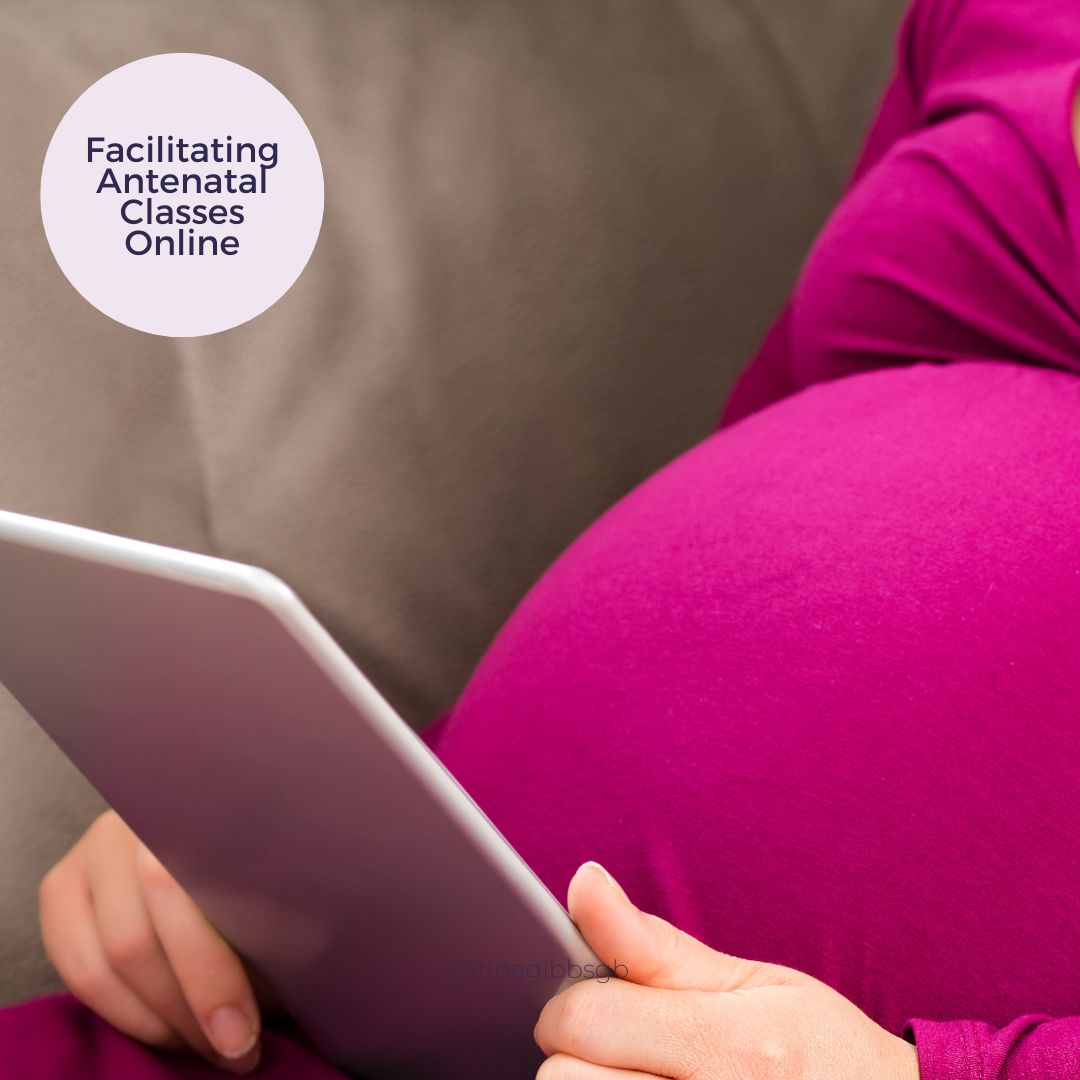
Facilitating Antenatal Classes online

What do I need and where do I start when facilitating antenatal classes online? How can I keep my clients actively engaged in during the classes and how can I make my online antenatal classes more interactive?

What do I need to facilitate antenatal classes online?

When facilitating your antenatal classes online, it’s important that you have reliable equipment:

  • A reliable, stable and speedy internet connection. Test your internet connection with friends and family on a video call first, maybe while other people in your household stream some video content or play online games at the same time.
  • A PC or laptop. Ideally a modern one which can cope with the video and audio streaming content, multiple windows being open etc without overheating – especially during hot summer days!
  • A video conference platform such as zoom, Microsoft teams or similar. There are many different platforms available. My chosen platform is zoom as it (at the time of writing this) is the most flexible and suitable platform for interactive group education. If you are facilitating 1:1 only or use more of a lecture-style approach, any platform will do. When facilitating group antenatal classes online, I like to be able to split my larger group into smaller groups (breakout rooms in zoom) to give my clients some private ‘away from the teacher’ time but also allow for and encourage bonding as a group.
  • Some visual content such as powerpoint slides, google slides or canva presentations. For your visual learners, you ma wish to have some powerpoint slides (or similar) that you can share from time to time.
  • Some good lighting in the room so that your clients can see you.
  • A good camera and microphone so that your clients can see and hear you properly.
dress the baby (move the appropriate clothes onto the baby).

Where do I start?

Practise – Before you start facilitating online with/for paying clients, you may wish to practise with family members, friends or colleagues first. Alternatively or in addition to that, you could record yourself and watch it back.

Set expectations – set expectations with your clients. Let them know what to expect in advance. i.e. ‘please keep your cameras and microphones on, this is an interactive class’. or ‘mute yourselves’ for a lecture etc.

How do I keep/make my online antenatal classes interactive and fun?

Mix it up! Rather than having a full-on presentation going on, use your slides as visual aids. Use the breakout rooms (zoom) to create smaller groups. Use free* additional online tools such as mentimeter, kahoot, jamboard for wordclouds, quizzes and more.

wordsearch to annotate online on zoom

I have been using virtual

  • quizzes
  • card sorts
  • scavenger hunt
  • annotations
  • wordsearches
  • escape room
  • word clouds
  • polls
  • breakout rooms

and more in my virtual classes and workshops.

If you would like to learn more about some of the tools you can use and how to use them, book an empower hour with me. You can practise your approaches with me, get feedback on your activities and content or we can create your teaching plan and activities together. Any content we create during any of the sessions is yours to keep and use.

*free version available at the time of writing

Posted on — Leave a comment

Make some noise during childbirth

Make some noise during childbirth

Make some noise during childbirth or not? What do you think is more helpful or beneficial for the birthing process?

The Mirror, recently printed an article about a mother who had shared on social media that her doctor told her to be quiet when giving birth. She felt that that was rude, which prompted me to write this post…

Make some noise during childbirth

Now, make some noise during childbirth? Yes, make some noise during childbirth!

Most women and birthing people will make some noise when they are birthing their baby or babies. You can use the noise to your advantage! Especially, lower, deeper abdominal noise and sounds can be helpful! If in doubt, any noise is better than holding your breath! Here are some examples of noised I’ve heard when attending births:

Growling/roaring – Occurs most likely and often during pushing, when a woman must summon up all of her strength to push out baby.

Low grunting – deep sounding noise from inside your abdomen, can help the birth process. It’s most often heard during the second stage (pushing) of labour. When making those deep, low sounds, you are using your diaphragm which helps the ‘pushing stage’.

Mantra/Affirmations/repeating words – another helpful way to stay calm, strong and focused during birth is to repeat a helpful mantra, affirmations or some words. The use of affirmations or mantra’s for birth is very common. You can sing them, say them out loud, say them in your head and/or read them. Here are some free affirmations for you to chose from/print or make your own. I have a recorded affirmation mp3 for which includes the script, so that your doula or partner can read them to you. They recording is available with and without background music.

Screaming – Unlike what you see in movies, screaming is actually uncommon during childbirth. However, if you observe the birthing woman or person screaming, it’s most likely that they are panicking and need some assistance/support to ground themselves, calm down and relax. A shoulder/touch anchor can be very helpful in this situation. To learn more about anchors for childbirth, join a hypnobirthing class!

Were you surprised about the noises you made while giving birth or you heard when someone was giving birth? Tell us in the comments!

Posted on — Leave a comment

Keeping your baby cool in hot weather

Keeping your baby cool in hot weather

With the summer approaching, I would like to share some top tips on keeping your baby cool in hot weather. Keeping your baby cool in the hot weather is not the only thing to look out for, it is also important to keep them safe at the same time.

Sleeping/Bedtime/Naps in hot weather

  • Give them a cool bath before bedtime.
  • To keep your baby’s bedroom cool, keep windows, curtains or blinds closed during the day.
  • You may wish to use a fan to circulate the air in the room.  If you have a fan, a bottle of frozen water or bowl of ice in front of it cools the air as it moves.
  • Your baby will sleep most comfortably when the room is between 16C and 20C. You may wish to monitor the temperature with a room thermometer. Sometimes it is not possible to get the room to a comfortable temperature. When that is the case, think about letting your baby sleep in just a nappy.
  • Keep nightwear and bedclothes to a minimum. Maybe let them sleep in just a nappy on very hot days. For safer sleep recommendations for babies, please see the Lullaby Trust website.  

Travelling/Out and about/Outdoor play in hot weather

  • Keep your buggy, pram, car seat etc uncovered to allow the air to flow. Use a parasol or similar to provide shade instead. The temperature inside a covered buggy (or similar) rises very quickly and can become very dangerous, very quickly!
  • When travelling long distances in the car, allow for extra breaks and take your baby out of their car seat!
  • Babies under 6 months should be kept in the shade, or should wear a sun hat to keep them cool. Factor 50 or higher sun cream is recommended for babies over the age of 6 months.
  • For toddlers and older children, playing in a paddling pool is a good way of keeping cool. Find a place in the shade or create some shade for the pool during very hot weather and supervise children at all times. 

Hydration & Feeding

  • 0-6 months:
    • Fully breastfed babies do not need any water. They may feed more frequently on hot days to up their fluid intake.
    • If you’re bottle feeding, you can give your baby a little cooled boiled water in addition to their usual milk feeds.
  • from 6 months:
    • Offer your baby sips of water from a cup or beaker with their meals, once you have started to introduce solid foods. Their breastmilk or infant formula is still their main drink during the first year. When it is really hot, you may need to offer some additional water outside of mealtimes.
  • from 12 months:
    • Your baby’s main drinks should be water, breastmilk or whole (full fat) cows’ milk or plant-based milk. On really hot days, you can try giving them frozen lollies made from plain water or from very diluted fruit juice to help keep them hydrated. Any lollies containing fruit juice or other sources of sugar, can cause tooth decay and should be kept to a minimum and given at mealtimes.

Have a look at the Lullaby Trust’s video below, if you prefer visual information!

Further reading and references:

Posted on — Leave a comment

Tips for keeping cool when pregnant

Tips for keeping cool when pregnant

Being pregnant when it’s hot can be uncomfortable. Here are some tips for keeping cool when pregnant in the hot summer months!

Tips for keeping cool when pregnant in hot weather.

Stay cool and safe with these cooling tips and tricks:

☀️ Stay hydrated – drink plenty of water. Drinking plenty of water helps to prevent dehydration. Drink more than on colder days as you’ll sweat more/loose more water in hot weather. Keep a bottle of water with you all day. Also, have a glass of water nearby in the night.

☀️ Wear loose and light clothing. Wear light-coloured, loose and breathable clothing. This allows the air to circulate around your skin and helps you to keep cool. When you are outside, seek shade, wear a sunhat, sunglasses and sunscreen. Maybe take a spray bottle with cold/iced water with you.

☀️ If you have a birth pool or paddling pool, fill it with cold water and sit in it. Submerging your body in the cool water will help you cool down.

☀️ Cool summer snacks such as cold or frozen watermelon, cucumber,… Freeze/chill some fruit and vegetables to eat.

☀️ Seek shade or stay indoors. If you can, stay indoors during the hottest part of the day. Seek some share when and where you can if you’re outside.

☀️ Exercise in the early morning hours or evening or in water. Adjust your exercise type and/or timing to suit the hot weather. It is cooler early in the morning and later in the evenings. Or seek exercises which you can do in water.

☀️ Put your feed up and rest. Chill out, hibernate, take a break. Look after yourself and your baby.

☀️ Put your feed in a washing up bowl filled with cold water – If you don’t have a bath, paddling pool or birthing pool, fill up a washing up bowl or bucket with cold water to put your feet in it. This also saves water…

☀️ Have a (paper) fan, to cool yourself down. Top tip: if using a paper fan, add two drops of peppermint essential oil onto your fan.

☀️ Eat ice lollies – You could make some ice-lollies from (sugar free) fruit juice, flavoured water, …

What are your top tips to stay cool in the heat?

These tips and tricks also help keeping you cool when you are not pregnant!

Know the signs of heat exhaustion and heat stroke!

Posted on — Leave a comment

Benefits of Waterbirth

benefits of waterbirth

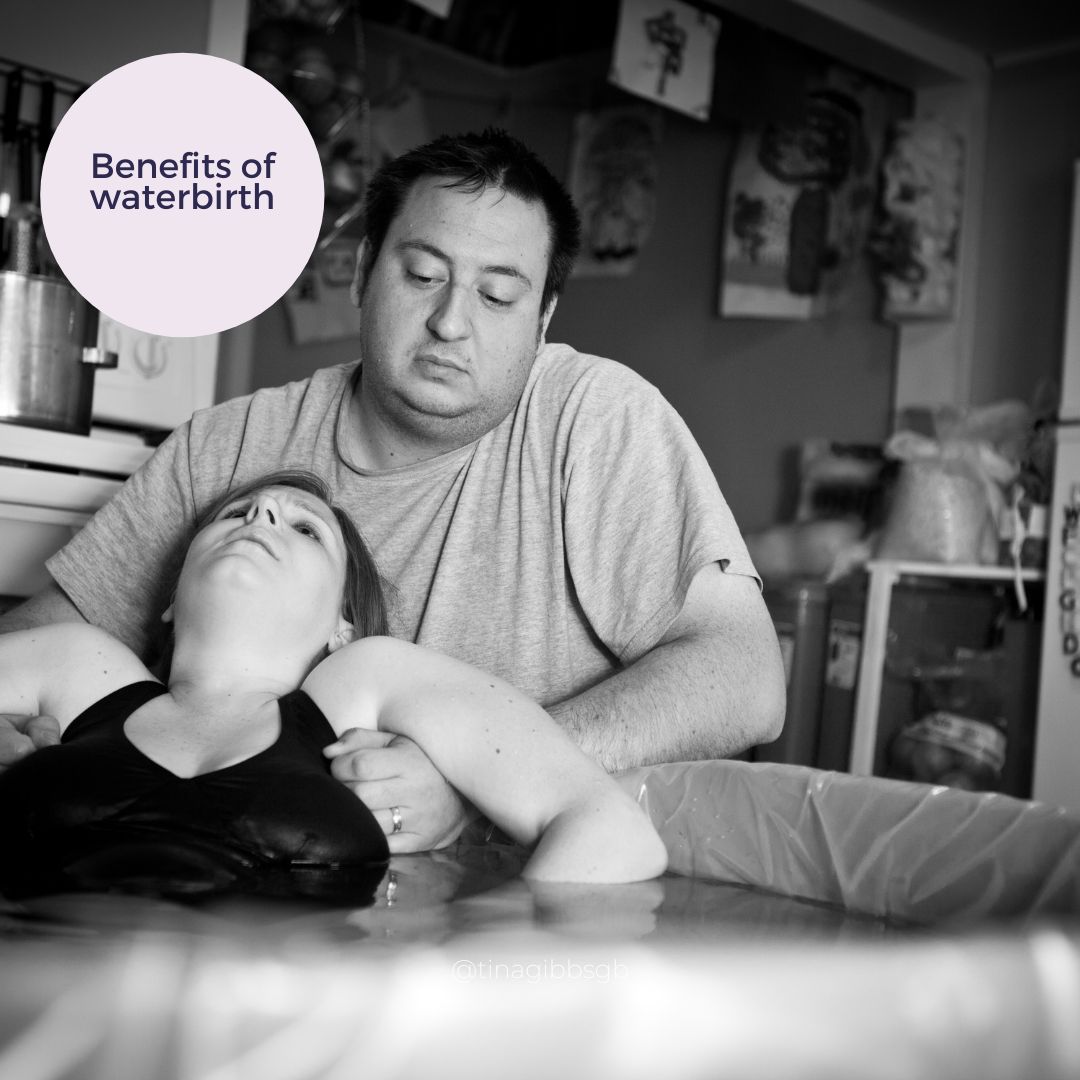
Due to it’s benefits, waterbirth has become increasingly popular with expectant families in the recent years. Let’s explore the benefits and possible disadvantages as well as practicalities a little further.

The Benefits of waterbirth:

  • Contractions will more comfortable
  • No known side effects on baby or mum
  • The warm water helps you to relax
  • Being relaxed helps your body to produce more endorphins (natural pain killers)
  • Being relaxed helps your body to produce more oxytocin (makes your contractions more efficient)
  • Less need for medical pain relief
  • Less need for drugs that accelerate labour
  • Shorter labour
  • Added privacy
  • Water supports your weight and makes you feel more comfortable and it will be easier for you to move and change positions.
  • You are more likely to achieve an unassisted vaginal birth
  • The birth is more gentle for your baby
  • Breastfeeding can be encouraged immediately
  • Reduced tearing as the water relaxes you and softens the perineum (the area between your vagina and anus).
  • A more enjoyable experience of labour and birth

Other comfort measures which can be used alongside/inside the pool:

Possible disadvantages:

  • Not suitable for everyone—under certain circumstances using water for labour / birth may not be recommended
  • Not available everywhere—your local birth unit or hospital may have limited or no pools
  • To hire or buy a birth pool for a homebirth can be expensive
  • Your home / hot water system may not be suitable for a pool

Other comfort measures which CANNOT be used inside the pool:

  • Tens machine – however, you can use your tens machine until you enter the pool!
  • Epidural
  • Opioids

Buying or hiring a pool for your homebirth?

There are many different suppliers and manufacturers. In my over 10 years of experiences in the birth world, I found that the pools from ‘Birth Pool in a box’ get the best reviews. Seek out your local homebirth group (if there is one). They may have a free or reduced-cost pool hire scheme. If you are looking to buy a birth pool or have hired or borrowed one and need further equipment, get 10% off everything at the Birth Pool in a Box shop! (Please note, this is an affiliate -sponsored- link!)

Online Birth Preparation Course only £35!

Please also check out my online course! No videos, just text and images to learn in your own time. Includes hypnobirthing mp3s, scripts, workbook, handouts, infographics and much more! Lots and lots of information at your fingertips! Includes:

  • hypnobirthing mp3s
  • hypnobirthing scripts
  • written information
  • infographics and other imagery
  • printable handouts
  • printable workbook/journal

References and further reading:

Posted on — Leave a comment

Waterbirth at home

waterbirth at home

You are pregnant and are planning a waterbirth at home? You are not quite sure how to sell the idea to your partner? Read this! Here is a ‘guide on how to persuade your partner to have a waterbirth at home 😉

My husband wrote about the birth of our second baby for one of the NCT (national childbirth trust) newsletters back in 2011. He wanted to write the story from the mother’s point of view, so he did.

Persuading the Hubby – Part 2 ‘Waterbirth in the kitchen’.

If you were lucky enough to delve between the covers of the last [blog post], you may remember the challenge I set myself persuading a sceptical Mr Hubby of the values of re-usable nappies.  Persuading the hubby can sometimes be like riding a bike uphill in a stiff wind, but just like the equally stiff wind encountered so often at changing time, it can all be overcome with a deep breath and a firm mind set to the task!  By comparison to the reusable nappies issue however, my next challenge was a veritable Tour de France in the uphill cycling stakes! 

The idea quite literally surfaced as we were swimming in the local pool.  It was towards the end of my second pregnancy and I was floating around in the water experiencing the sheer bliss that only a pregnant mother can feel as the weight of 8 months hard pregnancy was lifted off my feet.  Mr Hubby was throwing our youngest in the air and they were splashing around wildly filling the air with giggles.  My youngest was two years old now and he’d clearly come such a long way since his traumatic hospital-induced birth 24 months earlier.  It suddenly struck me how relaxed I felt, in the water with my family around me and I made the decision right there and then, that I was going to transfer that feeling of tranquillity to my next birth experience!  “I’m going to have a waterbirth in the kitchen!” I exclaimed!  My sudden outburst caught poor Mr Hubby completely unawares and he just stood there mid-throw in stunned bewilderment as our little bundle of joy spiralled through the air and hit the water with a resounding splosh!  Without the “1-2-3 breathe” that they’d been practicing at baby-swimming, the little mite came up coughing and spluttering, and despite him being quite ok, a pool life guard had already blown his whistle and a number of youthful pool attendants were diving athletically into the pool!  By the time we’d towelled off, and thanked the life guards for their diligence, and meekly smiled at the other swimmers who were looking at us as if we were completely incompetent parents, Mr Hubby finally pulled himself together and managed to reel off an immeasurably long list of reasons why he thought the whole ‘waterbirth in the kitchen’ concept was a terrible idea!  “Surely giving birth at home would create a right mess all over the place?”, “What if I was in labour at home and something went wrong?”, “Where on earth would we get a pool?”,  “Was I seriously thinking of the kitchen?”, “What if I got in to the pool and a wave of water went all over the place?”, “Was I going to cope without pain relief?”, “Was it going to be massively expensive?”, and finally “Could we do it on the cheap using little ones paddling pool and filling it with our leaky garden hose?!”.

Well, I’m all for trying to win my man round with a bit of frugalism, but after a stint of research on Google and the NHS Choices website it soon became apparent that the paddling pool and garden hose idea wasn’t going to fly.  Home birthing pools needed to be sterile, deep enough to immerse your body and strong enough to hold your weight as you hang over the side gasping for breath after an endless contraction.  Luckily though, I did find some options to save forking out gazillions of pounds on a birth pool.  First there was the hiring option – with pools available from around £80 for 5 weeks, but in the end I got a second hand one of ebay, complete with sterile hose for just £24.  All I needed then was a new pool liner for £25 and my set up was complete!  Now all this did come to around £50 in total, but as I pointed out to mr hubby (when the postman came to the door with an inflatable birthing pool under his arm), the hospital parking at the last birth came to over £30 anyway and this time round we would have need a baby sitter for our little tike as well, so I reckon we made a saving!

Mr Hubbys other concerns over the dangers of home birth were addressed by a couple of interesting encounters.  The first was with a very kindly midwife who visited us at home and reminded us that giving birth was a completely natural process and that we just had to trust my body.  In addition she promised to bring round plenty of gas-and-air and furthermore said that if we gave birth at home it would really help her meet her home-birth targets.  She seemed so nice that we could hardly say no, and the idea was sealed later that day with the second interesting encounter which was a chance conversation over the fence with the elderly lady who lives next door, who told Mr Hubby that in her day there was no such thing as a hospital and that kitchen births were quite the norm.  After an hour of listening through the fence to stories about birth in times gone-by, Mr Hubby was quite dazed and in no capacity to argue about the issue any further.

Despite my immaculate preparation, the one thing I did forget, and I would strongly advise against forgetting, was a decent pump.  My labour started a few days before my due date, and as Mr Hubby will tell you, home birthing pools are very, very, large.  Very large.  With his small bike pump, he needed a good hour of frantic pumping to get the thing inflated, and halfway through when he was at his lowest ebb and his right arm really was very nearly dropping off, two very stern midwives arrived just in time to whip him back into action.  Eventually he crossed the finish line and I stepped in to the warm soothing waters, and all my cares drifted away.  Mr hubby was clearly exhausted and looked rather like he’d been in labour himself, but before he’d had time to even catch his breath one of the stern midwives spun on her heels and told him in no short order that his next task was to keep the temperature of the pool within a degree of 36 Celsius and given that it was already down to 34, he’d better get cracking! At this point Mr Hubby was required to race back and forwards across the kitchen carrying saucepan-fulls of water from the pool and topping it up with hot water from the tap.  Back and forwards he went at ten to the dozen for a good three hours, spurred on by the hawkish glare of the midwives, which provided me with excellent entertainment during contractions.  In fact, it occurred to me that the whole situation was rather like a modern-day equivalent of “Why don’t you go and get some warm towels ready” and it kept him nicely occupied for the duration of the labour.

Before I really knew it my second child was born. My contractions were eased by the warm water, my tender regions were softened and I avoided the dreaded stitches. It was such a soothing entry to the world I will never forget the experience.  And neither will Mr Hubby, for his pumping arm has never been the same to this day!

If you are toying with the idea of a waterbirth at home or in the hospital but are not sure where to start, please get in touch and we can arrange a 1:1 birth planning session or waterbirth/homebirth workshop! I also offer other 1:1 and group antenatal workshops!