Posted on — Leave a comment

Icebreakers for antenatal classes

Icebreakers for antenatal classes. Break the ice, bond the group. Create lifelong friendships!

Facilitating successful group antenatal and parenting classes in a group setting requires icebreakers. Icebreakers help the participants to engage in the content, get to know the facilitator and other participants as well as building a bond as a group.

I’d start off with an icebreaker which goes round the room/group fairly early on as research shows that once everyone has said one thing in the group early on they are more likely to ask questions and join in later on.

Icebreakers can be really simple, like asking a question to the group and ask each participant [to state their name] to give their response to the question/statement.

Some ideas for icebreakers/questions (choose one per activity/session/round only) for your antenatal classes:

  • One thing I already know about my/our baby…
  • My biggest question about becoming a parent/family/mother/father is…
  • As a new parent I look forward to…
  • My greatest fear about being a parent is…
  • As a new parent I do not look forward to…
  • One quality I would like my child to have is…
  • One thing I have done/changed because of having a baby is…
  • As a new parent I hope I can…
  • One thing I would like to achieve during my/our baby’s first week at home is…
  • Becoming a family/father/mother/parent means to me…
  • One person, I would like my/our baby to meet is…
  • When I need support, I can turn to…
  • One thing I’ll gain as a new parent is…
  • One thing I’ll lose as a new parent is…
  • My/our baby will sleep in…
  • When I hear the word ‘breastfeeding’ it makes me think…
  • If I had an extra hour a day when everyone still has 24hrs a day, I will do… in my extra hour.
  • When I see a mother/parent/father/person breastfeeding I feel/think…
  • When I see a mother/parent/father/person bottle feeding I feel/think…
  • When I need advice I’ll ask/go to…
  • When I think about parental leave, I feel…
  • When I think about returning to work, I feel…

Allow each participant to give their response without commenting on it. These types of icebreaker questions can be used to encourage dialogue and interest in topics that you may not have covered during the course but can also aid revision and group bonding. You can download the questions/statements above as a printable A4 sheet here.

FREE DOWNLOAD

Other ideas are

  • Goodie bag activity – have a goodie bag full of items (one item per participant or couple) i.e. birth bag items, nappy bag items, post-partum recovery items. Ask each participant/couple to pick one [random] item. When everyone has one item, go round and ask the ‘owner’ to comment on the item. What might it be used for? What is it?…
  • People bingo – each participant has a “People Bingo” Card and has to go round and talk to other participants to find people matching the statement. Statements could be: Has a red car. Doesn’t drink tea. Is left-handed…
  • Scavenger hunt – when facilitating online, I often use a scavenger hunt. I put a list of items on the screen, usually related to a topic such as the birth bag and ask participants to find as many of the listed items as they can. This activity usually creates lots of laughter and gets people moving instead of sitting in front of a screen!
  • Physical skills demo – ask each participant/couple to demonstrate a breathing technique, position for childbirth or a massage technique and encourage the others to join in.

Find some more icebreaker activities for your antenatal and parenting classes, including the very popular “nice to meet you” people bingo, in my shop! I have also got a fully editable PowerPoint slide set for antenatal education and one for infant feeding education available from my shop.


Sources and Further reading

  • Chlup, D. T., & Collins, T. E. (2010). Breaking the Ice: Using Ice-breakers and Re-energizers with Adult Learners. Adult Learning, 21(3–4), 34–39. https://doi.org/10.1177/104515951002100305
  • S. Gillet, K. Winkle, G. Belgiovine and I. Leite, “Ice-Breakers, Turn-Takers and Fun-Makers: Exploring Robots for Groups with Teenagers,” 2022 31st IEEE International Conference on Robot and Human Interactive Communication (RO-MAN), Napoli, Italy, 2022, pp. 1474-1481, doi: 10.1109/RO-MAN53752.2022.9900644.
  • Pearce Eiluned,Launay Jacques and Dunbar Robin I. M. 2015 The ice-breaker effect: singing mediates fast social bonding R. Soc. Open sci.2150221150221 http://doi.org/10.1098/rsos.1

Posted on — Leave a comment

Recovery after Caesarean Birth

You are planning or have had a Caesarean birth? What to expect for your recovery after Caesarean Birth.

Emotionally
How you will feel after a caesarean birth depends on what your expectations on the birth of your baby were as well as on what happened before and during the birth.

The caesarean rate in England is close to 25% (Birth Choice UK, 2011), therefore there is always a chance you may have a caesarean birth. You may feel happy that your baby is finally born but you may feel disappointed that you had a caesarean birth if a vaginal birth is what you were hoping for. If possible, prior to giving birth, try to accept all possibilities for your birth. Births very rarely go exactly as you plan them. Attending an antenatal course will help you to find out more about different options help to prepare you for possible birth outcomes.

Talking over your caesarean birth with a health professional, soon after may help your emotional recovery. You should get a chance to talk to your midwife or obstetrician before you leave the hospital.

If you do not get the chance to talk to any health professional prior to leaving the hospital arrange an appointment as soon as possible. You may then be able to discuss how the caesarean may affect future pregnancies.

Physically
The physical recovery after caesarean birth usually takes about 6 weeks. You will not be insured  to drive a car for 6 weeks after your caesarean. However, if you do feel ready to drive, talk to your insurance company, they may insure you if your GP has signed you off. A caesarean is a major operation and you will experience some pain and discomfort. Even when laughing, coughing or other small movements will make your scar hurt. Supporting your wound with your hands or a pillow will help.

Tips to aid your recovery and ease discomfort

  • Drink plenty and eat and drink as soon as you feel hungry or thirsty. Eat foods that are high on fibre to help prevent constipation.
  • Keep your wound clean by washing and drying it daily. You can use a freshly washed flannel to clean your wound. If you do use soap make sure you rinse the wound thoroughly. To dry, pad rather than rub the wound with a clean towel. Change your towel and flannel daily.
  • Go to the loo hourly to reduce pressure from your bladder on scar.
  • Wear loose clothes and soft cotton underwear. Your knickers should be one or two sizes bigger or wear a pair of your partner’s  There are special knickers which fit over your scar.
  • Tell your midwife if you notice any signs of infection of the scar, e.g. redness, extra soreness or discharge. Also tell your midwife if you are having a temperature.

You will be encouraged to start exercising gently the day after your operation to help speed up your recovery. You may be able to see a physiotherapist but should at least be given a leaflet by your midwife. Take it slowly and do not start any more strenuous exercise until at least 10 weeks after the operation.

Pain relief
There will be pain relief available in hospital and your doctor will give you something to take at home, too. Depending on how much pain you are in, the options may vary. Most pain killers are safe to take when breastfeeding. Please discuss your options with your midwife, obstetrician or other health professional.

Scar – if you would like to know what your scar will / should look like please visit the Caesarean Birth and VBAC Information. In the menu on the left hand side there is a link to Caesarean scar pictures. Caesarean Birth and VBAC Information has a wealth of information on Caesarean Birth, recovery as well as VBAC (vaginal birth after caesarean).

Breastfeeding
You can start breastfeeding straight after the caesarean. Additional skin-to-skin as well as extra support may help. Because of the wound, breastfeeding can be more challenging during the early days. Please ask for help when needed. Most pain relief is safe to use when breastfeeding. Please mention that you are breastfeeding to your health professional.

Future pregnancies
If you have your baby by Caesarean it does not necessarily mean that you will have to have your subsequent babies by Caesarean. You can discuss future pregnancies with your GP and  whether or not you will have another Caesarean will depend on

  • risks and benefits of caesarean for you and your baby
  • your personal preferences and priorities

However, if the reason for your first caesarean was a condition that will not change for future pregnancies e.g. shape of your pelvis / birth canal, it is very likely that a caesarean will be necessary for all births.

Online course including Caesarean Info

Please also check out my online course! No videos, just text and images to learn in your own time. Includes hypnobirthing mp3s, scripts, workbook, handouts, infographics and much more! Lots and lots of information at your fingertips! Includes:

  • hypnobirthing mp3s
  • hypnobirthing scripts
  • written information
  • infographics and other imagery
  • printable handouts
  • printable workbook/journal

Further information

Posted on — Leave a comment

8 tips for self-care in pregnancy

8 tips for self-care in pregnancy, why is that a thing?

During your pregnancy, many expectant parents will focus on what is best for their baby. One of the most important parts of doing the right thing for your baby should be taking care of yourself. While there are a lot of things to prepare before your baby comes, you need to focus on your physical and mental health. These tips for pregnancy self-care may help you prioritize your health and wellness for the benefit of you and your baby and your immediate family.

Not sure where to start? Here are my 8 tips for self-care in pregnancy:

  1. Keep a diary or do some journaling
    • Many people find creativity relaxing and soothing for their minds. Why not try some journaling? Here are some free affirmations that can get you started!
  2. Enjoy some bonding time
    • Bond with your baby while you are listening to your hypnosis tracks, mediate or just sit and relax. Stroke your belly and tune into your little one! A great way to do this is to listen to my “Bonding with your baby” track!
  3. Have a bath or shower or go for a swim
    • Being in water can help you feel weightless again! Many pregnant parents love the way it feels to be floating in a swimming pool! Alternatively, have a relaxing bath while listening to some music or reading a book!
  4. Try a pregnancy massage
    • If you are a fan of massages, a pregnancy massage is an awesome way to practice some self-care. Have a look for some local massage therapists who offer pregnancy massages. Local to me (I am in Nottinghamshire, UK) there is the amazing Emily offering her pregnancy massages at The Parlour.
  5. Enjoy early nights
    • Growing a baby is exhausting! Enjoy some early nights!
  6. Eat well
    • Check with your healthcare provider which foods are recommended and not during pregnancy. The recommendations vary from time to time and country to country. So, it’s best to check with your local and current recommendations.
  7. Enjoy some (long) walks in the fresh air
    • Enjoy some (long) walks and bathe in nature. Nature bathing might sound like an alien concept but most people will have done it before. Nature bathing is taken from the Japanese concept of forest bathing. It means that you are outside and mindfully enjoy and experience nature. Turn off your phone, clear your mind and stroll through your local country side. Lots of studies shoe that this is good for mental wellbeing.
  8. Talk to a friend or family member
    • We all know that talking to a loved-one can really boost our wellbeing. So, phone a friend or meet them for a cuppa and a chat!

What do you do to relax? Share your ideas with me and other expectant parents!

Now is the time to enroll in your online birth preparation course!

Please also check out my online course! No videos, just text and images to learn in your own time. Includes hypnobirthing mp3s, scripts, workbook, handouts, infographics and much more! Lots and lots of information at your fingertips! Includes:

  • hypnobirthing mp3s
  • hypnobirthing scripts
  • written information
  • infographics and other imagery
  • printable handouts
  • printable workbook/journal
Posted on — Leave a comment

Clothes checklist for your winter baby

Clothes checklist for your winter baby. You are having a baby this winter? Congratulations! You are wondering how many and what types of clothes and layering you might need?

When purchasing your baby clothes, make certain that they all are machine washable, non-flammable and made from soft comfortable materials. Choose clothes which open at the front or have wide/enveloped neck openings.

The layette checklist below should be taken as a minimum and guide only. A winter baby will need a few more items compared to a summer baby. You may wish to have a few more spares of each item if you can afford to purchase more.

Clothes checklist for your winter baby

  • 4 body suits/sleepsuits/babygrows
  • 4 vests (check for a wide neck opening) – you may wish to choose long-sleeved ones
  • 4 cardigans or jackets
  • 1 hat
  • 2 pairs of socks
  • 2 pairs of mittens (many babygrows now have integrated mittens, so you may not need to purchase any).
  • 1 baby blanket
  • 1 baby snowsuit/pramsuit (optional)
  • 1 baby sleeping bag (optional)

In addition to the layette (set of clothing) your baby will also need nappies (either reusable or single-use) and you’ll want to make sure you have plenty of muslin squares! These are very handy to protect your clothing, mop up sick or clean up other bits and bobs. Muslin squares are also very handy to have as emergency nappy or breast pads 😉

I have created two handouts for you. One is a layering clothing guide and the other one is your winter baby clothes checklist!

how many layers sh
How many layers should my baby wear at night? Click the image to download your pdf handout.
Clothes checklist for your winter baby. Click on image to download your pdf handout.

Posted on — 2 Comments

Massage during labour and birth

man massaging his pregnant partner head and smiling

Massage Massage during labour and birth? What is massage and why might it be helpful during labour and birth?

Massage involves one person touching the other to manipulate their body’s soft tissues. It is often used to help relax tense muscles and can also help people to relax.

There are different massage techniques which may benefit different people during labour. For example, some people may prefer intense massage over their lower back helpful. Others may find light effleurage[1], or soothing strokes more relaxing and helpful.

You can practice your massage techniques while you’re pregnant, which helps you relax during pregnancy, too! If you need some guidance and ideas for simple massage techniques, you can purchase my massage worksheets from my shop!

Alternatively, you could join one of my hypnobirthing classes or join my fully self-paced online course!

massage techniques for childbirth

Research suggests that are different ways in which massage techniques may help during childbirth:

  • Massage might work by decreasing stress hormones and increasing levels of serotonin[2] and dopamine[3] in your brain.
  • Non-painful gentle massage may flood the body with pleasant sensations, so that the brain does not perceive the painful sensations as much.
  • Deep, intense, or painful massage acts on something called the Diffuse Noxious Inhibitory Control method of pain relief. The idea is that this stimulates our brain to release our body’s own pain-killers called endorphins. The body is then flooded with endorphins which helps to perceive less pain from contractions.
man massaging his pregnant partner head and smiling
Head massage with a hand-held scalp massager

Things to note if using massage (during labour and birth):

  • Aromatherapy: Essential oils can be powerful substances and can interfere with contractions if used incorrectly. Before using / buying essential oils, consult an accredited aromatherapist and your healthcare professional. Always dilute essential oils. Your midwife may also be trained in aromatherapy and may be able to advise you directly.
  • Communication: Communicate, whether the massage is helping you and how it could be made better i.e. firmer pressure, less pressure…
  • Continued touch: During massage always keep at least one hand on the recipient’s body.
  • Oils: Massage may be more comforting and soothing if non-scented massage oil is used. For example organic, cold-pressed sunflower oil. Do not use any oils on damaged skin.
  • One-handed massage: If massaging with only one hand rest the other on the recipient’s body. So they know they have your full attention and know where your other hand is.
  • Positions: The person being massaged may be kneeling, sitting, laying on their side or standing. Their birth partner needs to be comfortable too.
  • Previous injuries: Don’t massage places which have been affected by previous injuries. Consult your health care professional first.
  • Timing: Some women like massage during contractions; others prefer it in-between.

Further reading and sources:


[1] Effleurage: a form of massage involving a repeated circular stroking movement made with the palm of the hand.

[2] Serotonin: a compound present in blood platelets and serum, which constricts the blood vessels and acts as a neurotransmitter.

[3] Dopamine: a compound present in the body as a neurotransmitter and a precursor of other substances including adrenaline.

Posted on — Leave a comment

Potty Training – Toddler-led toileting

Potty Training Workshop for parents in Nottinghamshire

Potty training or as I prefer to call it toddler-led toileting is a journey every parent will have to go on with each of their children.

What is toddler-led toileting?

Learning to use the toilet or a potty is one step in your child’s development. Similar to learning to walk, eat foods (baby-led weaning) or learn to talk. Toddler-led toileting is treating the ‘potty training’ journey in the same way as learning to walk, etc.

Take your child’s lead. Trust the process. Make it fun! Allow for mistakes and setbacks. Be body positive. Normalise going to the toilet. Let them watch you go to the toilet, it’ll help them learn.

Getting started with toddler-led toileting

  1. Normalise it
    • 🚽 Everybody wees and poos.
    • 🚽 Let them see you on the toilet.
    • 🚽 Let them flush.
    • 🚽 Point out animal poo.
    • 🚽 Share picture books featuring potties, toilets and poos (get them from your local library or purchase them).
    • 🚽 Let their teddies/toys have a go on the clean (!) potty
    • 🚽 Let them observe and learn
    • 🚽Let them learn through play
  2. Observe
    • 🧐 Notice when your child is still.
    • 🧐 Use language to help them understand. “Did you just do a wee/poo?”
    • 🧐 Reassure and affirm, with no pressure. “Your body is working well.”
  3. Play
    • 🧸 Buy a potty (if using, you can let them use the toilet straight away if you prefer) & let them play with it.
    • 🧸 Put teddy/doll on potty and pretend.
    • 🧸 Let them sit on it with a nappy on.
    • 🧸 Avoid pressure. They’ll do it in their own time.
  4. Be body positive
    • 👍 Use positive language about your own body.
    • 👍 Toileting is a normal bodily function. Talk about it factually. Use factual terms for their body parts such as vulva, vagina, penis, buttocks, bottom, anus etc. Avoid pet names.
    • 👍 Avoid emotional pressure.
    • 👍 Let them feel happy with their body.
    • 👍 Explain that some people use different terms for their bodily functions and discuss common ones for your area/language/culture.

If you feel that you don’t know where to start or would like a chat with someone, I offer one-to-one online toddler-led toileting workshops. Get in touch to book yours!

Here is my top tips crib sheet to get you started! Let me know how you’re getting on!

Posted on — 1 Comment

Breathing techniques for childbirth

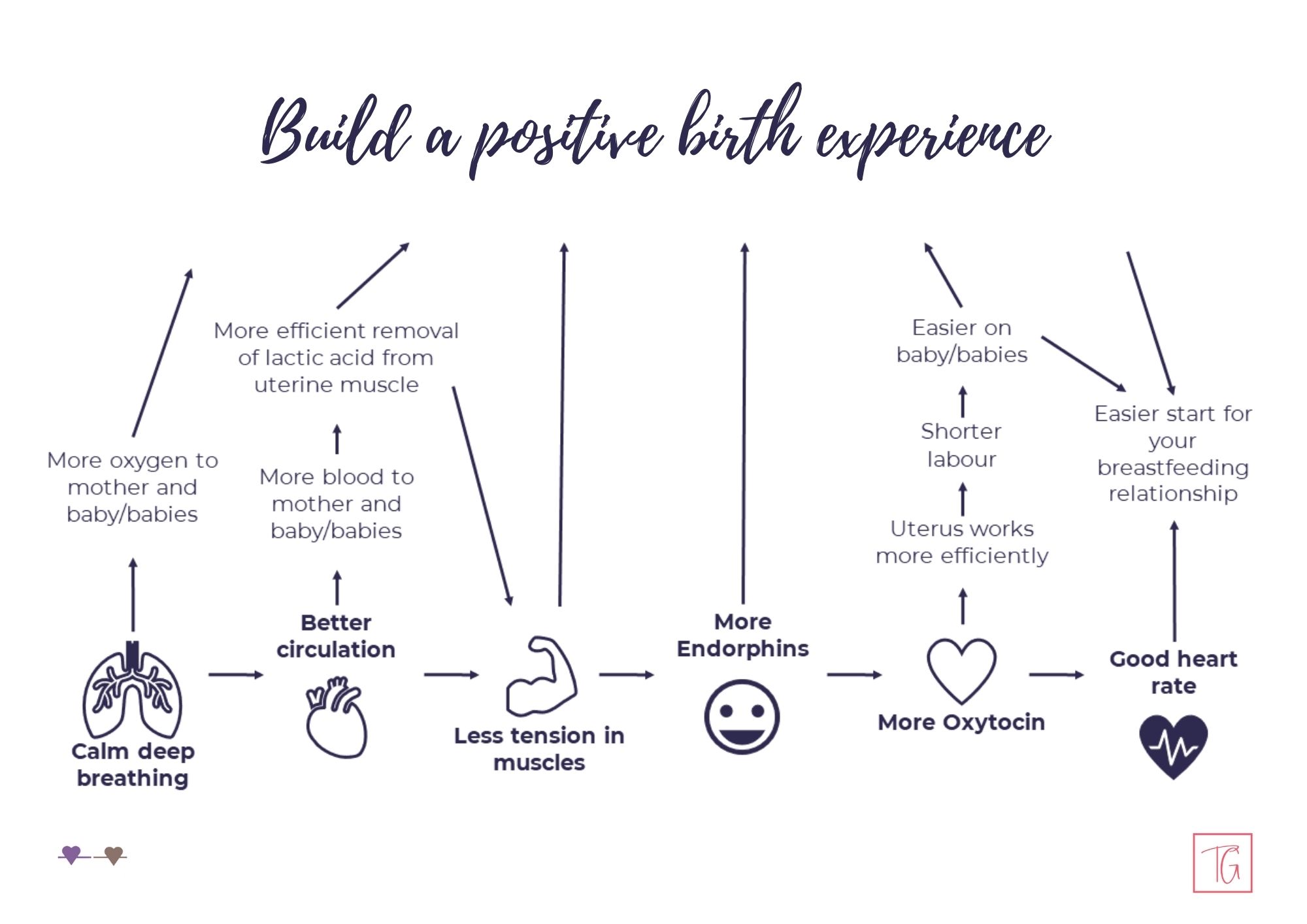
Breathing techniques for childbirth can be a useful tool to keep calm during the birth but also support the birthing process. Being calm and relaxed during childbirth can make the birth of your baby easier, quicker and more comfortable. There are many ways to help yourself or your partner to be calm during childbirth. Breathing techniques are just one of them.

How can breathing techniques help the birthing process?

Some researchers think there are a couple of different ways that breathing might support the birthing process by using the technique as a form of pain management. When you focus on your breathing, it may interrupt the transmission of pain/discomfort signals to your brain by giving you something else, more positive to focus on. Being aware of your breathing and focussing on it, may also work by stimulating the release of your body’s natural pain-relieving hormones endorphins.

Breathing techniques for childbirth are a useful tool to help you and your partner build a positive birth experience! There is a catch, though… to make the techniques work well for you, practise your techniques regularly. The more you practise, the easier and more effectively the breathing techniques will work for you during the birth of your child.

TOP TIP:

Practice the techniques as well as your comfortable breathing pattern together with your (birth) partner. When your birth partner is aware of your comfortable breathing pattern/speed, they can help you by counting you in/out or by keeping eye contact and breathing at your comfortable speed until you have reached your comfortable pattern again.

Download my breathing techniques worksheets today to start your birth prep!

Breathing Techniques for childbirth worksheets

The Breathing techniques worksheets are included in your self-paced online childbirth preparation course!

Please also check out my online course! No videos, just text and images to learn in your own time. Includes hypnobirthing mp3s, scripts, workbook, handouts, infographics and much more! Lots and lots of information at your fingertips! Includes:

  • hypnobirthing mp3s
  • hypnobirthing scripts
  • written information
  • infographics and other imagery
  • printable handouts
  • printable workbook/journal
Posted on — Leave a comment

Setting up birth preparation classes

When you are a birth worker, such as a doula, antenatal teacher, perinatal educator etc you might be wondering about setting up birth preparation classes. When do you start advertising your classes or workshops? Where do you advertise them?

When setting up birth preparation classes, you’ll have to think about when are your potential clients going to be doing their research into antenatal classes? When will they be most likely to book? What did you do when you were expecting your baby?

Do you book a venue right away? Or can you can to an agreement with a local venue where you can confirm/cancel x weeks prior to the event without having to pay?

What dates and times will suit your pregnant clients best? Do they fit in with your preferences, other job, family, venue? Is an online pre-recorded course more suitable for you or your ideal client? Or maybe a hybrid option, with pre-recorded content and some live online or in-person time?

These are the questions, I ask myself when I am thinking about setting up my birth preparation classes. There is no ‘one fits all solution’ your answers are pretty much depending on where you live, whether or not you have a family or an additional job, what venues you have available and who your ideal clients are. This post is mostly about encouraging you to think about these questions and finding YOUR answers and setting up YOUR birth preparation classes and workshops. In a way that works for you and your (potential) clients.

To help a little with the question on when to set aside dates and when to start advertising your classes, I have created a spreadsheet. You can download your free copy here!

Posted on — Leave a comment

How long does labour last?

How long does labour last?

How long does labour last? What is the average time for labour & childbirth?

In medical terms labour is divided into three stages:

  • 1st stage – where your uterus and body are getting ready. Your cervix is softening and will begin to open until it is fully open (dilated). It is sometimes referred to as the “up stage” because the sensations are pulling/moving upwards. .
  • 2nd second – the second stage begins when you’ll feel the urge to push. It is sometimes referred to as the “pushing stage” or “down stage” because the sensations are pushing downwards. At the end of this stage, your baby will be here.
  • 3rd stage – the birth of the placenta. After your baby is born, you’ll have to give birth to the placenta. This is what is happening in the 3rd and final stage of labour.

So, how long does labour last? According to the NHS, the average first labour lasts between 8-12 hours and subsequent births will be significantly quicker (approx. 5 hours). However, your midwives will only record the timing from when you are considered to be in established labour, which is when your cervix is already around 4cm dilated (open). That means that the contractions and sensations that you are experiencing until then are not officially ‘counted or measured’. However, birthing folk themselves will usually add that time on when they describe their experience. It will take hours or sometimes days (first birth) from your baby dropping (lightening) to the beginning of established labour (4cm). Use this time to rest when you can, hydrate and keep your positive energy up!

Although the NHS and other healthcare providers divide labour and birth into three stages, it is not always that simple… Each medical stage can itself be divided into further smaller steps and stages. When speaking to women and people who have given birth and/or attended births, they describe the birthing process in many more steps. Milli Hill, for example, divides the birth into 15 steps in her Positive Birth Book (affiliate link).

Here is a graphic to show a timeline of childbirth:

How long does labour last?
Childbirth/labour timeline

Posted on — Leave a comment

What to wear during childbirth?

what to wear during childbirth

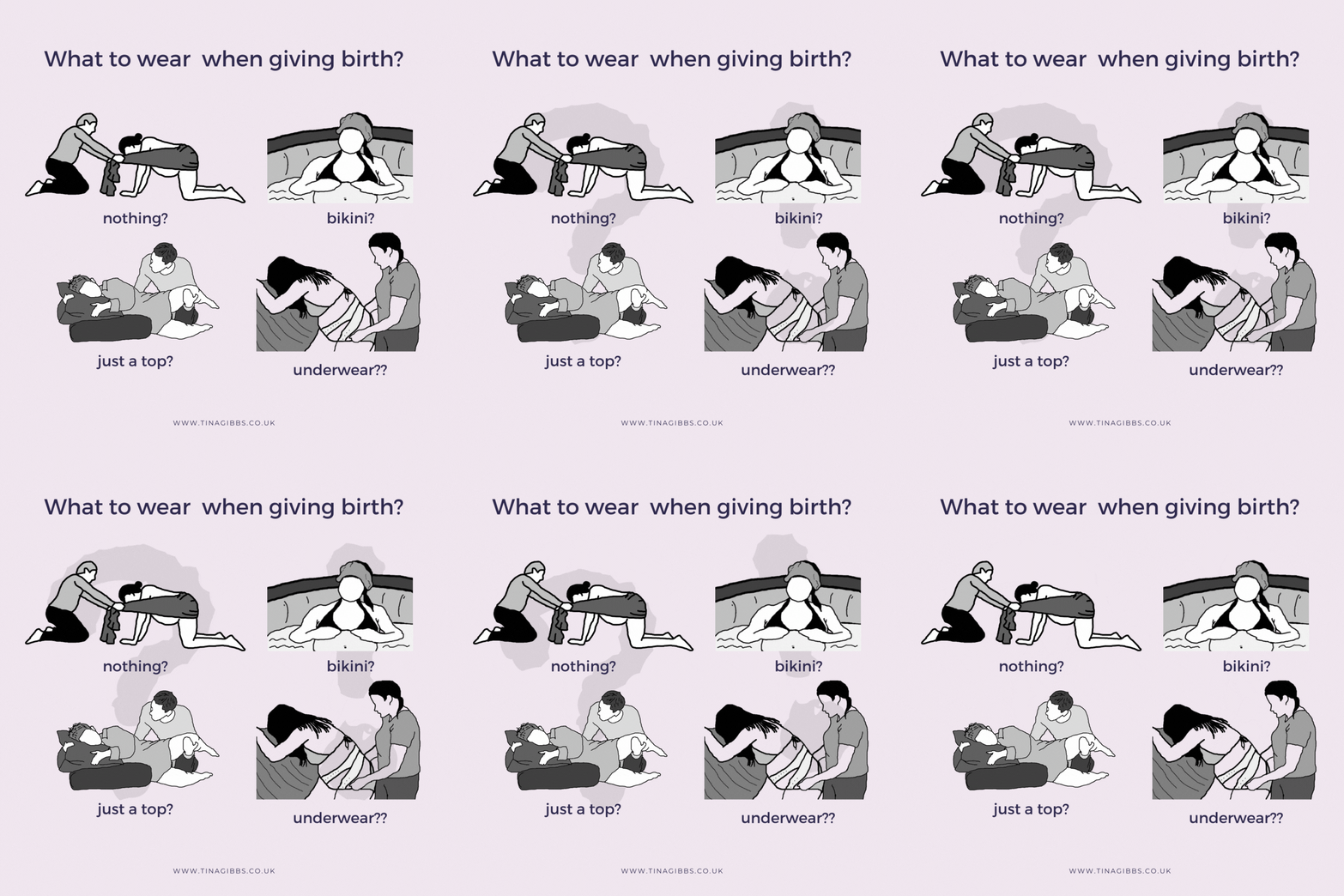
A question that comes up frequently during my childbirth preparation classes is “What to wear during childbirth?”.

The answer is, whatever feels comfortable to you. There are a few things you may wish to consider when deciding what to wear during childbirth

  • The birth environment – While you are in control of the temperature of your home, hospital birthing rooms tend to be very hot!
  • Are you giving birth in water? – if you are using/planning on using a birthing pool, you may wish to consider to not wear anything on your bottom half once you get into the pool. Clothes are more difficult to take off when they’re wet!
  • Are you planning a caesarean birth? Think about accessibility for skin-to-skin after the birth. Ask your care provider about your options. Most NHS trusts in the UK support skin-to-skin after a planned caesarean birth and do also support alternative clothing instead of the hospital gown.
  • Skin-to-skin straight after birth is important for your and you. It helps initiate breastfeeding and bonding but also helps to transfer good bacteria to your baby. Think about the clothing you are wearing during the birth of your child and check, whether skin-to-skin would be easily possible with your chosen clothing.
  • Breastfeeding/chestfeeding/bodyfeeding/nursing – If you are planning on nursing your baby, it is important to wear clothing which allow easy access to your breasts/chest.
  • Personal comfort & body confidence are also an important factor when choosing clothing for childbirth. At the end of the day it’s your choice and you’ll choose clothing which make you feel comfortable! You may of course choose to not wear any clothing!

In conclusion, wear comfortable, loose fitting clothes which allow access to your chest for the golden hour.