Posted on Leave a comment

When to do a hypnobirthing class?

When to do a hypnobirthing class

What is hypnobirthing? When to do a hypnobirthing class? What are the benefits of hypnobirthing?

What is hypnobirthing?

Hypnobirthing is a type of childbirth education. It focuses on relaxation techniques and self-hypnosis to help expectant mothers experience a more calm and comfortable birth. In addition to that, hypnobirthing, especially Mindful Hypnobirthing can help you deal and come to terms with (sudden) changes during your pregnancy and childbirth journey. Hypnobirthing teaches you techniques to calm your body and mind in any situation helping you achieve a more satisfying (birth) experience.

When to do a hypnobirthing class?

Basked in the warmth of expectant anticipation, the journey of pregnancy holds boundless possibilities. Embracing this transformative phase, hypnobirthing serves as a gentle beacon, guiding you towards a serene and empowering birth experience. By attending your hypnobirthing class between 21-30 weeks, you gracefully intertwine knowledge and practice, nurturing a profound connection with your body, baby, and the birthing process.

During these immersive sessions, you will delve into the intricacies of hypnobirthing techniques, equipping yourself with a rich toolbox of relaxation exercises, visualization practices, and deep breathing methods. This precious time devoted to learning and self-discovery ensures that you absorb the wisdom imparted by your course, allowing sensations of tranquility and confidence to take root within you.

As you embark on this path, make the conscious decision to prioritize self-care and integration. Carve out moments in your schedule to indulge in self-reflection, savoring the invaluable opportunity to unwind and surrender to the present moment. Remember, practice is the key to unlocking the full potential of hypnobirthing. By dedicating time to honing your skills, you cultivate an innate sense of calmness and resilience, ready to embrace the birthing journey with unwavering grace.

As you honour your body’s innate wisdom and the innate wisdom of your baby, embrace the affirmations that flow through hypnobirthing. Enveloped in an atmosphere of love, trust, and empowerment, you harness the strength of your mind and spirit, harmoniously co-creating a positive childbirth experience.

Embrace this transformative passage, for it is an invitation to embark on a sacred and empowering journey. Through the art of hypnobirthing, discover newfound serenity, reclaim your inner power, and paint an exquisite portrait of birth, woven with love and grace.

What are the benefits of hypnobirthing classes?

The benefits of attending a hypnobirthing class are numerous. During a group hypnobirthing class you’ll meet like-minded people embarking on their journey to parenthood at a similar time. By learning effective relaxation and breathing techniques, hypnobirthing can help reduce anxiety, fear, and tension during labour, making the experience more positive and enjoyable.

In a hypnobirthing class, you can expect to learn various techniques such as deep relaxation, visualization, affirmations, and self-hypnosis. These techniques are designed to help you achieve a state of deep relaxation and promote a more efficient and comfortable labour. The classes are typically taught by certified hypnobirthing practitioners who guide you through the process and provide ongoing support throughout your pregnancy journey.

It’s important to note that hypnobirthing classes are beneficial for all types of births, whether you are planning a natural birth or have opted for medical interventions. The techniques learned in hypnobirthing can be applied in any birthing scenario and can help you stay calm, focused, and in control.

If you’re considering attending a hypnobirthing class, it’s recommended to do your research and find a reputable practitioner in your area. Many classes offer both in-person and online options, allowing you to choose the format that suits you best. Remember, hypnobirthing is not just about the birthing day but also about preparing mentally, emotionally, and physically throughout your pregnancy for a positive birthing experience. So, take the time to explore this wonderful approach to childbirth and embrace a more relaxed and empowered journey into motherhood.

Online Birth Preparation Course only £35!

Please also check out my online course! No videos, just text and images to learn in your own time. Includes hypnobirthing mp3s, scripts, workbook, handouts, infographics and much more! Lots and lots of information at your fingertips! Includes:

  • hypnobirthing mp3s
  • hypnobirthing scripts
  • written information
  • infographics and other imagery
  • printable handouts
  • printable workbook/journal
Posted on

Baby Weaning – signs of readiness

starting solids baby weaning

Baby Weaning or starting solid foods with your baby. How do you know when, how and where to start? Where can we find some tried and tested recipes? Are we exploring baby-led-weaning (BLW) or are we starting our baby on purees first? So many questions new parents have with regards of weaning their baby.

The current recommendation (at the time of writing) is to start weaning your baby around 6 months of age.

Baby Weaning – Signs of readiness

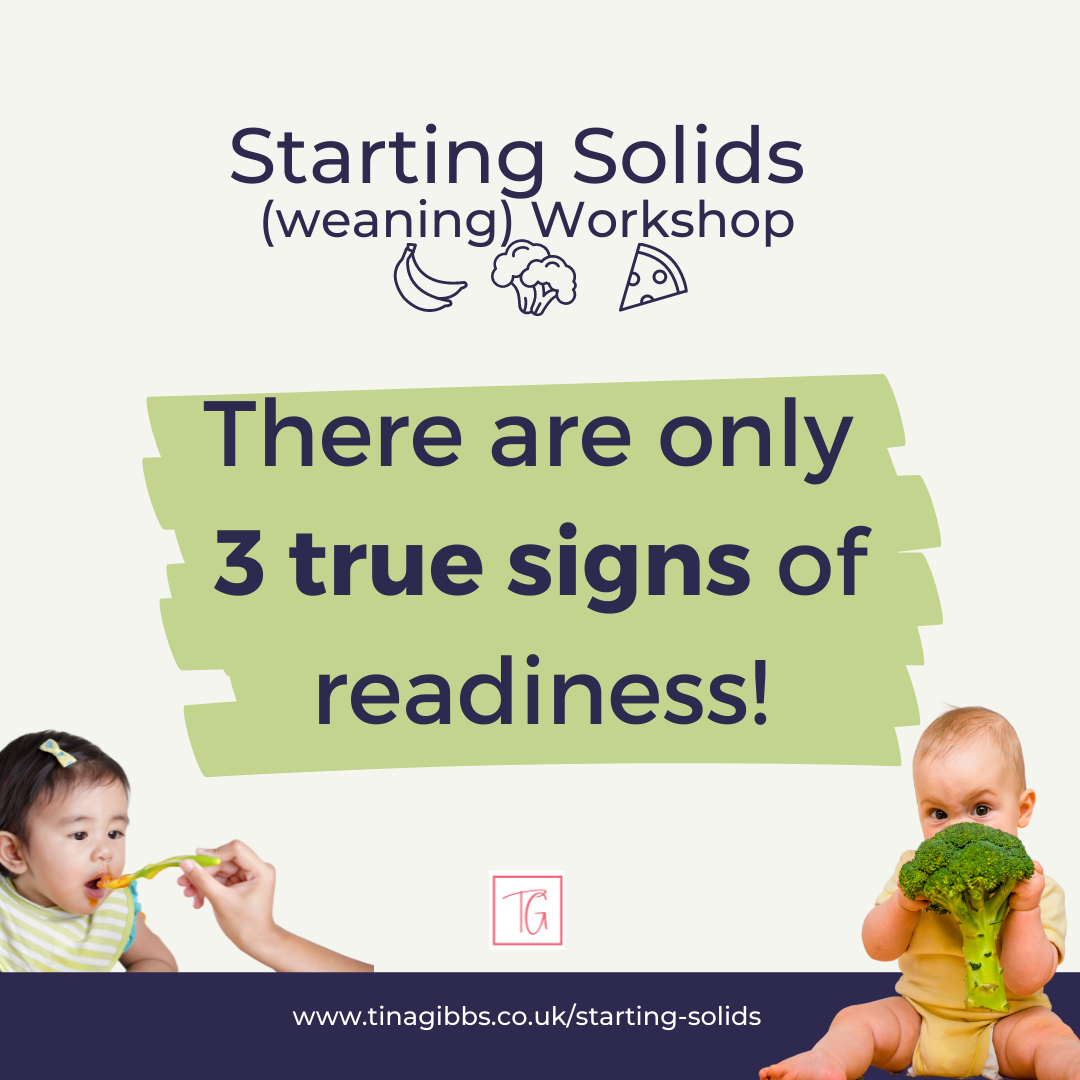
There are (only) three true signs of readiness

Your baby…

  1. can sit up unaided and hold their head steady.
  2. puts things to their mouth accurately
  3. has lost their tongue thrust reflex and can swallow

The golden rules – How to start

When introducing solid foods to your baby and during their first year of life follow these golden rules:

  • Offer simple and unprocessed foods – Make the main part of the meal of simple and unprocessed foods.
  • Offer natural foods – Your child needs to see & touch their food so that they can
  • connect food tastes with how things look and feel – this enables them to learn how to choose foods for themselves.
  • Let your baby get involved in the eating experience – Make eating a pleasurable, calm and relaxed experience. Eat together with your baby. Starting solid foods is not just nutrition it is learning and play, too!
  • Avoid ultra-processed foods – If there are too many ingredients on the label (5+) avoid giving it to your little one!

Baby-Led Weaning or Purees?

Start introducing solids at about 6 months of age alongside breastmilk or infant formula. Your baby’s milk will still be the main source of energy and nutrients for your baby.

Whether to start off with purees, finger foods or a combination pretty much depends on your baby, your personal preferences and your life style.

Some babies will happily start off with finger and mashed foods, and may move on swiftly to a range of tastes and textures. However, other babies may progress
more slowly and start off eating smooth foods off a spoon. When spoon-feeding, offer foods they can hold themselves alongside, to encourage your baby to move on to mashed and finger foods.

  • Smooth foods have no big lumps, pips, seeds or skin.
  • Mashed foods are raw or cooked foods mashed to a slightly lumpy consistency.
  • Finger foods are raw or cooked foods shaped/cut into batons. It is best to cut them bigger than a baby’s hand, so that your baby can hold them more easily. Use your (adult) finger as a sizing guide.

Always pay attention to your baby when they are eating. Never leave them alone.

Finger foods – tips for parents
  • Remove any pips, stones or stringy bits
  • Cut foods such as grapes, blueberries in half or quarters
  • Avoid nuts, popcorn and any hard-ish chunks of food
  • Stay with you baby when they are eating
  • Start off with soft and cooked foods such as vegetables and fruit
  • Wash your raw foods thoroughly

Learn more about weaning your baby

If you’d like to learn more about weaning your baby, book a starting solids (weaning) workshop with me! I offer the workshop in different formats:

1:1 (up to two adults with their baby/babies) or group (up to 8 adults with their babies). You can book these in-person to be held in Scarrington, Nottinghamshire at my home or I can travel to your home with a 10-mile radius of Scarrington/Bingham. Alternatively, I also offer a online live video course option.

In addition to the traditional starting solids workshop, I also offer a live online cook-along version. This is available online and as a 1:1 format only.

Posted on 2 Comments

How does hypnobirthing work?

How does Hypnobirthing work and what is the difference between hypnobirthing and mindful hypnobirthing?

Hypnobirthing is a method to help women and birthing people to keep calm during pregnancy and childbirth.

There is not much research around hypnobirthing available. However, from my experience of giving birth to my four children and supporting families since 2010, I would encourage any family to explore hypnobirthing.

So how does hypnobirthing work? Do you have to be a Hippie?

Hypnobirthing [Hypnosis] works with the power of suggestion. Your practitioner works with you using affirmations, visualisations and suggestion to help you [the birthing mother/person] to relax your body and mind, guide your thoughts as well as control your breathing. Your practitioner does not need to be present during the birth, but you’ll have to practice your techniques thoroughly to fully benefit from them and for hypnobirthing to work for you!

You can learn the techniques during an in-person workshop, or online in a group or a private 1:1 setting. Some parents chose to simply do a self-paced online course or read a book.

Benefits of Hypnobirthing

  • Alternative for anyone who is looking for a non-medical pain relief method
  • Can be used alongside medical and other pain management methods
  • Non-invasive
  • Accessible to anyone who practices
  • No adverse health outcomes / side-effects known
  • Inexpensive
  • The skills learnt are transferrable

Disadvantages of Hypnobirthing

  • Learning the techniques takes time and effort and requires practice
  • The language used in a hospital setting may disrupt the hypnotic state
  • Not provided by the NHS
  • Not everyone can afford a workshop or practitioner
  • Families [mostly first-time parents] have reported that their relaxed state was misinterpreted by medical professionals [midwives] at arrival at the hospital and seen as not ‘far along enough to stay’.
  • May not meet your expectations
Hypnosis + Mindfulness = Magic

WHAT IS HYPNOBIRTHING?

Hypnobirthing is a range of hypnosis techniques to help keep you calm and relaxed during the birth.

Why is being calm and relaxed during birth so important?

Well, it’s pretty basic. Our survival instinct makes it important!

Naturally and instinctively, all mammals – including humans – have a fight or flight response when in danger. So when we are scared or anxious our bodies produce stress hormones to help us deal with the situation. Some situations will require us to run and act quickly and the stress hormones help us do so. These protective stress hormones (including adrenaline) block any non-essential systems such as our digestive system and raise our blood pressure and heart rate. Our blood is diverted away from our brain, uterus etc. into our legs and arms.

Adrenaline, while it is a life-guard hormone also slows down labour by inhibiting the hormone oxytocin…

Oxytocin is the hormone of love, labour and lactation. It gives us uterine contraction but also clouds our perception of the intensity. Your natural oxytocin makes you feel better, happier and let’s your body-own pain killers (endorphins) thrive, too.

Nobody wants to give birth in an uncomfortable or unsafe environment

The way our body responds to the environment around us is rooted in the basic survival instinct that we used thousands of years ago. Of course we all know know that your midwives and other healthcare professionals won’t hurt your baby, but we are still ‘triggered’ by the ‘strangers’ in the room and/or the unfamiliar environment. These triggers make us feel out of control and maybe unable to birth our babies without fear and pain taking over. Hypnobirthing techniques aim to deal with your anxieties around childbirth, and to help you create a ‘safe place’ inside your head that you can retreat to at anytime. Other techniques include the toning down of unwanted sensations and thoughts.

What is Mindful Hypnobirthing?

Mindful Hypnobirthing was first introduced by Sophie Fletcher in her book Mindful Hypnobirthing. Sophie Fletcher was the first to combine Hypnosis with Mindfulness for Childbirth.

Hypnosis

Hypnosis is the being in a state of consciousness in which one seemingly loses the power of voluntary action. Furthermore they are highly responsive to suggestion or direction. The recipient is always in control of how deep the hypnosis goes and will only accept suggestions/changes which they are willing to make.

Mindfulness

Mindfulness is a state of mind where you are aware and live ‘in the moment’. You are paying attention to the here and now. Your awareness is in the present moment while you are calmly acknowledging and accepting your feelings, thoughts, and sensations.

Mindful Hypnobirthing combines both self-hypnosis as well as mindfulness techniques to enable you and your partner to have an empowered, calm and positive birth experience. I am offering 1:1 mindful hypnobirthing sessions online and in the comfort of your own home.

Mindful Hypnobirthing in Bingham and online with Tina Gibbs
positive birth affirmations