Posted on 1 Comment

Breathing techniques for childbirth

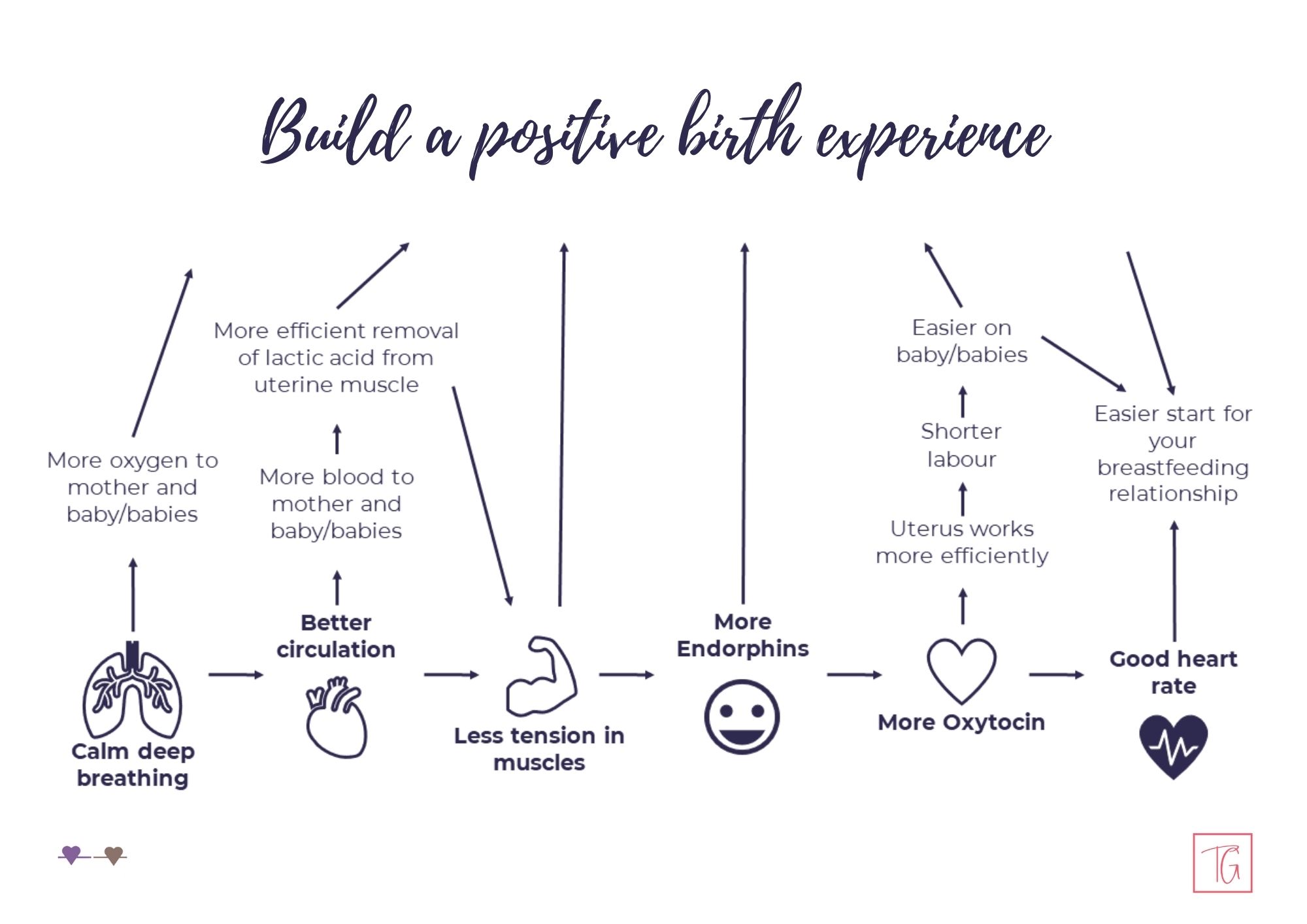
Breathing techniques for childbirth can be a useful tool to keep calm during the birth but also support the birthing process. Being calm and relaxed during childbirth can make the birth of your baby easier, quicker and more comfortable. There are many ways to help yourself or your partner to be calm during childbirth. Breathing techniques are just one of them.

How can breathing techniques help the birthing process?

Some researchers think there are a couple of different ways that breathing might support the birthing process by using the technique as a form of pain management. When you focus on your breathing, it may interrupt the transmission of pain/discomfort signals to your brain by giving you something else, more positive to focus on. Being aware of your breathing and focussing on it, may also work by stimulating the release of your body’s natural pain-relieving hormones endorphins.

Breathing techniques for childbirth are a useful tool to help you and your partner build a positive birth experience! There is a catch, though… to make the techniques work well for you, practise your techniques regularly. The more you practise, the easier and more effectively the breathing techniques will work for you during the birth of your child.

TOP TIP:

Practice the techniques as well as your comfortable breathing pattern together with your (birth) partner. When your birth partner is aware of your comfortable breathing pattern/speed, they can help you by counting you in/out or by keeping eye contact and breathing at your comfortable speed until you have reached your comfortable pattern again.

Download my breathing techniques worksheets today to start your birth prep!

Breathing Techniques for childbirth worksheets

The Breathing techniques worksheets are included in your self-paced online childbirth preparation course!

Please also check out my online course! No videos, just text and images to learn in your own time. Includes hypnobirthing mp3s, scripts, workbook, handouts, infographics and much more! Lots and lots of information at your fingertips! Includes:

  • hypnobirthing mp3s
  • hypnobirthing scripts
  • written information
  • infographics and other imagery
  • printable handouts
  • printable workbook/journal

Posted on Leave a comment

How long does labour last?

How long does labour last?

How long does labour last? What is the average time for labour & childbirth?

In medical terms labour is divided into three stages:

  • 1st stage – where your uterus and body are getting ready. Your cervix is softening and will begin to open until it is fully open (dilated). It is sometimes referred to as the “up stage” because the sensations are pulling/moving upwards. .
  • 2nd second – the second stage begins when you’ll feel the urge to push. It is sometimes referred to as the “pushing stage” or “down stage” because the sensations are pushing downwards. At the end of this stage, your baby will be here.
  • 3rd stage – the birth of the placenta. After your baby is born, you’ll have to give birth to the placenta. This is what is happening in the 3rd and final stage of labour.

So, how long does labour last? According to the NHS, the average first labour lasts between 8-12 hours and subsequent births will be significantly quicker (approx. 5 hours). However, your midwives will only record the timing from when you are considered to be in established labour, which is when your cervix is already around 4cm dilated (open). That means that the contractions and sensations that you are experiencing until then are not officially ‘counted or measured’. However, birthing folk themselves will usually add that time on when they describe their experience. It will take hours or sometimes days (first birth) from your baby dropping (lightening) to the beginning of established labour (4cm). Use this time to rest when you can, hydrate and keep your positive energy up!

Although the NHS and other healthcare providers divide labour and birth into three stages, it is not always that simple… Each medical stage can itself be divided into further smaller steps and stages. When speaking to women and people who have given birth and/or attended births, they describe the birthing process in many more steps. Milli Hill, for example, divides the birth into 15 steps in her Positive Birth Book (affiliate link).

Here is a graphic to show a timeline of childbirth:

How long does labour last?
Childbirth/labour timeline

Posted on Leave a comment

What to wear during childbirth?

what to wear during childbirth

A question that comes up frequently during my childbirth preparation classes is “What to wear during childbirth?”.

The answer is, whatever feels comfortable to you. There are a few things you may wish to consider when deciding what to wear during childbirth

  • The birth environment – While you are in control of the temperature of your home, hospital birthing rooms tend to be very hot!
  • Are you giving birth in water? – if you are using/planning on using a birthing pool, you may wish to consider to not wear anything on your bottom half once you get into the pool. Clothes are more difficult to take off when they’re wet!
  • Are you planning a caesarean birth? Think about accessibility for skin-to-skin after the birth. Ask your care provider about your options. Most NHS trusts in the UK support skin-to-skin after a planned caesarean birth and do also support alternative clothing instead of the hospital gown.
  • Skin-to-skin straight after birth is important for your and you. It helps initiate breastfeeding and bonding but also helps to transfer good bacteria to your baby. Think about the clothing you are wearing during the birth of your child and check, whether skin-to-skin would be easily possible with your chosen clothing.
  • Breastfeeding/chestfeeding/bodyfeeding/nursing – If you are planning on nursing your baby, it is important to wear clothing which allow easy access to your breasts/chest.
  • Personal comfort & body confidence are also an important factor when choosing clothing for childbirth. At the end of the day it’s your choice and you’ll choose clothing which make you feel comfortable! You may of course choose to not wear any clothing!

In conclusion, wear comfortable, loose fitting clothes which allow access to your chest for the golden hour.

Posted on Leave a comment

Pregnancy and new baby timeline – What to expect

pregnancy and new baby timeline

You are pregnant! Congratulations! Now you are wondering about the pregnancy and new baby timeline and what to expect before and after the birth of your new baby? Here is a rough guide of what to expect during your pregnancy, on the day of the birth of your baby and in the early few weeks as a new parent! This is a guide for expectant and new parents living, birthing and parenting in the UK.

During pregnancy
  • Start Pelvic Floor Exercises – here is a guide from the NHS on how to do your pelvic floor and other exercises during pregnancy!
  • Antenatal appointments with your midwife and consultant (where applicable) – here is an explanation on the NHS website.
  • Antenatal tests and scans
  • Health Visitor and/or Midwife visits your home
  • Book and attend your childbirth preparation courses (optional), such as hypnobirthing.
  • Look into hiring a birth and/or postnatal doula
  • Research and learn about your childbirth options and rights – Birthrights is a great place to find out more about your rights in childbirth
Day one – the day your baby is born
  • APGAR score for baby
  • Vitamin K offered to be given to your baby/babies
  • Midwife or a member of the paediatric team check your baby over before you’ll leave the hospital or midwife-led unit.
  • Newborn hearing screening – before you leave the hospital or within the first few weeks
  • Mum and baby/babies can leave the hospital. After a straightforward birth and with healthy mum and baby/babies they can leave the hospital on the same day. After a Caesarean Birth, you can usually leave 2 days after giving birth.
  • You’ll receive the red book for your baby’s growth charts and vaccination schedule etc. – some areas also offer an online red book.
Once at home – please note that the timescale varies in different parts of the UK
  • Mother and baby/babies will get midwife home visits for checks on day 1, 3 and 5. More often if necessary.
  • Mother on emotional high: days 1-3
  • Baby might develop jaundice: 2-3 days. Usually clears by week 2.
  • Milk comes in, days 3-5
  • Baby blues, days 3-5
  • Newborn blood spot test, day 5
  • Umbilical cord stump falls off, day 7
  • Lochia (postpartum blood loss) stops, 2-6 weeks
  • Discharged from midwifery care, between 10-28 days
  • Mother and baby postnatal check by GP: 6-8 weeks
  • Resume light exercise and sex: from after GP postnatal check, from 6-8 weeks

The dates are a rough guide and average only. This list does not give or replace medical advice. If you are concerned about yourself, your partner or your baby, please see your health care professional for help.

References and further reading:
Posted on 2 Comments

Informed decision-making for birth

Why is Informed decision-making for birth so important?

Often, pregnancy is a woman’s or pregnant person’s first significant introduction to the healthcare system. Suddenly, you have to make all sorts of decisions for you, your baby and your family unit. You’ll be faced with difficult choices around your healthcare during your pregnancy and birth. Often you’ll be influenced by healthcare professionals, your family and friends, media, social media, books, memories, etc. All claiming to know what’s best for you and your baby and in the end leaving you torn…

Whatever choices you are contemplating, you can positively impact your ability to make informed choices you’ll be happy with and you’ll feel empowered by. You can help yourself making informed decisions for your birth.

One frequently used acronym in childbirth education or hypnobirthing classes is BRAIN(S) or BRIAN. Here is a visual to help you remember it:

meet brian

BRIAN aka BRAIN is a simple acronym to help you in gathering all the information you need to make informed decisions about your own and your baby’s health care. When you join my hypnobirthing classes you’ll get to meet BRIAN (my weighted baby doll). We will help you with your informed decision-making for birth! 

Alternatively, if you prefer a self-paced online course, you can now enrol in my online childbirth preparation course. The online course includes all my antenatal mp3 recordings, the scripts as well as a 20 page printable workbook!

Benefits:
What are the benefits of the treatment/procedure/etc? Is this what is usually done? How do the usual benefits apply to your personal, individual care?

Risks:
Are there any risks? What risks are there with the treatment/procedure/etc? Is this what is usually done? How do these apply to your personal and individual care?

Intuition:
How do you feel about the treatment/procedure/etc. offered? What does your gut tell you?

Alternatives:
What are the alternatives? Where can I get a second/third opinion?

Nothing:
What would happen if I do nothing? Is it an emergency? How much time have we got to think about it? Do we have to make a decision now?

With this simple and memorable acronym you can make informed decisions without having to memorise or read all the available statistics and research. You will feel more in control of the birth as well as more empowered and happier with your individual birth experience.

And that’s why informed decision-making for childbirth is so important.

Posted on Leave a comment

Tips for keeping cool when pregnant

Tips for keeping cool when pregnant

Being pregnant when it’s hot can be uncomfortable. Here are some tips for keeping cool when pregnant in the hot summer months!

Tips for keeping cool when pregnant in hot weather.

Stay cool and safe with these cooling tips and tricks:

☀️ Stay hydrated – drink plenty of water. Drinking plenty of water helps to prevent dehydration. Drink more than on colder days as you’ll sweat more/loose more water in hot weather. Keep a bottle of water with you all day. Also, have a glass of water nearby in the night.

☀️ Wear loose and light clothing. Wear light-coloured, loose and breathable clothing. This allows the air to circulate around your skin and helps you to keep cool. When you are outside, seek shade, wear a sunhat, sunglasses and sunscreen. Maybe take a spray bottle with cold/iced water with you.

☀️ If you have a birth pool or paddling pool, fill it with cold water and sit in it. Submerging your body in the cool water will help you cool down.

☀️ Cool summer snacks such as cold or frozen watermelon, cucumber,… Freeze/chill some fruit and vegetables to eat.

☀️ Seek shade or stay indoors. If you can, stay indoors during the hottest part of the day. Seek some share when and where you can if you’re outside.

☀️ Exercise in the early morning hours or evening or in water. Adjust your exercise type and/or timing to suit the hot weather. It is cooler early in the morning and later in the evenings. Or seek exercises which you can do in water.

☀️ Put your feed up and rest. Chill out, hibernate, take a break. Look after yourself and your baby.

☀️ Put your feed in a washing up bowl filled with cold water – If you don’t have a bath, paddling pool or birthing pool, fill up a washing up bowl or bucket with cold water to put your feet in it. This also saves water…

☀️ Have a (paper) fan, to cool yourself down. Top tip: if using a paper fan, add two drops of peppermint essential oil onto your fan.

☀️ Eat ice lollies – You could make some ice-lollies from (sugar free) fruit juice, flavoured water, …

What are your top tips to stay cool in the heat?

These tips and tricks also help keeping you cool when you are not pregnant!

Know the signs of heat exhaustion and heat stroke!

Posted on Leave a comment

Benefits of Waterbirth

benefits of waterbirth

Due to it’s benefits, waterbirth has become increasingly popular with expectant families in the recent years. Let’s explore the benefits and possible disadvantages as well as practicalities a little further.

The Benefits of waterbirth:

  • Contractions will more comfortable
  • No known side effects on baby or mum
  • The warm water helps you to relax
  • Being relaxed helps your body to produce more endorphins (natural pain killers)
  • Being relaxed helps your body to produce more oxytocin (makes your contractions more efficient)
  • Less need for medical pain relief
  • Less need for drugs that accelerate labour
  • Shorter labour
  • Added privacy
  • Water supports your weight and makes you feel more comfortable and it will be easier for you to move and change positions.
  • You are more likely to achieve an unassisted vaginal birth
  • The birth is more gentle for your baby
  • Breastfeeding can be encouraged immediately
  • Reduced tearing as the water relaxes you and softens the perineum (the area between your vagina and anus).
  • A more enjoyable experience of labour and birth

Other comfort measures which can be used alongside/inside the pool:

Possible disadvantages:

  • Not suitable for everyone—under certain circumstances using water for labour / birth may not be recommended
  • Not available everywhere—your local birth unit or hospital may have limited or no pools
  • To hire or buy a birth pool for a homebirth can be expensive
  • Your home / hot water system may not be suitable for a pool

Other comfort measures which CANNOT be used inside the pool:

  • Tens machine – however, you can use your tens machine until you enter the pool!
  • Epidural
  • Opioids

Buying or hiring a pool for your homebirth?

There are many different suppliers and manufacturers. In my over 10 years of experiences in the birth world, I found that the pools from ‘Birth Pool in a box’ get the best reviews. Seek out your local homebirth group (if there is one). They may have a free or reduced-cost pool hire scheme. If you are looking to buy a birth pool or have hired or borrowed one and need further equipment, get 10% off everything at the Birth Pool in a Box shop! (Please note, this is an affiliate -sponsored- link!)

Online Birth Preparation Course only £35!

Please also check out my online course! No videos, just text and images to learn in your own time. Includes hypnobirthing mp3s, scripts, workbook, handouts, infographics and much more! Lots and lots of information at your fingertips! Includes:

  • hypnobirthing mp3s
  • hypnobirthing scripts
  • written information
  • infographics and other imagery
  • printable handouts
  • printable workbook/journal

References and further reading:

Posted on 2 Comments

Flying when pregnant

Ahead of the travelling season, let’s explore things to know about flying when pregnant. Maybe you have booked a holiday before you knew that you were pregnant? Now, do you need to cancel? Or is it okay to fly while pregnant?

The good news:

Flying isn’t harmful to you or your baby, […]

NHS.

but it is always a good idea to discuss any concerns with your midwife and/or team of healthcare professionals.

It is worth taking into consideration:

  • how far along you are in your pregnancy at the time of travel
  • whether you have any health concerns
  • where you are travelling to
    • is it long-distance?
    • are vaccinations recommended for your destination?
  • which airline you are flying with

Flying when pregnant infographic and top tips!

Flying when pregnant
  • For long-distance flights (longer than 4 hours), drink plenty of water and move about regularly, or do in-seat exercises. This helps to minimise the small risk of blood clots (1-2 women in 1000). You can buy a pair of graduated compression or flight stockings from the pharmacy, which will help reduce leg swelling.
  • Some airlines won’t let you fly towards the end of your pregnancy. Remember to check with the airline for their policy on this.
  • Make sure you have your maternity notes, travel insurance and health insurance documents with you and know about maternity care/hospitals at your destination.
  • You can listen to your hypnobirthing tracks while you are flying to help with comfort, confidence and nausea.
  • Ask the cabin crew for a seatbelt extension if needed, and wear your seatbelt under your bump.
  • Avoid gassy foods before the journey to increase your comfort during the flight!
  • Carry medication in your hand-luggage!

Online Birth Preparation Course only £35!

Please also check out my online course! No videos, just text and images to learn in your own time. Includes hypnobirthing mp3s, scripts, workbook, handouts, infographics and much more! Lots and lots of information at your fingertips! Includes:

  • hypnobirthing mp3s
  • hypnobirthing scripts
  • written information
  • infographics and other imagery
  • printable handouts
  • printable workbook/journal

Download your free packing list:

References and further reading:
Posted on 2 Comments

Your Birth Plan


Your birth plan or better birth preferences can be an important part of your journey into parenthood.

You may have heard people talking about their birth plan going out of the window or saying it is not worth writing one… In my opinion, as a doula and mother of 4, it is worth thinking about your birth preferences (rather than “plan”). You may or may not wish to put them in writing, that’s up to you. However, sharing and discussing your preferences, personal thoughts and feelings about the birth with your birth partner(s) is important.

positive birth affirmations
Information is power – write down your birth preferences!

You can go all out and make it very detailed, of course, but the more details you choose the less realistic your expectations may become. So, let’s focus on your main 4-5 preferences for the birth. Things that you are likely be able to control.

You may wish to consider:

  • Your birth place – where do you wish to give birth
  • The birth environment
    • who will be there (birth partner(s), doula, …)
    • what (home) comforts would you like to be there (music, blanket, cushion…)
    • what is the lighting going to be like?
    • is there music?
  • Birth Method
    • vaginal
    • caesarean
    • induction
    • in water
    • out of water
  • Your religion/beliefs/traditions
  • Your medical history and your individual options
  • Mention your medical pain relief preferences
    • don’t want any or
    • let me know when I can have the epidural or
    • I would like x but avoid y
  • You are allowed to decline all/any vaginal examinations at any point as well as any other form of physical touch. You can change your mind at any point. However, most women are happy to vaginal examinations, and consenting to them may help your midwife do their job.

The NHS website has a very detailed birth plan template, which you may wish to use to check that you’ve considered all your different options. However, you may not wish to use it as your actual birth preferences.

Think about it in a chronological order:

  • Early labour / at home
  • active labour / on the way to the hospital / while waiting for the midwives to arrive
  • established labour / at the birth place under midwifery care
    • transition
  • second stage / pushing
  • third stage / the placenta
    • the golden hour with your baby

If there are any of your preferences which don’t align with your health care provider’s recommendations, negotiate before the day, not on the day. In addition to that, it may be helpful to have a doula to help with your birth preferences and to ensure you have good evidence-based information. I offer private online or local in-person birth planning sessions.

Please also check out my online course! No videos, just text and images to learn in your own time. Includes hypnobirthing mp3s, scripts, workbook, handouts, infographics and much more! Lots and lots of information at your fingertips! Includes:

  • hypnobirthing mp3s
  • hypnobirthing scripts
  • written information
  • infographics and other imagery
  • printable handouts
  • printable workbook/journal
Some sources for good evidence-based information:

Posted on Leave a comment

Hypnobirthing FAQ

Hypnobirthing FAQ

Who is a hypnobirthing course for?

My hypnobirthing workshops are aimed at anyone who wants to give their baby a gentle and loving start in life. If you want a positive experience of birth that you can look back and treasure – for the rest of your life, then my workshops are for you. Suitable for all types of birth including induction and caesarean birth. Expectant parents are bombarded with images, videos and stories of childbirth as a negative event. During my hypnobirthing workshops we’ll explore your thoughts, fears and experiences and help you regain your faith in your body and choices. Empowering you to make the right choices for your positive birth experience; and look forward to your birth experience.

When should I go to a hypnobirthing course?

Hypnobirthing courses are suitable from 20 weeks of gestation. Ideally, you’d like to give yourself and your partner some time to practice the techniques you learn during the course. The more you practice, the better it’ll work for you. However, most expectant parents join a class around 32-35 weeks of pregnancy.

Does my birth partner have to attend the course?

I strongly encourage birth partners to attend the course. Your birth partner is an essential part of your day and they’ll benefit from learning about your options and challenges during birth. It’ll help them to be more confident in supporting you.

Do I have to have a birth partner?

That’s up to you. Some mothers decide to have their partner or/and a doula or friend present at the birth, others chose to be on their own. It can be beneficial for the birthing process to have a familiar face in the room to keep you grounded, calm and comfortable. If you do have a birth partner, please encourage them to come along to the workshop!

I have experienced a birth trauma/negative birth experience – is hypnobirthing for me?

I am a trauma-informed doula and hypnobirthing practitioner. Hypnobirthing is your chance to do things differently this time, and maximise your body’s ability to have a positive and satisfying birth experience. Depending on whether you have or not dealt with your experience, you may also benefit from my birth trauma services before you are giving birth or trying to conceive.

What if I had a previous caesarean birth?

My hypnobirthing workshops can help you towards a VBAC (vaginal birth after caesarean) by helping you to stay calm and confident throughout the birth. I have worked with many clients towards a positive VBAC experience. If you would like another caesarean birth this time, my hypnobirthing workshop can help you towards a gentle caesarean birth.

Does hypnobirthing replace medical pain relief options?

The short answer is no. The techniques you learn can be used instead of or alongside medical pain management options. However, using hypnobirthing techniques does increase your chances of using fewer pharmaceutical pain management options.

How does hypnobirthing work?

See my post “how does hypnobirthing work?”

What do midwives think about hypnobirthing?

That depends of course on the midwife… However, many midwives are also trained in hypnobirthing and teach hypnobirthing. If your midwife is not supportive, ask for a different one!

Do I have to have a homebirth?

No. Hypnobirthing is suitable for any birth environment.

Does hypnobirthing work for subsequent births?

Yes. Hypnobirthing works (if you practice!) for any birth.

How can my partner support me with hypnobirthing?

Coming along to the hypnobirthing workshop is a great start! Your partner may also wish to read up about hypnobirthing but that’s not essential. Have a look at my blog post “How does hypnobirthing work?” to find out about the science of hypnobirthing.