Posted on Leave a comment

Teaching about Caesarean Birth

Teaching about Caesarean Birth in an antenatal setting. An important topic to cover with rising caesarean rates worldwide.

Preparing expectant parents for the possibility of a Caesarean birth, sharing information about how to avoid a caesarean birth, educating them about their choices and birth rights are all part of what modern antenatal settings should be covering.

Offering parents-to-be evidence-based and up to date information will help your clients to feel more empowered during their pregnancy and birth.

In your antenatal settings you will come across expectant parents where a Caesarean birth is not on their radar at all and parents who already know that a Caesarean birth is their preference and anyone in between…

How to facilitate teaching about Caesarean Birth

One option is that you give each participant in your class a role. Ask for a volunteer to be the person prepped for C-birth. Then hand out some c-birth prep cards with clips and strings on them to be “pinned” onto the volunteer.

C-birth prep card, printed on coloured card, laminated, strings and clips attached.

Discuss/explain each item where needed. It may be worthwhile pointing out that all of the prep items are the same for any operation and that only the foetal monitoring equipment is in addition for a Caesarean birth. Learning outcome here: Participants are aware that a lot of equipment is needed for theatre prep and reassured that this is normal.

Once the person is prepped, you can give everyone else a role play card of a person in the operating theatre. Ask the prepped person to sit or stand in the middle of the room. Then one by one have the medical staff roles step around the person. Again discussing and explaining everyone’s role. It is worthwhile to consider that this kind of role play with real people standing around a real person can feel very daunting and “too much” for some expectant parents.

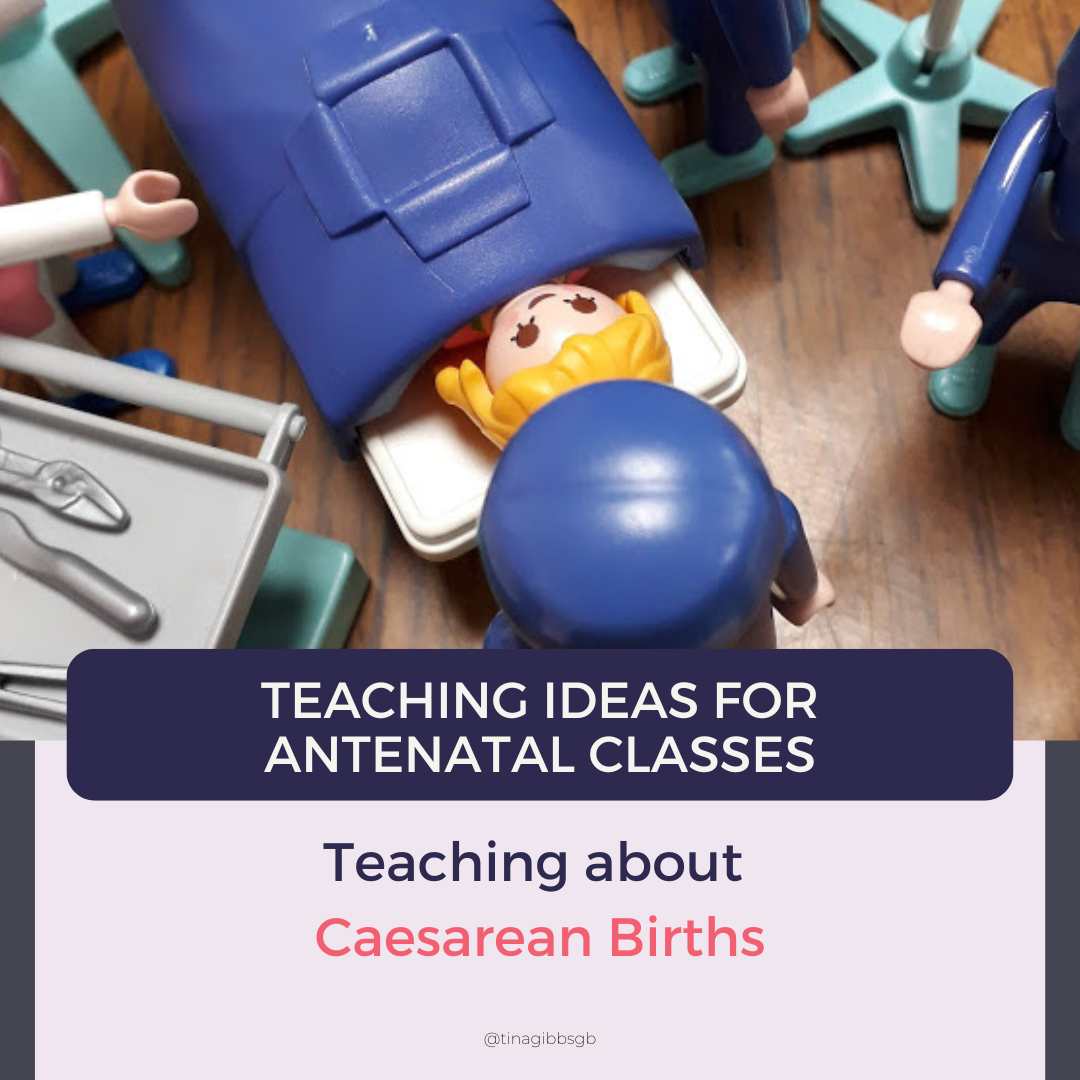
For the past 10 years or so, I have been using some Playmobil, lego, and wooden characters for the “people in the theatre” role-play part. I deliberately added some non-scrubbed/medical-looking characters to keep it fun. I pass around the cards at random and ask clients to pick a random character out of a bag…

The parent-feedback has been very positive! I’ve received many messages saying how parents were feeling very prepared, remembering all the little people from the antenatal sessions.

I support the activity with epidural and Caesarean birth information handouts from the OAA, I send out a link to a gentle caesarean birth video, and have a Caesarean birth photo story available for clients to look at if they wish.

We also talk about preparing a Caesarean birth plan and how to make their Caesarean birth options and things to consider.

Overall, expectant parents are keen to explore the options and reasons and how to make a caesarean birth less likely. They value the time spent on this topic whether or not they have a caesarean birth or not.

Let me know how you facilitate teaching about caesarean birth in your antenatal classes in the comments or get in touch!

Sources and further reading

Posted on Leave a comment

Affirmations for new parents

What are affirmations? And how can they help new parents?

Affirmations, aka positive affirmations, are phrases that you repeat to yourself over and over again to change your mindset. You can say them out loud our in your head. Receive them as part of treatment with your hypnotherapist or other therapist. Most commonly they help you to change a negative into a positive thought or negative into positive thinking.

Affirmations can help you feel more in control and empowered during your experience as a new parent and also when nursing your new baby!

Affirmations can improve your ability to problem-solve and decision-making while under stress such as sleep deprivation or peer pressure. Making the right decisions for you and your baby enables you to feel empowered while being the good enough parent for your baby.

You can download all my affirmations for new parents for free here.

Here are some videos you can loop if you like for when you are nursing your baby:

Using affirmations can really help new parents to focus on what they can control and let go of what is outside of their control.

Create a bubble of calm, confidence and control. Set aside a few minutes every day to focus on yourself and your bond with your baby. Imagine, that you and your baby are inside a bubble, your safe space. Leave all the daily chores, visitors, etc. outside that bubble. It’s just you and your baby. Focus on your breathing. Use a calm breathing technique which suits you. You can use the moving circle in gif below if you like. For that designated time, it is just you and your baby. In a safe space, focusing on your bond.

Circle of calm, confidence and control – a technique for new parents

Alternatively, you may also focus on your positive parenting affirmations while you are inside your bubble of calm, confidence and control.

Practice your affirmations daily. You’ll feel better for it. Look after yourself and your mental health. Making time for yourself and your baby will strengthen your bond, improve your mental wellbeing and may also improve postpartum healing.

Having a baby means that your time for yourself, for you as a couple and time with friends and family will have to be divided differently. You have to find a new balance which works for you and your family. Both mothers and fathers benefit from bonding with their baby and taking care of themselves. Your family benefits from parents allowing time and space for themselves, as a family together as well as parents as a couple.

Have a look at the images below. Each circle represents an person. The larger ones (grey and blue) are the parents and the smaller one is the baby (lilac). Where the circles overlap is how much time they spend together. There may be very little or no couple time possible unless you get some help such as a postpartum doula or babysitters… One parent may spend more time with the baby than the other. The time where there is no overlap with a person, is the time you’ll have to divide between chores, you-time, work, family and friends, pets, hobbies etc. The process of re-balancing your personal time to a balance that works for you and your family, may take some time. Give it time. Use some time every day with positive affirmations to help you re-balance your time and life.

Sources and further reading

  • F, H. R., Supriyana, S., & Runjati, R. (2021). Self-Empowerment, Affirmation And Relaxation Training Against Stress Levels And Cortisol Levels In Pregnant Women: Systematic Literature Review. STRADA Jurnal Ilmiah Kesehatan10(1), 335–343. https://doi.org/10.30994/sjik.v10i1.636
  • Hill Zoelene, Spiegel Michelle, Gennetian Lisa A., Pride-Based Self-Affirmations and Parenting Programs, Frontiers in Psychology, Vol. 11, 2020, https://www.frontiersin.org/articles/10.3389/fpsyg.2020.00910/full
  • Sari, R. P., Vivi Silawati and Putri Azzahroh (2022) “The Effectiveness of Positive Affirmations Combination of Face Acupressure and Aromatherapy Against Anxiety in Preoperative Sectio Cesarean Patients At Sentosa Hospital Bogor”, Science Midwifery, 10(3), pp. 2164-2170. doi: 10.35335/midwifery.v10i3.629.
  • Wiesenfeld, B.M., Brockner, J., Petzall, B., Wolf, R., & Bailey J. (2001). Stress and coping among layoff survivors: A self-affirmation analysis. Anxiety, Stress and Coping: An International Journal, 14, 15–34.
  • Worthman C.M., Plotsky, P.M., Schechter, D.S., & Cummings, C.A. (editors). (2010). Formative Experiences: The Interaction of Caregiving, Culture, and Developmental Psychobiology. New York: Cambridge Univ. Press

Posted on 1 Comment

Teaching about pregnancy anatomy

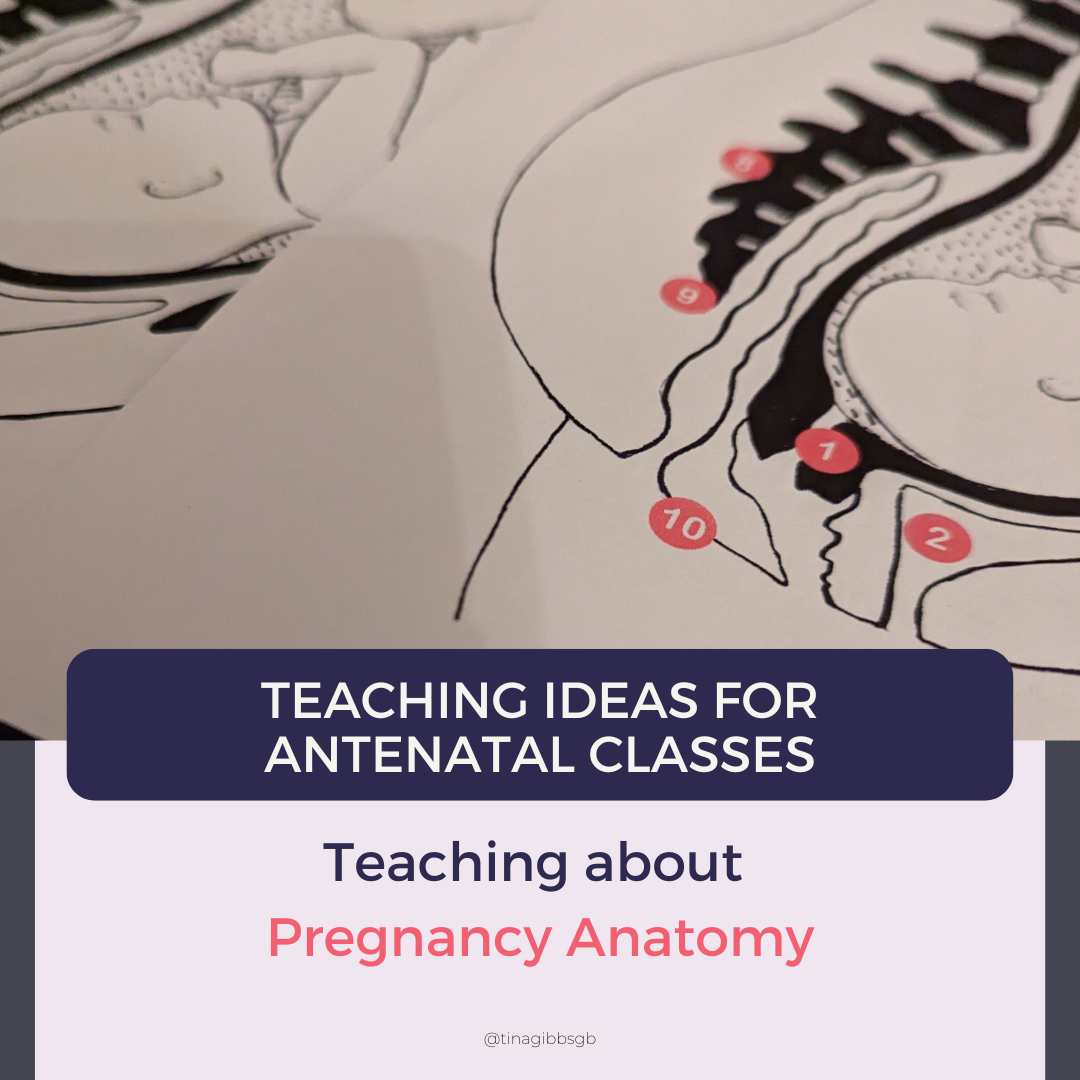
Teaching about pregnancy anatomy in an antenatal setting. One of the first topics I cover during my childbirth preparation classes is “pregnancy vocabulary”.

Pregnancy vocabulary

During an in-person group setting, I often split up the group into two “teams”. Each team will have an A2 poster of either the pre-pregnancy cross section or the pregnant cross-section body and body part labels such as “coccyx”, “uterus/womb”, “sacrum”, “vagina”, “cervix” etc… I explain that these words they are likely to hear during their journey into parenthood and that we will be referring to some of them during the rest of the course. I give them 5-10 minutes to add the labels to their poster (i use laminated cards with blu tack or similar on my PVC posters).

You can download the body part labels for free here:

Pregnancy anatomy changes

Once they are done, we bring the group back together, including their posters and we have a look and compare the pregnancy anatomy images. We have a discussion about common pregnancy discomforts, where they are coming from and how to avoid or minimize them.

During a 1:1 in-person setting, I use either both posters together or my new pregnancy anatomy comparison poster, where all three images are on one poster.

During an online setting I use my pregnancy vocabulary animated slide which is part of my Antenatal Course PowerPoint Slides.

Pregnancy Vocabulary and anatomy PowerPoint Slide

The image above is also part of my antenatal class journals, which I give out in class. I have recently created a downloadable worksheet on that topic, too. Recently, I found that parents-to-be like to take home paper handouts again. They especially rate my worksheets where they are encouraged to colour-in images and take notes. All these things help them focus and retain the information.

Pre-pregnancy vs pregnant body comparison worksheets

I have not had an opportunity to use my new pre-pregnancy vs pregnant body worksheets yet, but I am certainly looking forward to using these beauties! They are available in three skin tones as well as the colouring in version. With and without annotations or lines. So they’d work as handouts, too! I am really excited about these!

These printable pregnancy anatomy handouts are now also available from my TpT store and are included in my BARGAIN growing bundle!

Posted on 1 Comment

7 ways to personalise your Caesarean birth

7 ways to personalise your Caesarean birth

You have chosen to have a caesarean birth. Here are 7 ways to personalise your Caesarean birth, to help you plan the birth you want and deserve!

Hypnobirthing yes, you can use hypnobirthing, mediations, mindfulness and relaxations to your advantage during and in preparation for your caesarean birth. Practice your calm breathing techniques, positive affirmations for birth and your bonding with your baby techniques. The calmer you are, the more oxygen goes to your baby or babies and your recovery after Caesarean will also be improved. Hypnosis also has a positive impact on your mental wellbeing during pregnancy and in the postpartum period.

Skin to skin. Immediate skin to skin contact for baby with one of their parents helps your baby with regulating their temperature, spreads good bacteria etc. It’s all around beneficial! The good news is, that most hospitals in the UK support immediate skin to skin with mother/birthing parent and baby after any method of birth as long as it is safe to do so. So if you and your baby are well, the cord is long enough (it usually is!) then, you can have immediate skin to skin!

Optimal or delayed cord clamping. Optimal cord clamping or delayed cord clamping allows the flow of your baby’s blood from their placenta to them. This results into better apgar scores and improves your baby’s overall immediate and later health! Most hospitals in the UK will support delayed or optimal cord clamping for any type of birth including caesarean births.

Adapt the environment. Have your partner or doula there (some hospitals will support you to have two birth partners present in the theatre), choose your music. Some mothers/birthing parents chose headphones to cancel out the noises of the surgery. You can listen to your hypnobirthing tracks or have your partner repeat your affirmations with you.

Stay calm – more oxygen to baby, better recovery. Try and use anything which keeps you calm. This can be your partner, your doula, your relaxations, your music, or maybe a photograph of a loved one or pet. The calmer you are, the lower the blood loss, more oxygen for your baby or babies and your recovery time improves.

Vaginal seeding. Vaginal seeding refers to the practice of inoculating a cotton gauze or cotton swab with vaginal fluids to transfer the vaginal flora to the mouth, nose, or skin of your newborn baby. Your midwife will take a piece of gauze that’s been soaked in a sterile solution. This will then be inserted into your vagina, ideally around an hour before your caesarean birth is due to take place. Some parents choose to do vaginal seeding and some hospitals in the UK will support you with that. Another way to improve your baby’s microbiome is to focus on breastfeeding and lots of skin-to-skin.

Ask for/about gentle caesarean – family centered caesarean birth many hospitals in the UK offer gentle caesarean births or family centred caesarean births. During a gentle caesarean the baby or babies are allowed to be born in their own time. Rather than the obstetrician pulling the baby out, the uterus, aided by synthetic oxytocin, will contract the baby or babies out of the womb. This is usually accompanied by immediate skin-to-skin and optimal cord clamping.

Here is an article on a gentle caesarean birth story: https://www.theguardian.com/society/2005/dec/03/health.medicineandhealth

Here is a video of a gentle caesarean at one of my local hospitals in Nottinghamshire:

Knowledge. Knowledge, knowing your options, finding out what is happening during your caesarean, will enable you to plan the perfect experience for you. Discuss your options with your healthcare provider and ask them about skin-to-skin, optimal cord clamping, adaptation of the birth environment etc.

Planning your Caesarean Birth if you would like someone to walk alongside you when planning your Caesarean Birth, book a birth planning session with me! I can provide you with evidence-based information and help you plan your birth experience!

Have a look at the video below. It shows you the number of people who are present during your caesarean birth.

These are just 7 ways to personalise your Caesarean birth. I am sure you can think of a few more. Please share your ideas and experiences with us in the comments!

Newsletter for expectant and new parents

Online Birth Preparation Course only £35!

Please also check out my online course! No videos, just text and images to learn in your own time. Includes hypnobirthing mp3s, scripts, workbook, handouts, infographics and much more! Lots and lots of information at your fingertips! Includes:

  • hypnobirthing mp3s
  • hypnobirthing scripts
  • written information
  • infographics and other imagery
  • printable handouts
  • printable workbook/journal

Sources and Further Reading:

http://www.caesarean.org.uk/

Ginandes C, Brooks P, Sando W, Jones C, Aker J. Can medical hypnosis accelerate post-surgical wound healing? Results of a clinical trial. Am J Clin Hypn. 2003 Apr;45(4):333-51. doi: 10.1080/00029157.2003.10403546. PMID: 12722936.

Hourigan SK, Dominguez-Bello MG, Mueller NT. Can maternal-child microbial seeding interventions improve the health of infants delivered by Cesarean section? Cell Host Microbe. 2022 May 11;30(5):607-611. doi: 10.1016/j.chom.2022.02.014. PMID: 35550663; PMCID: PMC9237654.

Smith J, Plaat F, Fisk NM. The natural caesarean: a woman-centred technique. BJOG. 2008 Jul;115(8):1037-42; discussion 1042. doi: 10.1111/j.1471-0528.2008.01777.x. PMID: 18651885; PMCID: PMC2613254.

Wilson, Brooke C. et al. (2021) Oral administration of maternal vaginal microbes at birth to restore gut microbiome development in infants born by caesarean section: A pilot randomised placebo-controlled trial. eBioMedicine, Volume 69, 103443. Available at: https://www.thelancet.com/journals/ebiom/article/PIIS2352-3964(21)00236-X/fulltext [accessed: 03/04/2023]