Posted on Leave a comment

Floppy Face Floppy Fanny

“Floppy Face Floppy Fanny” a magic technique to make childbirth easier, more enjoyable and reduces tearing. How?

During childbirth, the process of delivering a baby can be both physically and emotionally intense for the expecting mother. It is natural to feel some level of fear, tension, or discomfort during this journey. However, there is an intriguing technique that some believe can help make the birthing experience easier, more enjoyable, and even reduce the likelihood of tearing. This technique is known as “Floppy Face Floppy Fanny.” The phrase was first said by American midwife Ina May Gaskin.

The concept behind Floppy Face Floppy Fanny is based on the interconnectedness of our facial muscles with those in our pelvic floor, vagina, and vulva. According to this technique, when the face is relaxed, especially the muscles around the mouth and jaw, it has a profound impact on the relaxation of the pelvic area as well. By consciously relaxing the face, the woman aims to create a ripple effect, allowing the muscles in her birthing canal to also relax, making it easier for the baby to pass through.

The idea of linking facial relaxation with childbirth may sound unconventional, but proponents of this technique suggest that it can have a significant impact on the overall birthing experience. By practicing deep breathing exercises, visualization, and consciously relaxing the facial muscles, women may find increased comfort, reduced pain, and a smoother delivery process.

It’s important to note that its effectiveness may vary from person to person. Every woman’s/birthing person’s experience with childbirth is unique, and there are many factors involved in the ease and outcome of the process. It is always recommended to consult with a healthcare professional or midwife for personalized guidance and support during pregnancy and childbirth.

So why am I saying Floppy Face, Floppy Fanny rather than relax your mouth and jaw? To make it more memorable for expectant parents. I’ve also been using the “loose lips, loose hips”.

Here are some flashcards for breathing techniques to help you to keep your jaw, lips and mouth relaxed. One of the most memorable but simple technique is “horse lips”.

Online Birth Preparation Course only £35!

Please also check out my online course! No videos, just text and images to learn in your own time. Includes hypnobirthing mp3s, scripts, workbook, handouts, infographics and much more! Lots and lots of information at your fingertips! Includes:

  • hypnobirthing mp3s
  • hypnobirthing scripts
  • written information
  • infographics and other imagery
  • printable handouts
  • printable workbook/journal

Sources and Further Reading

  • Emmer, Helene et al. “Obstructive sleep apnea syndrome is associated with overactive bladder and urgency incontinence in men.” Sleep vol. 32,2 (2009): 271-5. doi:10.1093/sleep/32.2.271
  • Fischer MJ, Riedlinger K, Gutenbrunner C, Bernateck M. Influence of the temporomandibular joint on range of motion of the hip joint in patients with complex regional pain syndrome. J Manipulative Physiol Ther. 2009 Jun;32(5):364-71. doi: 10.1016/j.jmpt.2009.04.003. PMID: 19539119
  • Dr Lauren Keller: https://drlaurenkeller.com/blog/2022/5/23/5xlrzq50dx7n127nsavetabxr7jseg
  • Mamastefit: https://mamastefit.com/breathing-our-pelvic-floor-and-labor/
  • Talasz H, Kremser C, Talasz HJ, Kofler M, Rudisch A. Breathing, (S)Training and the Pelvic Floor-A Basic Concept. Healthcare (Basel). 2022 Jun 2;10(6):1035. doi: 10.3390/healthcare10061035. PMID: 35742086; PMCID: PMC9222935.
  • Van der Velde, J., & Everaerd, W. (2001). The relationship between involuntary pelvic floor muscle activity, muscle awareness and experienced threat in women with and without vaginismus. Behaviour Research and Therapy, 39(4), 395–408. doi:10.1016/s0005-7967(00)00007-3
  • Van der Velde, J., Laan, E., & Everaerd, W. (2000). Vaginismus, a component of a general defensive reaction. An investigation of pelvic floor muscle activity during exposure to emotion inducing film excerpts in women with and without vaginismus. Submitted
  • WombWisdom: https://www.wombseedwisdom.com/
Posted on 1 Comment

Teaching Techniques for Perinatal Educators

Teaching Techniques for Perinatal Educators are essential in providing comprehensive and effective guidance to expectant parents. These techniques help birth keepers in their mission to educate and empower expectant parents with the knowledge and skills necessary to navigate the childbirth process and their maternity system confidently.

Here are some Teaching Techniques for Perinatal Educators

Lecture – The simplest teaching method is to stand in front of the class and share all the necessary information. This method offers several advantages. First and foremost, it allows for the efficient delivery of a large amount of information in a relatively short time span. Furthermore, lectures provide an opportunity for students to gain knowledge without having to conduct extensive research on their own. Additionally, lectures facilitate the dissemination of complex ideas and concepts in a structured manner. However, despite its benefits, the lecture method has its drawbacks. One significant disadvantage is that students typically retain only about 20% of the information presented during a lecture. This limited retention can be attributed to various factors such as the passive nature of the learning experience and the inability to actively engage with the material.

Use visual aids – Posters, banners, illustrations, and videos can effectively enhance understanding and retention of information. By incorporating visual aids, childbirth educators can create a more engaging and interactive learning environment, making complex concepts easier to grasp.

Create an engaging and active learning experience – Another valuable technique is active learning. Encouraging expectant parents to actively participate in discussions, group activities, and role-plays can greatly enhance their learning experience. This approach allows parents to practice the skills they will need during childbirth and fosters a sense of empowerment and confidence.

Storytelling – Learning through the use of storytelling can also be a powerful teaching technique. Sharing real-life birth stories and experiences can provide expectant parents with practical insights and emotional support. Storytelling helps build empathy and creates a connection between the childbirth educator and the parents, fostering a sense of trust and openness.

Brainstorming – is a valuable activity that encourages expecting parents to come together and share their thoughts and ideas regarding various aspects of pregnancy, childbirth, and parenting. This provides a platform for open discussions and allow participants to exchange their experiences, concerns, and knowledge surrounding this transformative period in their lives. Through the process of brainstorming, attendees can explore different strategies, techniques, and coping mechanisms to navigate the challenges and joys of pregnancy and early parenthood. Moreover, this collaborative approach fosters a sense of community and support, enabling individuals to feel more prepared and empowered as they embark on their journey to becoming parents.

Q&A – Allow some time for questions and answers. When people come up with questions, it helps them to think more. They will understand the information they hear in response to questions better than the information given in a lecture.

Incorporate technology into your teaching – Utilizing online resources, interactive apps, and virtual platforms can provide additional opportunities for learning and accessibility. Technology allows childbirth educators to reach a wider audience and provide resources and support beyond the classroom. Ultimately, by combining these teaching techniques, perinatal educators can create a dynamic and inclusive learning environment that promotes knowledge acquisition, skill development, and emotional support for expectant parents.

Card Sort – is a practical activity where you prepare cards with various prompts such as signs of the onset of labour, myths and truths about newborns, or a hormone picture and statement hunt. During a card sort activity, participants categorize these prompts into different groups based on their similarities. This method allows for a visual and interactive way to understand and organize information related to childbirth and parenting. By engaging in this activity, individuals can gain a deeper understanding of these topics and explore the connections between different concepts, options and ideas.

Demonstrations – To effectively convey breathing techniques, positions, and movement for birth (and other related topics), it is important to utilize demonstrations. By visually demonstrating these techniques, you can provide a clear understanding and promote effective learning for both visual and kinesthetic learners. Encourage expectant parents to actively participate in trying these techniques during the sessions. This will will not only enhance their understanding but also help them retain the information better.

Goodie Bag – Another great teaching technique for perinatal educators! You pass around a bag or container of props (e.g. things which may be helpful/useful during the early postpartum period). They pick an object out of the container, say what it is, and why they think it could be helpful.

Quizzes – A quiz is a type of activity that can be done in a small group, as homework, or as a worksheet given in class. It is useful for reviewing information that has already been taught, especially information that is easy to understand, such as “Name three things that help you relax”. It is also helpful for providing information that is good to know, but not necessary to remember the answers to, like the advantages of having a doula.

Small group discussions – When it comes to facilitating better communication in a classroom setting, one effective strategy is to divide the class into smaller groups. By doing so, we create an environment where individuals can engage in more intimate conversations and exchange ideas freely. Sometimes it may be beneficial to keep couples together and other times there are instances where it’s more beneficial to separate couples. Overall, implementing small group discussions fosters active participation and enhances the overall learning experience.

Games – There are many different styles of games you can utilise in your antenatal education setting. I have a labour board game and a labour revision game which I use regularly on my antenatal classes. Games are fun, interactive, people solve problems and retain the memory however they can take up a lot of time for how much information gets covered.

HomeworkWorksheets to take home, lists of skills to practice, book recommendations and other further reading are a great way to encourage expectant parents to think about their journey between classes/sessions. However, many of your clients will not actually do their homework

Sources and further reading

  • Brookfield, S.D., 2013. Powerful techniques for teaching adults. John Wiley & Sons.
  • Future Learn: https://www.futurelearn.com/info/blog/how-to-teach-adult-learners
  • Kerka, S., 2002. Teaching adults: Is it different?. ERIC Clearinghouse on Adult, Career, and Vocational Education, Center on Education and Training for Employment, College of Education, the Ohio State University.
  • Nesbit, T., Leach, L. and Foley, G., 2020. Teaching adults. In Dimensions of adult learning (pp. 74-95). Routledge.
  • Rogers, A. and Horrocks, N., 2010. Teaching adults. McGraw-Hill Education (UK).
Posted on Leave a comment

Why I don’t offer mates’ rates…

I don’t offer “mates’ rates and here is why:

What are mates’ rates?

I first came across mates’ rates as a child and it would usually be a trade business offering a service at a lower price than usual to their mates. Now that’s great and if you do pay taxes and get the money without putting the income through your books, then the extra cash could save you tax money. So it was a two-way street back then.

But what happens to small business owners such as myself? My business does not earn enough money to be paying taxes, so offering my mates cheaper rates would be a one-way street. Yes, my mates would benefit but I’d be out of pocket.

How to break the news to your mates?

Have an honest conversation with your friend. Your friend probably hasn’t even thought about how mates’ rates affect you as a small business owner and your business.

Explain to and remind your friend that you are running a business and that this is NOT just a hobby. Let them know how hard it is to start and grow a successful business. There are many costs involved such as materials, rent, website costs etc. Remind them that small businesses need a lot of regular support and that sharing your business/service means the world to you and your business. Share your passion about what you do with them. Most people will understand.

What could you offer instead?

Instead of offering ‘mates’ rates’ try this:

  • £x cash/or discount if they write an honest and positive review about your services
  • £x cash for each referral that results into a booking
  • If they have a small business, too, share their info and they share yours.
  • Loyalty cards may work for some of your classes, too. Buy 5 get one half-price…

Next time someone asks for ‘mates’ rates’ have an honest conversation with them about what it means to discount your work and how friendly ‘mates’ rates’ really are and how they affect you and your small business.

Posted on Leave a comment

Teaching about Caesarean Birth

Teaching about Caesarean Birth in an antenatal setting. An important topic to cover with rising caesarean rates worldwide.

Preparing expectant parents for the possibility of a Caesarean birth, sharing information about how to avoid a caesarean birth, educating them about their choices and birth rights are all part of what modern antenatal settings should be covering.

Offering parents-to-be evidence-based and up to date information will help your clients to feel more empowered during their pregnancy and birth.

In your antenatal settings you will come across expectant parents where a Caesarean birth is not on their radar at all and parents who already know that a Caesarean birth is their preference and anyone in between…

How to facilitate teaching about Caesarean Birth

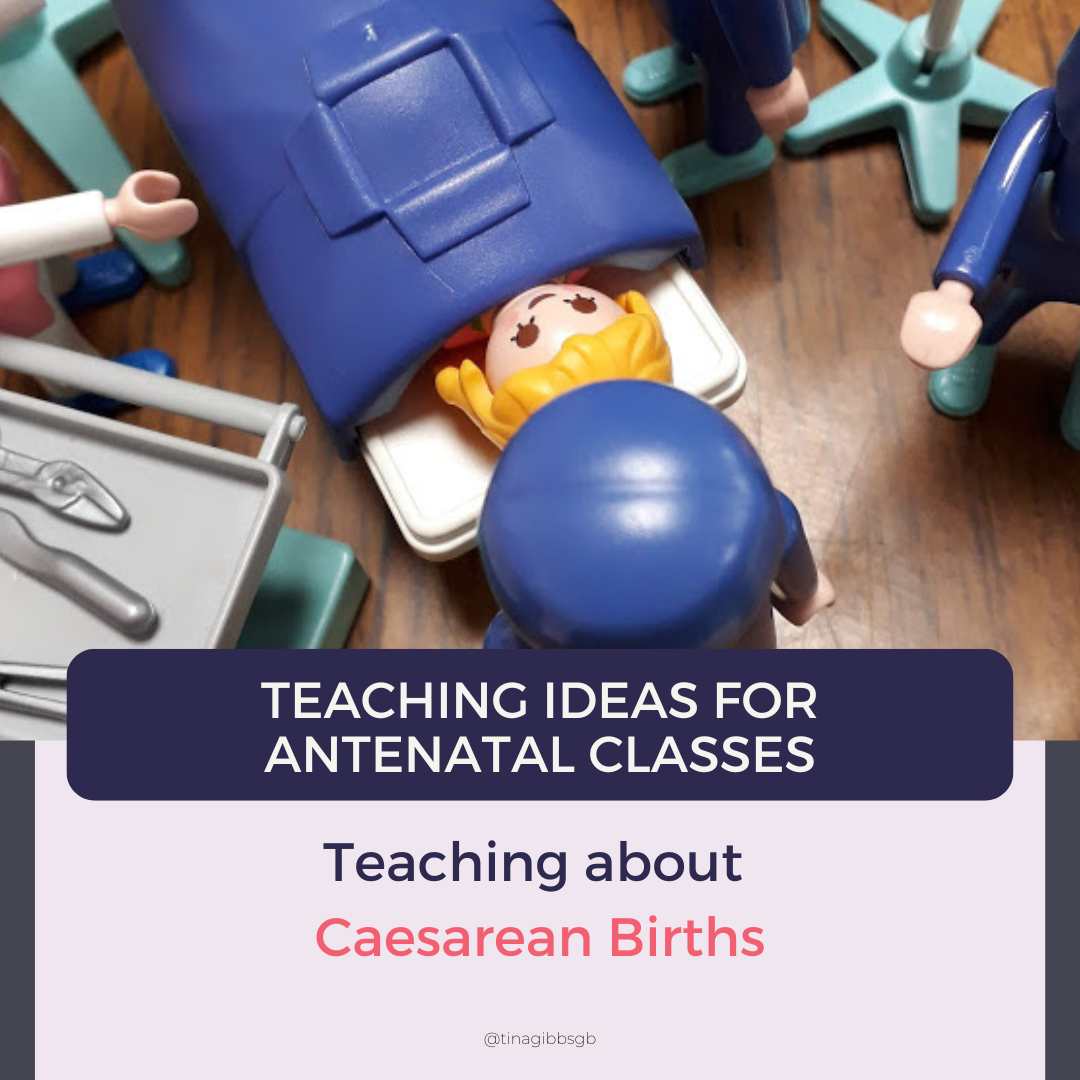
One option is that you give each participant in your class a role. Ask for a volunteer to be the person prepped for C-birth. Then hand out some c-birth prep cards with clips and strings on them to be “pinned” onto the volunteer.

C-birth prep card, printed on coloured card, laminated, strings and clips attached.

Discuss/explain each item where needed. It may be worthwhile pointing out that all of the prep items are the same for any operation and that only the foetal monitoring equipment is in addition for a Caesarean birth. Learning outcome here: Participants are aware that a lot of equipment is needed for theatre prep and reassured that this is normal.

Once the person is prepped, you can give everyone else a role play card of a person in the operating theatre. Ask the prepped person to sit or stand in the middle of the room. Then one by one have the medical staff roles step around the person. Again discussing and explaining everyone’s role. It is worthwhile to consider that this kind of role play with real people standing around a real person can feel very daunting and “too much” for some expectant parents.

For the past 10 years or so, I have been using some Playmobil, lego, and wooden characters for the “people in the theatre” role-play part. I deliberately added some non-scrubbed/medical-looking characters to keep it fun. I pass around the cards at random and ask clients to pick a random character out of a bag…

The parent-feedback has been very positive! I’ve received many messages saying how parents were feeling very prepared, remembering all the little people from the antenatal sessions.

I support the activity with epidural and Caesarean birth information handouts from the OAA, I send out a link to a gentle caesarean birth video, and have a Caesarean birth photo story available for clients to look at if they wish.

We also talk about preparing a Caesarean birth plan and how to make their Caesarean birth options and things to consider.

Overall, expectant parents are keen to explore the options and reasons and how to make a caesarean birth less likely. They value the time spent on this topic whether or not they have a caesarean birth or not.

Let me know how you facilitate teaching about caesarean birth in your antenatal classes in the comments or get in touch!

Sources and further reading

Posted on 1 Comment

6 ways to include solo parents in antenatal classes

include solo parents in antenatal classes

When you’re used to facilitating your antenatal classes for couples, you might find solo parents attending daunting. So here are 6 ways or ideas on how to include solo parents in your antenatal classes.

Language

Watch your language. Take the solo parent’s lead. How do they introduce themselves to you and the group. Are they calling themselves single parent, sole parent, solo parent…? Mirror that language.

Self massage

It is always a good idea to facilitate and teach about self-massage and self-hypnosis. Here are some self-massage techniques…

Self-massage techniques to include solo parents in antenatal classes

Images

Include images of solo parents to your antenatal classes. Images of a single person in a labour and birth position, a mother or father holding their baby, etc. Check your visual aids to see if they include images of labouring people on their own. My positions for labour and birth poster as well as the cards include images of solo parents.

Storytelling

Include stories about solo parents you know (use their names with their consent only). You could say something like “A solo parent from a previous course found XYZ really helpful.”

Hypnobirthing

Hypnobirthing or self-hypnosis for birth is a very popular choice amongst solo parents. They regular practice of the techniques enables the birthing parent to be “in the zone” and focus on their body and baby.

Mindfulness

Just like hypnobirthing, mindfulness techniques have recently gained popularity especially with solo parents. The focus on the here and now, themselves, their body and their baby works wonders during labour and birth.

Inclusion of solo attendees as standard in your classes

Make the inclusion of solo parents to your antenatal classes something you do every time. Even if everyone in the room has a birthing partner, you never know if the birthing partner can make it to the birth. Explain to expectant parents, that there is like to be a time when the birthing mother/person/parent is on their own at least for a short time.

Posted on Leave a comment

Teaching about induction

Teaching about augmentation and induction of labour as part of childbirth education classes has become an essential topic. Expectant parents need to know the pros and cons, different options and reasons for the recommended induction of labour.

In my opinion, teaching about induction and augmentation of labour means to explore:

  • Common reasons for the recommendation, and why the recommendations are made, how important the reason is, what evidence there is to support the recommendation
  • Different options of for induction and augmentation, i.e. membrane sweep, drip, etc
  • Timeline of induction and augmentation of labour – what may be offered when and why
  • Options of “self-induction” – how can we encourage labour to start on its own?
  • Reputable sources of information to support informed decision-making (some are listed below)
  • Their Birthrights (Human Rights in Childbirth)
  • How to feel empowered once/if they’ve agreed to an induction (support, informed decision making, best for them and their baby in their individual situation…)
  • How to adapt their birth plan

Teaching about induction and augmentation of labour ideas

Discussion

Have a discussion in class about reasons, ways and pros and cons of inducing labour. My induction discussion prompt cards are a visual way to encourage expectant parents to discuss the topic. They are also available as ready printed version and both versions include full instructions including links and references.

Timeline

Explore what methods of induction and augmentation may be offered/happening when, using one of my labour timeline banners.

timeline banner - induction and augmentation of labour

Informed Decision Making Game

One of my personal favourites is an informed decision making scenario game. This also works for teaching about induction and augmentation of labour! The way it works is that you start off with one scenario and give two or more options. Let participants choose one of the options. Each option/choice develops the story further. You’ll get different outcomes when making different choices. Some are choices others are chance as you roll a die or two. This is a fun way to explore how different choices may impact your birth experience. This game works in a in-person class, virtual class as well as for homework.

I also offer workshops on how to write and build your own interactive informed decision making game!

Teaching about induction of labour using visuals

To help include all different learning styles and your clients’ preferences use a mixture of visuals, taktile interactions as well as the written word! I have a range of visual learning aids ready printed as well as digital downloads available from my shop.

Posters

I like to use posters and hang them up on the wall or in the windows during sessions. Posters support the information and retention during the course. I have created these beautiful posters on “self-induction” called “How to encourage childbirth/labour to start”. They are a very recent (2023) addition to my shop and classes and are very positively received by clients as well as birth workers!

Workbooks/Journals/Worksheets

I also provide my clients with a journal/workbook the workbook includes images and information about childbirth and infant feeding. They can take it home and recap and/or take notes during the workshop.

I can also create personalised workbooks, activities, posters and powerpoints for you to fit your branding and content preferences. Please get in touch!

Posted on Leave a comment

Hypnosis and Mindset Iceberg

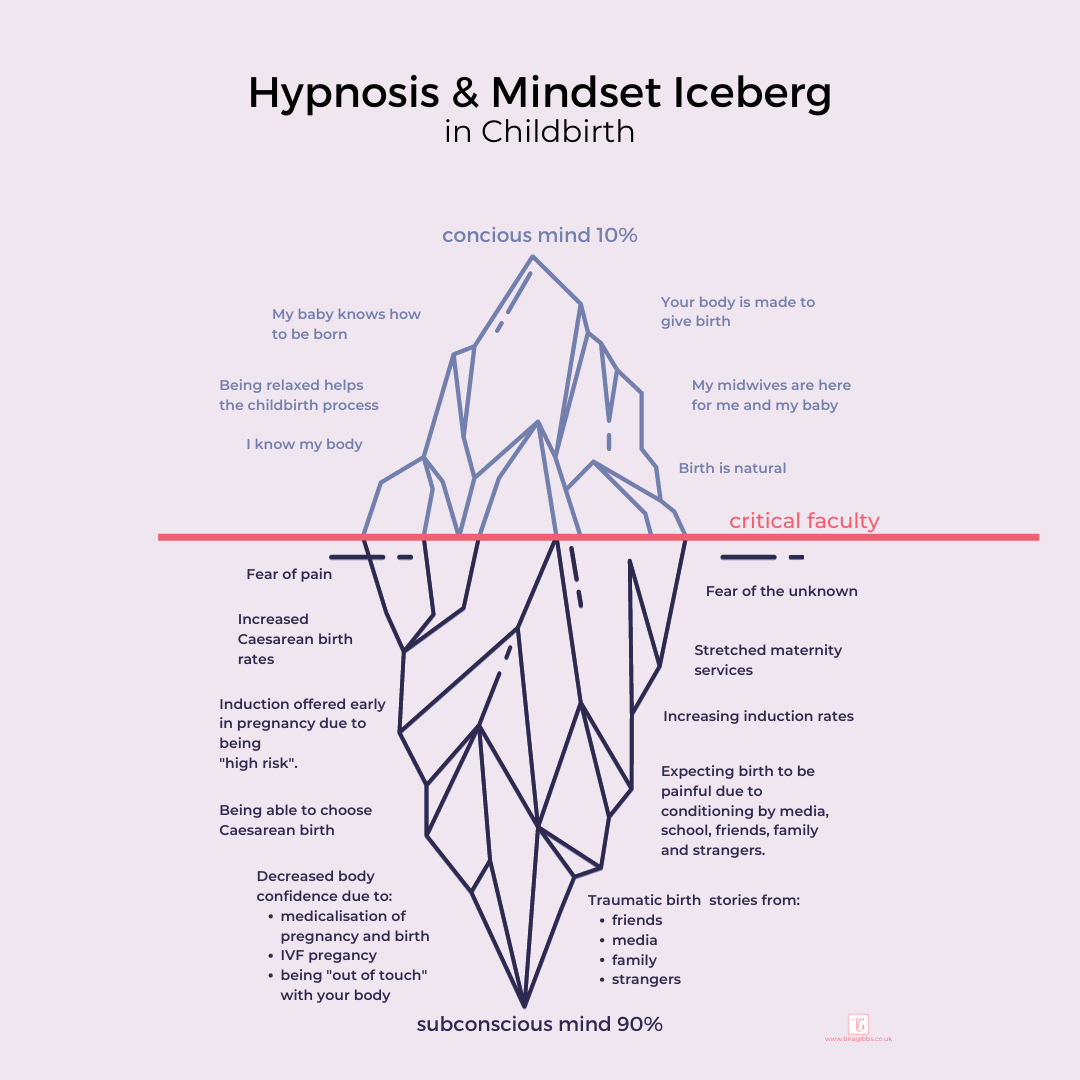
The Hypnosis and Mindset Iceberg. The conscious and subconscious mind and the critical faculty. How does that apply to childbirth?

Let’s think about that. When you look at an iceberg and you can see the tip of it, you can only see a small part of it. The majority is hiding underwater. So now how does that apply to hypnosis and your mindset for childbirth?

Consciously you know, that childbirth is a natural process and the majority of babies can be born without assistance. We know that when we relax, more oxytocin flows, which gives helps the birthing process along by giving you strong regular contraction waves. So why do so many expectant parents struggle to relax during the birth or even during their pregnancy? Because throughout our lives we hear and start to believe that childbirth is painful. The media, family or friends are telling us so. When you are pregnant tests, appointments, scans, precautions etc reinforce the believe that birth needs interference. You sometimes even hear a traumatic birth story from a stranger while waiting at the checkout!

So your conscious mind is the tip of the iceberg and your subconscious mind is the base. This is your Hypnosis and Mindset Iceberg:

Overcoming the Iceberg

When you practise self-hypnosis and mindfulness during your pregnancy, you can use these techniques to help to turn down or off your subconscious mind. It’ll help you to focus on the here and now and make the right decisions for and during your birth experience! Remember, practice and reinforcement of the techniques is the key to an empowered birth experience!

Book your 1:1 mindful hypnobirthing experience with me to learn your techniques to combat the Hypnosis and Mindset Iceberg.

Please also check out my online course! No videos, just text and images to learn in your own time. Includes hypnobirthing mp3s, scripts, workbook, handouts, infographics and much more! Lots and lots of information at your fingertips! Includes:

  • hypnobirthing mp3s
  • hypnobirthing scripts
  • written information
  • infographics and other imagery
  • printable handouts
  • printable workbook/journal

For perinatal educators:

The “Hypnosis and Mindset Iceberg” poster shows an image of an iceberg, where you can see the tip of the iceberg as well as the underwater base of the iceberg. Use it in antenatal or parenting classes to explore expectant parents’ feelings. Where they come from and how the subconscious can influence your decision-making, mindset as well as birth, feeding or parenting experience. An excellent resource for your perinatal education setting!

Hypnosis Iceberg Sources and Further Reading

All were accessed on the 24th January 2023.

Please note that I am in no affiliation with the owners of the websites above.

Posted on Leave a comment

Teaching about Waterbirth

Teaching about Waterbirth Teaching ideas for birthworkers

Teaching about Waterbirth has become one of my favourite topics in recent years. As waterbirth has many benefits and few downsides it is a popular choice among birthing families in the UK.

Teaching about waterbirth in your antenatal preparation classes:

Paperchase – benefits for mother, father, baby, midwife

Split the group into 4 groups. Each group gets one piece of flipchart paper. Four headings: mother/birthing person, father/partner, baby/babies, midwife. Each group brainstorms the benefits/advantages of waterbirth for their person. Move along to the next chart after 1 minute, fill in that chart. Keep going until each group had a minute for each chart. Share the findings in the big group afterwards. This activity takes around 10-15 minutes.

Dry run with inflatable pool

A great way to teach about waterbirth is to do a dry run with an inflatable pool. I usually have the partners set up the pool and time it how long it takes to inflate the pool, add the cover etc. Meanwhile the birthing mothers/people explore some pictures of different pool birth environments and positions in the pool. Once the pool is set up, we discuss how long it may take to fill the pool, along with some things that they may need. Every family can then try out the pool to get a feel for the size. Be careful, when trying out positions as the empty pool will tip over if someone leans over the edge. Always position yourself or someone else at the opposite end to keep the pool steady.

Brainstorm practicalities home vs hospital

This activity is suitable for big group or some smaller groups. You’ll need a piece of flipchart paper for each group. Divide each paper into two sections. Have families compare the practicalities of waterbirth at home vs the hospital or maternity unit.

Pictures – why did you pick…

I lay out a selection of photos and positions cards. Including photos of equipment families may need/choose for their waterbirth. I ask each person/family (depending on group size) to pick one picture. Then in the large group we share: Why have you chosen the picture, what can we see in the picture, how does the picture make you feel, any questions about the image…. I usually do this as an icebreaker as an information leveller…

How to you teach about waterbirth? Please share your ideas with me!

Have you seen my waterbirth video collection? You can find that here!

Posted on Leave a comment

Birth Bag – Teaching Ideas

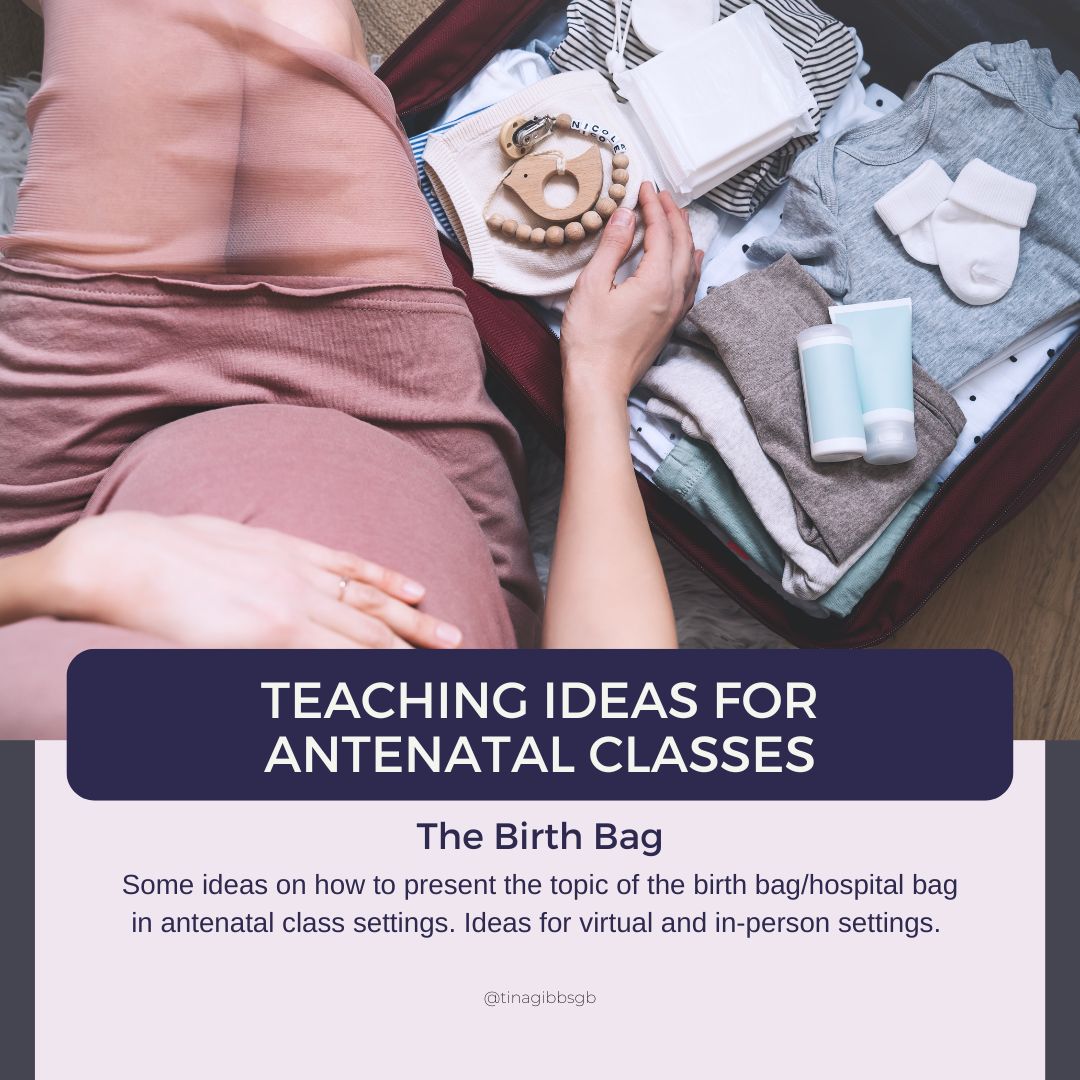
The Birth Bag – Teaching ideas for your antenatal classes. As a birth worker, doula, midwife, student midwife or perinatal educator we aim to prepare expectant parents for their birth experience. Part of their birth experience is packing their birth bag aka hospital bag.

Birth Bag – Teaching Ideas for in-person Antenatal Classes

Show and tell

Simply ask every family to bring in up to 3 items each for their birth bag to the next class. During the “show and tell” ask them to share their item and why they chose it.

Brainstorm

Split the class into similar-sized groups. If I am facilitating classes for couples, I split into two/four groups separating birthing mothers/parents from their birth partners. I ask them to write down and/or draw items they’d like to take with them for the birth. Then we have a list for birthing mothers and folks as well as a separate list for birth partners! If you prefer not to use paper and pens or would like to use this as a homework or pre-course task, you could use mentimeter (see above) instead.

Paperchase

Do a paperchase. Split the group into three groups. Have three sets of flipchart paper & pens available. I like to draw the outline of a suitcase on mine and add a header i.e. birthing mother/parent, birth partner or baby. Each group will brainstorm for their sheet for x minutes (I give them 2 minutes). Then they move on to the next one and add to it for two minutes and then move again to the last one.

Birth Bag – Teaching Ideas for Virtual Antenatal Classes

Hospital Bag / Birth bag Scavenger hunt
A good old scavenger hunt to explore possible contents of a birth bag! This not only helps your clients think about what they need and what they would like, but also gets them off their seats/butts during a virtual antenatal course! I like to include this as part of the break. Mainly to encourage clients to move… To do so I share my screen with a short list of things which may be useful for their birth experience. I ask my clients to grab a drink, snack and go to the toilet and bring as many things as possible back to the screen within 15 minutes.

You can find my very long birth bag list in one of my other blog posts. Select a few items from this list or write your own short list!

birth bag - teaching ideas

Wordsearch

To create a birth bag wordsearch is another way of creating some engagement during your online classes. I create my wordsearches on my husband’s website. I integrate my wordsearch into my powerpoint slides and ask parents-to-be to annotate the slides with their findings.

birth bag teaching ideas virtual antenatal classes
Wordsearch a teaching idea for virtual antenatal classes

We then discuss what they would add/remove from their birth bag.

Quick competition – show and tell

Similar to the scavenger hunt, I like to integrate this as part of one of my clients’ breaks. It is way too easy to just stay sat where you are while you are on an online course or workshop, so this is another teaching idea to get your clients moving and engaged in the topic!

I like to ask every couple/client/expecting family to think about what they may need during the birth of their baby or babies. Each participants gets ask to bring back 3 items to the screen. Three items per person, items which may be helpful to themselves, NOT their partner.

This is often the first time when birth partners realise, that they need to look after themselves, too and may need some comfort items.

Wordcloud

Set up a wordcloud on mentimeter and ask your clients to add their preferred items/essentials to the list. A very engaging, fun and visual way to create a birth bag/hospital bag list with your clients. It’s anonymous and fun! You can save the results as a picture or pdf afterwards and send them out as a reminder/handout.

an example of mentimeter wordcloud results

How do you facilitate the topic of birth bags during your childbirth preparation classes? Please comment with your ideas or share them in an email with me!

Posted on Leave a comment

Icebreakers for antenatal classes

Icebreakers for antenatal classes. Break the ice, bond the group. Create lifelong friendships!

Facilitating successful group antenatal and parenting classes in a group setting requires icebreakers. Icebreakers help the participants to engage in the content, get to know the facilitator and other participants as well as building a bond as a group.

I’d start off with an icebreaker which goes round the room/group fairly early on as research shows that once everyone has said one thing in the group early on they are more likely to ask questions and join in later on.

Icebreakers can be really simple, like asking a question to the group and ask each participant [to state their name] to give their response to the question/statement.

Some ideas for icebreakers/questions (choose one per activity/session/round only) for your antenatal classes:

  • One thing I already know about my/our baby…
  • My biggest question about becoming a parent/family/mother/father is…
  • As a new parent I look forward to…
  • My greatest fear about being a parent is…
  • As a new parent I do not look forward to…
  • One quality I would like my child to have is…
  • One thing I have done/changed because of having a baby is…
  • As a new parent I hope I can…
  • One thing I would like to achieve during my/our baby’s first week at home is…
  • Becoming a family/father/mother/parent means to me…
  • One person, I would like my/our baby to meet is…
  • When I need support, I can turn to…
  • One thing I’ll gain as a new parent is…
  • One thing I’ll lose as a new parent is…
  • My/our baby will sleep in…
  • When I hear the word ‘breastfeeding’ it makes me think…
  • If I had an extra hour a day when everyone still has 24hrs a day, I will do… in my extra hour.
  • When I see a mother/parent/father/person breastfeeding I feel/think…
  • When I see a mother/parent/father/person bottle feeding I feel/think…
  • When I need advice I’ll ask/go to…
  • When I think about parental leave, I feel…
  • When I think about returning to work, I feel…

Allow each participant to give their response without commenting on it. These types of icebreaker questions can be used to encourage dialogue and interest in topics that you may not have covered during the course but can also aid revision and group bonding. You can download the questions/statements above as a printable A4 sheet here.

FREE DOWNLOAD

Other ideas are

  • Goodie bag activity – have a goodie bag full of items (one item per participant or couple) i.e. birth bag items, nappy bag items, post-partum recovery items. Ask each participant/couple to pick one [random] item. When everyone has one item, go round and ask the ‘owner’ to comment on the item. What might it be used for? What is it?…
  • People bingo – each participant has a “People Bingo” Card and has to go round and talk to other participants to find people matching the statement. Statements could be: Has a red car. Doesn’t drink tea. Is left-handed…
  • Scavenger hunt – when facilitating online, I often use a scavenger hunt. I put a list of items on the screen, usually related to a topic such as the birth bag and ask participants to find as many of the listed items as they can. This activity usually creates lots of laughter and gets people moving instead of sitting in front of a screen!
  • Physical skills demo – ask each participant/couple to demonstrate a breathing techniqueposition for childbirth or a massage technique and encourage the others to join in.

Find some more icebreaker activities for your antenatal and parenting classes, including the very popular “nice to meet you” people bingo, in my shop! I have also got a fully editable PowerPoint slide set for antenatal education and one for infant feeding education available from my shop.


Sources and Further reading

  • Chlup, D. T., & Collins, T. E. (2010). Breaking the Ice: Using Ice-breakers and Re-energizers with Adult Learners. Adult Learning, 21(3–4), 34–39. https://doi.org/10.1177/104515951002100305
  • S. Gillet, K. Winkle, G. Belgiovine and I. Leite, “Ice-Breakers, Turn-Takers and Fun-Makers: Exploring Robots for Groups with Teenagers,” 2022 31st IEEE International Conference on Robot and Human Interactive Communication (RO-MAN), Napoli, Italy, 2022, pp. 1474-1481, doi: 10.1109/RO-MAN53752.2022.9900644.
  • Pearce Eiluned,Launay Jacques and Dunbar Robin I. M. 2015 The ice-breaker effect: singing mediates fast social bonding R. Soc. Open sci.2150221150221 http://doi.org/10.1098/rsos.1