Posted on Leave a comment

How to use your birth ball

How can you use your birth ball for pregnancy, childbirth and during the early postpartum?

What is it?

A birthing ball is the same as an exercise or gym ball. The name “birth or birthing ball” refers to this specific purpose. A birth ball can help rotation while the you are sitting or when standing isn’t an option and a birthing stool isn’t available.

Why should I use one?

Using a birth ball to sit on strengthens your lower back, and improves your posture as your pelvis is better supported. This can help to prevent or ease lower back pain. Sitting upright helps your abdomen be a “hammock” for your baby and encourages them to settle into a more beneficial position for the birth (anterior position). For this to be most effective, start early, best before you get pregnant!

What is the best size for me?

The best size depends on your height. Ideally, your knees should be equal or slightly lower than your hips when you sit on it.

YOUR HEIGHTBALL SIZE (CENTIMETERS)
up to 163cm55cm (or inflate 65cm ball to 55-60cm instead)
164 to 173cm65cm
Above 173cm75cm

Ensure that you purchase a good quality ball which has a no burst (anti-burst) layer and has been pressure tested to support weights up to 300kg (47st).

What are the benefits of using a birthing ball?

  • Eases back pain and improves your ability to move around and stay upright.
  • Offers counter-pressure to your perineum
  • Gives excellent support when you’re squatting (holding on to it) or sitting on it, leaning over it….
  • Reduces pressure on your spine
  • Supports you to remain in an upright position. When upright, gravity increases the efficiency of your baby’s descent – supports a straightforward birth and may reduce the length of time you are in labour
  • Stimulates blood flow to the pelvic area, which increases blood flow to your uterus and placenta
  • May improve your baby’s position in utero
  • Helps open up the pelvic muscles
  • Can reduce the discomfort from contractions and therefore reduce tension, anxieties and fears

How and when can I use it?

Sit on it with your feet flat on the ground and apart.

During your pregnancy

Use your birth ball instead of a chair when sitting, when working, watching tv etc.

To bring on labour

Sit on your ball and do circular movements with your hips. This can help get your baby’s head into your pelvis and on the cervix. If your baby is back-to-back (posterior) check out Spinning babies for some exercises!

During labour and birth

During early labour, you can continue to sit on your birth ball. It offers great support and gives a good counter pressure to your slightly uncomfortable and possibly swollen vulva. Way more comfortable and supportive than a hospital bed or chair while supporting the birthing process!

You can also

  • Use it throughout all of your labour and birth to sit on
  • Lean over your ball during any part of labour while kneeling or standing. Place your ball on the bed or a chair/surface when leaning over it while standing.
  • Sit and rock on it in gentle circular or side-to-side or back-to-front
  • Standing, put the ball behind you against a wall. Lean into it and you can use it for a gentle massage
  • Standing, put the ball in front of you against a wall, and lean into it. You can use it support when rocking and leaning over slightly
  • Hold on to it for a supported squat
During the early postpartum and forever…

Continue to sit on your birth ball for comfort and support. Your baby, like any new baby, needs to be held. They have been in your womb for 10 months and are used to being squished and squashed, and rocked by your movements and heartbeat. Siting and gently rocking or bouncing on your ball while holding your baby can help you stay comfortable and your baby to calm.

Forever, always, anytime, your birthing ball will be a great place to sit to improve your posture, reduce, prevent or eliminate lower back pain. It’s fun, too!

Download your birth ball and peanut ball handout here.

Please also check out my online course! No videos, just text and images to learn in your own time. Includes hypnobirthing mp3s, scripts, workbook, handouts, infographics and much more! Lots and lots of information at your fingertips! Includes:

  • hypnobirthing mp3s
  • hypnobirthing scripts
  • written information
  • infographics and other imagery
  • printable handouts
  • printable workbook/journal

Sources and further reading:

Posted on Leave a comment

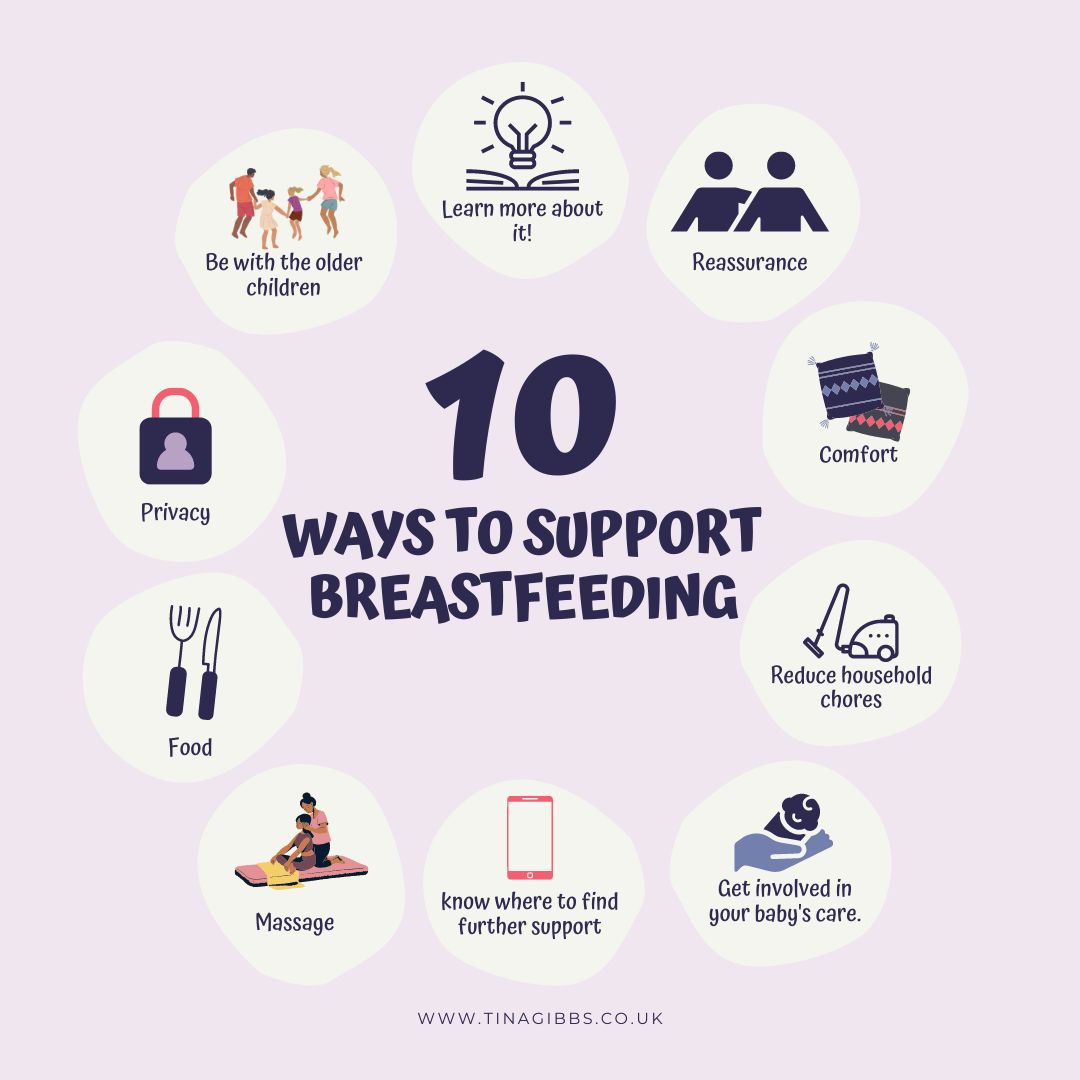
10 ways for partners to support breastfeeding

Fathers/Partners support breastfeeding

10 ways for partners to support breastfeeding. You are a new parent and your partner is breastfeeding/nursing/chestfeeding your baby or they are planning to. During antenatal classes I often get ask how partners, dads, friends and family members can support the breastfeeding/nursing/chestfeeding mother/parent.

Knowledge – Learn about breastfeeding

The first step to support someone who is nursing is to have some [basic] knowledge about how it works. Put in some time and effort to learn about the physiology of breastfeeding/nursing/chestfeeding, then you’ll be the best support your partner can hope for. An interesting and fun to read book is Kate Evan’s “Food of Love” (amazon affiliate link). For further websites and books, please see the sources and further reading section at the bottom of this page.

Reassurance

Reassuring your partner that you are there for support, encouraging words and being positive about their progress, will help your partner on their breastfeeding/nursing/chestfeeding journey. Like with every new skill a person is learning, reassurance and praise are a great help!

Comfort

Your partner may be feeding your baby for quite some time. That there is a comfortable, relaxing space for them is important. Ideally help set up a nursing nest with cushions, snacks, remote control, a book, muslin squares, a drink! (hydration is important for the milk production and flow) etc… A lot of parents chose to have a little basket that they keep nearby when they are feeding their baby.

Reduce household chores

Help and support by reducing household chores. Take on more than your usual household chores and/or get help such as a doula, cleaner, dog walker… The more your partner can focus on feeding your baby the more successful the journey will be.

Get involved in your baby’s care in other ways

Other than feeding, your baby will need a lot more than that. Get involved in their care by playing with them, reading stories, bathtime, changing nappies, taking them for a walk, cuddles…. That way your partner will be able to find some time for themselves to recharge, have a shower etc. and you can bond with your baby also.

Know where to find further support

It is important to know where you can get further support. Many places in the UK run regular breastfeeding peer support groups in-person and online. It is a good idea to find out about them while your partner is still pregnant. Encourage your partner to go along to one or more while you are waiting for your baby to be born. You can also find lots of valuable support and information on the Breastfeeding Network’s website!

Massage

Offering a massage can be really helpful to encourage milk flow and increase comfort. The hormone oxytocin lets the milk flow. Not everyone is a fan of massages but if you are, it’s a great way to support the milk flow!

Food

Feeding the breastfeeding/nursing/chestfeeding mother/parent is feeding your baby. Ensuring that there are plenty of nutritious food and some treats available is key to comfort, milk production and a rewarding feeding experience. Top tip: food that can be eaten with one hand and without cutlery is the most practical while feeding a baby. A pizza cutter, to cut any food can be helpful, as you can operate it with just one hand!

Privacy

Too many visitors in the first few weeks as a new parent can negatively influence the baby feeding experience. Help by keeping visitors to a bare minimum or inviting them for after breastfeeding/nursing/chestfeeding is established.

Other/older children

If you have older children, look after them while your baby is being fed. It can be incredibly helpful to be able to just focus on feeding your baby without having to worry about the wellbeing of the older siblings.

Posted on Leave a comment

Clothes checklist for your summer baby

Clothes checklist for your summer baby. You are having a baby this summer? Congratulations! You are wondering how many and what types of clothes and layering you might need?

When purchasing your baby clothes, make certain that they all are machine washable, non-flammable and made from soft comfortable materials. Choose clothes which open at the front or have wide/enveloped neck openings. This will make it easier for you to do frequent nappy changes!

The layette checklist below should be taken as a minimum and guide only. You may wish to have a few more spares of each item if you can afford to purchase more. Please also check out the guidance from BASIS and the Lullaby Trust.

Clothes checklist for your summer baby

  • 4 body suits/sleepsuits/babygrows
  • 4 vests (check for a wide neck opening) – you may wish to choose long-sleeved ones
  • 2 cardigans or jackets
  • 4 wide-necked cotton t-shirts or dresses
  • 4 pairs of trousers, tights, shorts or skirts
  • 1 summer hat
  • 2 pairs of socks
  • 1 baby blanket

In addition to the layette (set of clothing) your baby will also need nappies (either reusable or single-use) and you’ll want to make sure you have plenty of muslin squares! These are very handy to protect your clothing, mop up sick or clean up other bits and bobs. Muslin squares are also very handy to have as emergency nappy or breast pads 😉

I have created two handouts for you. One is a layering clothing guide and the other one is your summer baby clothes checklist!

How many layers should my baby wear at night? Click on the image to download your guide.
Summer Baby clothes checklist
How many clothes will I need for my summer baby? Click on the image to download your checklist.

Sources and Further Reading:

Posted on Leave a comment

Halloween craft activities for your newborn!

Halloween craft activities for you with your newborn! Since your newborn baby is probably a bit young for trick and treat here are some craft ideas instead!

Ghost baby footprint

Halloween crafts for/with your newborn baby

Use hand and/or footprints for Halloween crafts. This will not only provide some great fun and decoration for your home, but also become a great keepsake! You could create the same image every year to see how much your little-ones hands and feet have grown.

Top tips for hand and footprints with babies:

  • If you baby is old enough to safely sit in a highchair, have them sit in a highchair to get safe and less messy access to their feet
  • If your baby is too young to be able to sit in a highchair, either do their footprints when they are asleep or have a friend or family member helping.
  • Use water based paints and check the lable to see if they’ll wash out or might stain
  • It is easier to get a successful handprint from your baby when they are a little older. Newborn babies tend to have the hands tightly closed into a fist a lot of the time. Best bet of newborn handprints is when they are fast asleep!

Here are some images of Halloween craft activities for your newborn:

I have created a pinterest board with some more hand and footprint halloween ideas for you and your baby!

Happy Halloween!

Share your pictures with me in the comments!

Posted on Leave a comment

Bottle-feeding for breast-fed babies

love cute kids baby

Bottle-feeding for breast-fed babies

How to get my breast-fed baby to take a bottle?

To be perfectly honest, just like many things when it comes to birthing your baby and raising your children, it is a lot of trial and error. There is no one-fix or quick-fix solution. Every baby and baby-parent relationship are unique. Your journey is unique.

The following suggestions on how to introduce bottle-feeding to your breast-fed baby, come from years of experience of working with new parents.

When to start introducing a bottle to my breast-fed baby?

Depending on why you are planning on introducing a bottle and whether you wish to continue to breast-feed or mixed-feed, timing is up to you. Some parents have to stop breastfeeding before they wanted to due to medical reasons, or because they are going to be away from their baby. Others choose to stop completely or to start mixed-feeding as their personal preference. Anything is possible. There is no one best time to start as again, you, your family and circumstances are unique.

How to start introducing a bottle to my breast-fed baby?

  • Choose a day when your partner or primary support person will be available
    • Your baby may accept a bottle more easily from someone other than you / the breastfeeding mother or person. They know their milk comes from you and may not understand why it is now offered from this new object (the bottle).
  • Choose a time when your baby is settled and patient.
    • An settled baby is usually more receptive of changes and new things
  • Offer the bottle about 1 hour after a breastfeed at first. Start with a small amount of breastmilk or formula milk such as 1/2 ounce.
  • Offer the milk at the “right” temperature.
    • Breastfed babies are used to drinking their milk at a body temperature of approximately 37 degrees Celsius. They can be a little more particular about the milk temperature. Warm up refrigerated milk in a bowl of warm water, in a bottle warmer or under warm running water. Cool down freshly prepared formula milk in a bowl of cold water or under cold running water.
  • Leave the room/house
    • Sometimes it may be necessary for the breastfeeding mother or parent to leave the room or even the house, so that your baby cannot smell your milk.
  • Be patient
    • Tickle your babies upper lip with the bottle teat, letting your baby “latch on” to it like they would to your breast. If they get upset and haven’t eaten anything after 10 minutes, stop and try again later or the next day. Responsive bottle-feeding or paced bottle-feeding
  • Bond with your baby
    • Talk to them, look them in the eyes. Skin-to-skin when introducing a bottle can help, too. Skin-to-skin contact helps your baby to relax and settle, while it’s stimulating their digestion and interest in feeding.
  • The teat and bottle
    • try different teats and bottles. You may be lucky that the first one you try works for you and your baby but if it isn’t there are many more…
      • short round teats with a wide base are believed to be the encourage a similar experience and movements to breastfeeding.
      • some babies gag on longer teats, therefore, shorter teats seem preferable.
      • warm the teat with warm water before feeding
  • Positions
    • Try different positions. Preferred positions for breastfeeding are often different than those preferred for bottle-feeding. Maybe try a facing out position, so your baby can look around the room. Sometimes walking around the room while feeding can help, too.
  • Try feeding from a spoon, sippy cup, doidycup or small open cup
    • If you don’t wish to use a bottle or you’ve tried everything and it hasn’t worked out for you and your baby, you may try feeding the baby with a spoon, sippy cup, doidycup (baby/toddler training cup) or small open cup. Hold the baby in your lap in an upright, supported position. Bring the spoon or cup to the baby’s mouth and allow the baby to take the milk herself by just touching the milk in the spoon or cup to the baby’s upper lip. Let the baby set the pace. Be very careful to not dump the milk into the baby’s mouth to avoid choking.

Responsive bottle-feeding or paced bottle-feeding

For any parent who chooses to feed their baby with a bottle, responsive or paced bottle-feeding is the current recommendation by the NHS (at the time of writing this in 2022).

Recognize feeding cues. Feed your baby when they are showing signs of hunger.
Hold baby close, in a semi-upright position during feeds.
Tickle your baby’s nose with the teat to encourage them to open their mouth wide. Keep the bottle in a horizontal position.
Watch your baby and follow the cues for when they need a break.
Your baby will know how much milk they need. Follow their lead.
Responsive Bottle-feeding or paced bottle-feeding
Responsive Bottle-feeding or paced bottle-feeding – a visual guide

Here is a video on paced bottle feeding:

Sources, References and Further Reading

DiSantis KI, Hodges EA, Johnson SL, Fisher JO. (2011) The role of responsive feeding in overweight during infancy and toddlerhood: a systematic review. International Journal of Obesity. 35:480-492.

https://www.nature.com/articles/ijo20113

First Steps Nutrition Trust

https://www.firststepsnutrition.org/parents-carers

https://www.firststepsnutrition.org/infant-milks-overview

Posted on Leave a comment

Recovery after Caesarean Birth

You are planning or have had a Caesarean birth? What to expect for your recovery after Caesarean Birth.

Emotionally
How you will feel after a caesarean birth depends on what your expectations on the birth of your baby were as well as on what happened before and during the birth.

The caesarean rate in England is close to 25% (Birth Choice UK, 2011), therefore there is always a chance you may have a caesarean birth. You may feel happy that your baby is finally born but you may feel disappointed that you had a caesarean birth if a vaginal birth is what you were hoping for. If possible, prior to giving birth, try to accept all possibilities for your birth. Births very rarely go exactly as you plan them. Attending an antenatal course will help you to find out more about different options help to prepare you for possible birth outcomes.

Talking over your caesarean birth with a health professional, soon after may help your emotional recovery. You should get a chance to talk to your midwife or obstetrician before you leave the hospital.

If you do not get the chance to talk to any health professional prior to leaving the hospital arrange an appointment as soon as possible. You may then be able to discuss how the caesarean may affect future pregnancies.

Physically
The physical recovery after caesarean birth usually takes about 6 weeks. You will not be insured  to drive a car for 6 weeks after your caesarean. However, if you do feel ready to drive, talk to your insurance company, they may insure you if your GP has signed you off. A caesarean is a major operation and you will experience some pain and discomfort. Even when laughing, coughing or other small movements will make your scar hurt. Supporting your wound with your hands or a pillow will help.

Tips to aid your recovery and ease discomfort

  • Drink plenty and eat and drink as soon as you feel hungry or thirsty. Eat foods that are high on fibre to help prevent constipation.
  • Keep your wound clean by washing and drying it daily. You can use a freshly washed flannel to clean your wound. If you do use soap make sure you rinse the wound thoroughly. To dry, pad rather than rub the wound with a clean towel. Change your towel and flannel daily.
  • Go to the loo hourly to reduce pressure from your bladder on scar.
  • Wear loose clothes and soft cotton underwear. Your knickers should be one or two sizes bigger or wear a pair of your partner’s  There are special knickers which fit over your scar.
  • Tell your midwife if you notice any signs of infection of the scar, e.g. redness, extra soreness or discharge. Also tell your midwife if you are having a temperature.

You will be encouraged to start exercising gently the day after your operation to help speed up your recovery. You may be able to see a physiotherapist but should at least be given a leaflet by your midwife. Take it slowly and do not start any more strenuous exercise until at least 10 weeks after the operation.

Pain relief
There will be pain relief available in hospital and your doctor will give you something to take at home, too. Depending on how much pain you are in, the options may vary. Most pain killers are safe to take when breastfeeding. Please discuss your options with your midwife, obstetrician or other health professional.

Scar – if you would like to know what your scar will / should look like please visit the Caesarean Birth and VBAC Information. In the menu on the left hand side there is a link to Caesarean scar pictures. Caesarean Birth and VBAC Information has a wealth of information on Caesarean Birth, recovery as well as VBAC (vaginal birth after caesarean).

Breastfeeding
You can start breastfeeding straight after the caesarean. Additional skin-to-skin as well as extra support may help. Because of the wound, breastfeeding can be more challenging during the early days. Please ask for help when needed. Most pain relief is safe to use when breastfeeding. Please mention that you are breastfeeding to your health professional.

Future pregnancies
If you have your baby by Caesarean it does not necessarily mean that you will have to have your subsequent babies by Caesarean. You can discuss future pregnancies with your GP and  whether or not you will have another Caesarean will depend on

  • risks and benefits of caesarean for you and your baby
  • your personal preferences and priorities

However, if the reason for your first caesarean was a condition that will not change for future pregnancies e.g. shape of your pelvis / birth canal, it is very likely that a caesarean will be necessary for all births.

Online course including Caesarean Info

Please also check out my online course! No videos, just text and images to learn in your own time. Includes hypnobirthing mp3s, scripts, workbook, handouts, infographics and much more! Lots and lots of information at your fingertips! Includes:

  • hypnobirthing mp3s
  • hypnobirthing scripts
  • written information
  • infographics and other imagery
  • printable handouts
  • printable workbook/journal

Further information

Posted on Leave a comment

Clothes checklist for your winter baby

Clothes checklist for your winter baby. You are having a baby this winter? Congratulations! You are wondering how many and what types of clothes and layering you might need?

When purchasing your baby clothes, make certain that they all are machine washable, non-flammable and made from soft comfortable materials. Choose clothes which open at the front or have wide/enveloped neck openings.

The layette checklist below should be taken as a minimum and guide only. A winter baby will need a few more items compared to a summer baby. You may wish to have a few more spares of each item if you can afford to purchase more.

Clothes checklist for your winter baby

  • 4 body suits/sleepsuits/babygrows
  • 4 vests (check for a wide neck opening) – you may wish to choose long-sleeved ones
  • 4 cardigans or jackets
  • 1 hat
  • 2 pairs of socks
  • 2 pairs of mittens (many babygrows now have integrated mittens, so you may not need to purchase any).
  • 1 baby blanket
  • 1 baby snowsuit/pramsuit (optional)
  • 1 baby sleeping bag (optional)

In addition to the layette (set of clothing) your baby will also need nappies (either reusable or single-use) and you’ll want to make sure you have plenty of muslin squares! These are very handy to protect your clothing, mop up sick or clean up other bits and bobs. Muslin squares are also very handy to have as emergency nappy or breast pads 😉

I have created two handouts for you. One is a layering clothing guide and the other one is your winter baby clothes checklist!

how many layers sh
How many layers should my baby wear at night? Click the image to download your pdf handout.
Clothes checklist for your winter baby. Click on image to download your pdf handout.

Posted on Leave a comment

Pregnancy and new baby timeline – What to expect

pregnancy and new baby timeline

You are pregnant! Congratulations! Now you are wondering about the pregnancy and new baby timeline and what to expect before and after the birth of your new baby? Here is a rough guide of what to expect during your pregnancy, on the day of the birth of your baby and in the early few weeks as a new parent! This is a guide for expectant and new parents living, birthing and parenting in the UK.

During pregnancy
  • Start Pelvic Floor Exercises – here is a guide from the NHS on how to do your pelvic floor and other exercises during pregnancy!
  • Antenatal appointments with your midwife and consultant (where applicable) – here is an explanation on the NHS website.
  • Antenatal tests and scans
  • Health Visitor and/or Midwife visits your home
  • Book and attend your childbirth preparation courses (optional), such as hypnobirthing.
  • Look into hiring a birth and/or postnatal doula
  • Research and learn about your childbirth options and rights – Birthrights is a great place to find out more about your rights in childbirth
Day one – the day your baby is born
  • APGAR score for baby
  • Vitamin K offered to be given to your baby/babies
  • Midwife or a member of the paediatric team check your baby over before you’ll leave the hospital or midwife-led unit.
  • Newborn hearing screening – before you leave the hospital or within the first few weeks
  • Mum and baby/babies can leave the hospital. After a straightforward birth and with healthy mum and baby/babies they can leave the hospital on the same day. After a Caesarean Birth, you can usually leave 2 days after giving birth.
  • You’ll receive the red book for your baby’s growth charts and vaccination schedule etc. – some areas also offer an online red book.
Once at home – please note that the timescale varies in different parts of the UK
  • Mother and baby/babies will get midwife home visits for checks on day 1, 3 and 5. More often if necessary.
  • Mother on emotional high: days 1-3
  • Baby might develop jaundice: 2-3 days. Usually clears by week 2.
  • Milk comes in, days 3-5
  • Baby blues, days 3-5
  • Newborn blood spot test, day 5
  • Umbilical cord stump falls off, day 7
  • Lochia (postpartum blood loss) stops, 2-6 weeks
  • Discharged from midwifery care, between 10-28 days
  • Mother and baby postnatal check by GP: 6-8 weeks
  • Resume light exercise and sex: from after GP postnatal check, from 6-8 weeks

The dates are a rough guide and average only. This list does not give or replace medical advice. If you are concerned about yourself, your partner or your baby, please see your health care professional for help.

References and further reading:
Posted on Leave a comment

Keeping your baby cool in hot weather

Keeping your baby cool in hot weather

With the summer approaching, I would like to share some top tips on keeping your baby cool in hot weather. Keeping your baby cool in the hot weather is not the only thing to look out for, it is also important to keep them safe at the same time.

Sleeping/Bedtime/Naps in hot weather

  • Give them a cool bath before bedtime.
  • To keep your baby’s bedroom cool, keep windows, curtains or blinds closed during the day.
  • You may wish to use a fan to circulate the air in the room.  If you have a fan, a bottle of frozen water or bowl of ice in front of it cools the air as it moves.
  • Your baby will sleep most comfortably when the room is between 16C and 20C. You may wish to monitor the temperature with a room thermometer. Sometimes it is not possible to get the room to a comfortable temperature. When that is the case, think about letting your baby sleep in just a nappy.
  • Keep nightwear and bedclothes to a minimum. Maybe let them sleep in just a nappy on very hot days. For safer sleep recommendations for babies, please see the Lullaby Trust website.  

Travelling/Out and about/Outdoor play in hot weather

  • Keep your buggy, pram, car seat etc uncovered to allow the air to flow. Use a parasol or similar to provide shade instead. The temperature inside a covered buggy (or similar) rises very quickly and can become very dangerous, very quickly!
  • When travelling long distances in the car, allow for extra breaks and take your baby out of their car seat!
  • Babies under 6 months should be kept in the shade, or should wear a sun hat to keep them cool. Factor 50 or higher sun cream is recommended for babies over the age of 6 months.
  • For toddlers and older children, playing in a paddling pool is a good way of keeping cool. Find a place in the shade or create some shade for the pool during very hot weather and supervise children at all times. 

Hydration & Feeding

  • 0-6 months:
    • Fully breastfed babies do not need any water. They may feed more frequently on hot days to up their fluid intake.
    • If you’re bottle feeding, you can give your baby a little cooled boiled water in addition to their usual milk feeds.
  • from 6 months:
    • Offer your baby sips of water from a cup or beaker with their meals, once you have started to introduce solid foods. Their breastmilk or infant formula is still their main drink during the first year. When it is really hot, you may need to offer some additional water outside of mealtimes.
  • from 12 months:
    • Your baby’s main drinks should be water, breastmilk or whole (full fat) cows’ milk or plant-based milk. On really hot days, you can try giving them frozen lollies made from plain water or from very diluted fruit juice to help keep them hydrated. Any lollies containing fruit juice or other sources of sugar, can cause tooth decay and should be kept to a minimum and given at mealtimes.

Have a look at the Lullaby Trust’s video below, if you prefer visual information!

Further reading and references:

Posted on Leave a comment

Waterbirth at home

waterbirth at home

You are pregnant and are planning a waterbirth at home? You are not quite sure how to sell the idea to your partner? Read this! Here is a ‘guide on how to persuade your partner to have a waterbirth at home 😉

My husband wrote about the birth of our second baby for one of the NCT (national childbirth trust) newsletters back in 2011. He wanted to write the story from the mother’s point of view, so he did.

Persuading the Hubby – Part 2 ‘Waterbirth in the kitchen’.

If you were lucky enough to delve between the covers of the last [blog post], you may remember the challenge I set myself persuading a sceptical Mr Hubby of the values of re-usable nappies.  Persuading the hubby can sometimes be like riding a bike uphill in a stiff wind, but just like the equally stiff wind encountered so often at changing time, it can all be overcome with a deep breath and a firm mind set to the task!  By comparison to the reusable nappies issue however, my next challenge was a veritable Tour de France in the uphill cycling stakes! 

The idea quite literally surfaced as we were swimming in the local pool.  It was towards the end of my second pregnancy and I was floating around in the water experiencing the sheer bliss that only a pregnant mother can feel as the weight of 8 months hard pregnancy was lifted off my feet.  Mr Hubby was throwing our youngest in the air and they were splashing around wildly filling the air with giggles.  My youngest was two years old now and he’d clearly come such a long way since his traumatic hospital-induced birth 24 months earlier.  It suddenly struck me how relaxed I felt, in the water with my family around me and I made the decision right there and then, that I was going to transfer that feeling of tranquillity to my next birth experience!  “I’m going to have a waterbirth in the kitchen!” I exclaimed!  My sudden outburst caught poor Mr Hubby completely unawares and he just stood there mid-throw in stunned bewilderment as our little bundle of joy spiralled through the air and hit the water with a resounding splosh!  Without the “1-2-3 breathe” that they’d been practicing at baby-swimming, the little mite came up coughing and spluttering, and despite him being quite ok, a pool life guard had already blown his whistle and a number of youthful pool attendants were diving athletically into the pool!  By the time we’d towelled off, and thanked the life guards for their diligence, and meekly smiled at the other swimmers who were looking at us as if we were completely incompetent parents, Mr Hubby finally pulled himself together and managed to reel off an immeasurably long list of reasons why he thought the whole ‘waterbirth in the kitchen’ concept was a terrible idea!  “Surely giving birth at home would create a right mess all over the place?”, “What if I was in labour at home and something went wrong?”, “Where on earth would we get a pool?”,  “Was I seriously thinking of the kitchen?”, “What if I got in to the pool and a wave of water went all over the place?”, “Was I going to cope without pain relief?”, “Was it going to be massively expensive?”, and finally “Could we do it on the cheap using little ones paddling pool and filling it with our leaky garden hose?!”.

Well, I’m all for trying to win my man round with a bit of frugalism, but after a stint of research on Google and the NHS Choices website it soon became apparent that the paddling pool and garden hose idea wasn’t going to fly.  Home birthing pools needed to be sterile, deep enough to immerse your body and strong enough to hold your weight as you hang over the side gasping for breath after an endless contraction.  Luckily though, I did find some options to save forking out gazillions of pounds on a birth pool.  First there was the hiring option – with pools available from around £80 for 5 weeks, but in the end I got a second hand one of ebay, complete with sterile hose for just £24.  All I needed then was a new pool liner for £25 and my set up was complete!  Now all this did come to around £50 in total, but as I pointed out to mr hubby (when the postman came to the door with an inflatable birthing pool under his arm), the hospital parking at the last birth came to over £30 anyway and this time round we would have need a baby sitter for our little tike as well, so I reckon we made a saving!

Mr Hubbys other concerns over the dangers of home birth were addressed by a couple of interesting encounters.  The first was with a very kindly midwife who visited us at home and reminded us that giving birth was a completely natural process and that we just had to trust my body.  In addition she promised to bring round plenty of gas-and-air and furthermore said that if we gave birth at home it would really help her meet her home-birth targets.  She seemed so nice that we could hardly say no, and the idea was sealed later that day with the second interesting encounter which was a chance conversation over the fence with the elderly lady who lives next door, who told Mr Hubby that in her day there was no such thing as a hospital and that kitchen births were quite the norm.  After an hour of listening through the fence to stories about birth in times gone-by, Mr Hubby was quite dazed and in no capacity to argue about the issue any further.

Despite my immaculate preparation, the one thing I did forget, and I would strongly advise against forgetting, was a decent pump.  My labour started a few days before my due date, and as Mr Hubby will tell you, home birthing pools are very, very, large.  Very large.  With his small bike pump, he needed a good hour of frantic pumping to get the thing inflated, and halfway through when he was at his lowest ebb and his right arm really was very nearly dropping off, two very stern midwives arrived just in time to whip him back into action.  Eventually he crossed the finish line and I stepped in to the warm soothing waters, and all my cares drifted away.  Mr hubby was clearly exhausted and looked rather like he’d been in labour himself, but before he’d had time to even catch his breath one of the stern midwives spun on her heels and told him in no short order that his next task was to keep the temperature of the pool within a degree of 36 Celsius and given that it was already down to 34, he’d better get cracking! At this point Mr Hubby was required to race back and forwards across the kitchen carrying saucepan-fulls of water from the pool and topping it up with hot water from the tap.  Back and forwards he went at ten to the dozen for a good three hours, spurred on by the hawkish glare of the midwives, which provided me with excellent entertainment during contractions.  In fact, it occurred to me that the whole situation was rather like a modern-day equivalent of “Why don’t you go and get some warm towels ready” and it kept him nicely occupied for the duration of the labour.

Before I really knew it my second child was born. My contractions were eased by the warm water, my tender regions were softened and I avoided the dreaded stitches. It was such a soothing entry to the world I will never forget the experience.  And neither will Mr Hubby, for his pumping arm has never been the same to this day!

If you are toying with the idea of a waterbirth at home or in the hospital but are not sure where to start, please get in touch and we can arrange a 1:1 birth planning session or waterbirth/homebirth workshop! I also offer other 1:1 and group antenatal workshops!