Posted on Leave a comment

Starting Solids: The Benefits of Using a Meal Planner and Food Diary for Weaning

Weaning food diary

Introducing solids is one of the most exciting milestones in your baby’s first year. It’s a time filled with curiosity, mess, and a whole new world of tastes and textures. However, it can also be a bit overwhelming. With so many questions—What should I feed my baby? How much should they eat? Are they getting a balanced diet?—it’s easy to feel uncertain. This is where a meal planner and food diary can become your best allies in the weaning journey.

Why Consider a Meal Planner?

1. Ensures Variety and Balanced Nutrition A meal planner helps you ensure that your baby is receiving a variety of foods, which is essential for balanced nutrition. Babies need a mix of fruits, vegetables, proteins, and grains to develop healthily. By planning meals in advance, you can make sure your baby gets a good mix of nutrients each week, and you can avoid repetitive meals that might limit their exposure to different foods.

2. Saves Time and Reduces Stress Planning meals ahead of time can significantly reduce the daily stress of deciding what to feed your baby. With a meal planner, you’ll know exactly what you’re preparing each day, which can save you time and make shopping easier. It’s also a great way to ensure you’re always prepared, even on those busy days when things don’t go to plan.

3. Helps Identify Allergies and Preferences Introducing solids is also the time when potential allergies might become apparent. By planning and documenting what foods are introduced and when, you can more easily identify if any particular food causes a reaction. A meal planner also helps you track your baby’s preferences, so you can see which foods they enjoy and which might need a bit more time.

The Advantages of a Weaning Food Diary

1. Tracks Your Baby’s Progress A food diary is an excellent tool for tracking your baby’s weaning journey. It allows you to document what they’ve eaten, how much they’ve eaten, and their reactions to different foods. Over time, this record will give you a clear picture of your baby’s likes, dislikes, and overall progress with solid foods.

2. Supports Healthy Eating Habits Recording your baby’s meals can help you establish healthy eating patterns from the start. You can monitor portion sizes and ensure your baby is getting regular meals and snacks throughout the day. This consistency is key to developing a healthy relationship with food as they grow.

3. Useful for Health Appointments Bringing a food diary to health visitor appointments can be incredibly helpful. It provides a clear record of what your baby has been eating, which can be useful if you have any concerns about their nutrition, growth, or any possible food intolerances. Health professionals can offer tailored advice based on the detailed information you provide.

4. Reflects on Your Weaning Journey A food diary is not just practical—it can also be a lovely keepsake. Looking back on those first foods, the messy meals, and the milestones like the first time they fed themselves can bring back fond memories. It’s a personal record of an important phase in your baby’s life.

How to Get Started

1. Find the Right Tools There are many meal planners and food diary templates available online, or you can create your own. Some parents prefer paper-based diaries, while others use apps for convenience. Choose what works best for you and your lifestyle.

2. Keep it Simple You don’t need to plan elaborate meals or write detailed diary entries. Simple notes about what your baby ate, how much they ate, and any reactions or preferences are enough to start with. The key is consistency.

3. Make it a Routine Incorporate meal planning and food diary updates into your weekly routine. Set aside a time that works for you—perhaps on a Sunday evening—to plan the week’s meals and review your baby’s progress.

4. Be Flexible Babies are unpredictable, and your plans might not always go as intended. It’s important to remain flexible and adapt as needed. If your baby doesn’t like a food one week, don’t worry—try again later. The goal is to make the weaning process as smooth and enjoyable as possible.

Download my weaning food diary here.

food diary meal planner starting solids baby weaning

Final Thoughts

Starting solids is a big step for your baby, and using a meal planner and food diary can make the journey more manageable and enjoyable for both of you. These tools provide structure, reduce stress, and ensure your baby gets the balanced diet they need to grow and thrive. Plus, they offer a wonderful way to track and cherish these precious firsts.

So why not give it a try? With a little planning and documentation, you can navigate the weaning journey with confidence and peace of mind.

Posted on Leave a comment

Nurturing Adventurous Palates: A Guide to Avoiding Fussy Eating During Weaning

Avoiding Fussy Eating During Weaning


Avoiding Fussy Eating During Weaning. Embarking on the journey of introducing solids to your baby is an exciting milestone, but it can also be a challenging one, especially if you’re concerned about the possibility of raising a fussy eater. The good news is that with a thoughtful approach and some key strategies, you can lay the foundation for a lifetime of healthy eating habits. In this blog post, we’ll explore tips and advice on how to avoid creating a fussy eater during the weaning process, drawing insights from reputable sources such as the First Steps Nutrition Trust and NHS UK.

  1. Early Exposure to Variety

Research consistently shows that early exposure to a variety of flavours can positively impact a child’s acceptance of different foods. The First Steps Nutrition Trust emphasizes the importance of introducing a wide range of tastes, textures, and food groups during the weaning period.

  1. Consistent Routine

Establishing a consistent routine for meals and snacks can help create a sense of predictability for your baby. According to NHS UK, having regular mealtimes promotes a structured approach to eating. Avoiding distractions, such as television or electronic devices, during meals can also contribute to a positive eating environment.

  1. Lead by Example

Children often mimic the eating behaviors of those around them. Set a positive example by enjoying a diverse and balanced diet yourself. Eat while your baby/toddler eats. Let them see you eat. Family meals can be a great opportunity to showcase a variety of foods and make eating a social, enjoyable experience.

  1. Patience and Persistence

It’s normal for babies to initially reject some foods. First Steps Nutrition Trust advises parents to be patient and persistent, offering the same food multiple times in different ways. Repetition is key, and research indicates that it can take up to 15 tries for a baby to accept a new food.

  1. Avoiding Pressure and Power Struggles

Pressuring a child to eat or using food as a reward can contribute to fussy eating habits. NHS UK recommends avoiding power struggles and letting your baby decide how much to eat. Trust their appetite and respect their signals of fullness.

  1. Gradual Texture Progression

Introduce textures gradually, moving from soft finger foods (baton shapes are best at 6 months of age) to gradually harder finger foods and smaller pieces. This progression helps develop oral motor skills and encourages exploration. First Steps Nutrition Trust emphasizes the importance of incorporating a variety of textures to enhance sensory experiences.

  1. Be Mindful of Portion Sizes

Understanding appropriate portion sizes for your baby’s age and developmental stage is crucial. NHS UK provides guidelines on portion sizes for different age groups, helping you ensure that your baby receives the right amount of nutrients without overwhelming them.

Remember, your baby’s main nutrition still comes from their milk (breastmilk or formula or a combination).

While introducing solid foods is an exciting milestone, it is important to remember that their primary source of nutrition will still come from breastmilk or formula. These provide essential vitamins, minerals, and antibodies (breastmilk only) that support your baby’s growth and development.

Breastmilk is often referred to as “liquid gold” for its numerous benefits. It not only provides the perfect balance of nutrients for your baby, but it also contains antibodies that help fight off infections and boost their immune system. Breastfeeding also promotes a strong bond between you and your baby.

Alternatively, if you are using formula, rest assured that it is designed to meet your baby’s nutritional needs. Formula provides the necessary nutrients for their growth and development, and it is an excellent substitute for breastmilk if you are unable to breastfeed or choose not to.

It is important to remember that solid foods from the age of six months should complement, not replace, their milk intake.

Your baby will adjust their milk intake automatically as they start eating more solid foods.

By incorporating these tips and strategies into your weaning journey, you can set the stage for a positive relationship between your child and food. These can help with avoiding fussy eating during weaning. Remember that every baby is unique, and it’s essential to be flexible and responsive to their cues. Drawing on the advice from trusted sources like the First Steps Nutrition Trust and NHS UK can provide valuable guidance as you navigate the exciting and sometimes challenging world of introducing solids to your little one.

Posted on Leave a comment

Baby-Led Weaning explained

Starting Solids (Weaning) Workshop, Nottinghamshire

As you may know, I am running private starting solids sessions (weaning) in Scarrington, Nottinghamshire. The starting solids (weaning) workshop explores different ways you can wean your baby including baby-led weaning.

What is baby-led weaning?

Baby-led weaning, also known as BLW, is a method of introducing solid foods to your baby. BLW allows your baby to be in control of their eating experience from the very beginning. Instead of relying solely on purees and spoon-feeding, BLW encourages your baby to self-feed and explore a wide variety of age-appropriate foods, tastes and textures.

The concept behind baby-led weaning is quite simple yet revolutionary. It promotes the idea that babies are capable of feeding themselves and have an innate ability to know how much and what they need to eat. With BLW, there’s no need to spend countless hours pureeing fruits and vegetables or worrying about the perfect consistency of mashed food. Instead, parents can offer their little ones soft, easily graspable finger foods that they can explore, touch, and taste on their own.

By adopting baby-led weaning, parents can increase a positive relationship with food for their children right from the start. It allows babies to develop their motor skills by practicing the pinching and grasping movements needed to pick up food. It also encourages them to explore different textures, tastes, and smells, which can help expand their palate and reduce picky eating habits later in life.

One of the many benefits of baby-led weaning is that it promotes self-regulation and helps babies develop a sense of satisfaction. Since they are in control of how much they eat, they can learn to recognize their own hunger and fullness cues, leading to a healthier relationship with food as they grow older.

It is important to note that baby-led weaning does not mean entirely abandoning purees or spoon-feeding. It can be a complementary approach, with babies being offered a combination of finger foods and purees as they navigate their journey to solid foods. The key is to offer a wide range of nutritious foods, while also embracing the mess and allowing babies to explore and enjoy their meals at their own pace.

In summary, BLW is a method that empowers babies to take an active role in their eating experience. It promotes independence, motor skill development, and a positive relationship with food. Whether you choose to embrace it fully or incorporate elements of it alongside traditional feeding methods, baby-led weaning can be a wonderful way to introduce solids to your little one.

Starting Solids (Weaning) Workshop, Nottinghamshire. Baby-led weaning, Puree weaning

Sources and further reading:

  • Brown, A., Jones, S.W. and Rowan, H., 2017. Baby-led weaning: the evidence to date. Current nutrition reports6, pp.148-156.
  • Cameron, S.L., Heath, A.L.M. and Taylor, R.W., 2012. How feasible is baby-led weaning as an approach to infant feeding? A review of the evidence. Nutrients4(11), pp.1575-1609.
  • D’Auria, E., Bergamini, M., Staiano, A., Banderali, G., Pendezza, E., Penagini, F., Zuccotti, G.V. and Peroni, D.G., 2018. Baby-led weaning: what a systematic review of the literature adds on. Italian journal of pediatrics44(1), pp.1-11.
  • First Steps Nutrition Trust: https://www.firststepsnutrition.org/eating-well-infants-new-mums
Posted on Leave a comment

Bottle-feeding for breast-fed babies

love cute kids baby

Bottle-feeding for breast-fed babies

How to get my breast-fed baby to take a bottle?

To be perfectly honest, just like many things when it comes to birthing your baby and raising your children, it is a lot of trial and error. There is no one-fix or quick-fix solution. Every baby and baby-parent relationship are unique. Your journey is unique.

The following suggestions on how to introduce bottle-feeding to your breast-fed baby, come from years of experience of working with new parents.

When to start introducing a bottle to my breast-fed baby?

Depending on why you are planning on introducing a bottle and whether you wish to continue to breast-feed or mixed-feed, timing is up to you. Some parents have to stop breastfeeding before they wanted to due to medical reasons, or because they are going to be away from their baby. Others choose to stop completely or to start mixed-feeding as their personal preference. Anything is possible. There is no one best time to start as again, you, your family and circumstances are unique.

How to start introducing a bottle to my breast-fed baby?

  • Choose a day when your partner or primary support person will be available
    • Your baby may accept a bottle more easily from someone other than you / the breastfeeding mother or person. They know their milk comes from you and may not understand why it is now offered from this new object (the bottle).
  • Choose a time when your baby is settled and patient.
    • An settled baby is usually more receptive of changes and new things
  • Offer the bottle about 1 hour after a breastfeed at first. Start with a small amount of breastmilk or formula milk such as 1/2 ounce.
  • Offer the milk at the “right” temperature.
    • Breastfed babies are used to drinking their milk at a body temperature of approximately 37 degrees Celsius. They can be a little more particular about the milk temperature. Warm up refrigerated milk in a bowl of warm water, in a bottle warmer or under warm running water. Cool down freshly prepared formula milk in a bowl of cold water or under cold running water.
  • Leave the room/house
    • Sometimes it may be necessary for the breastfeeding mother or parent to leave the room or even the house, so that your baby cannot smell your milk.
  • Be patient
    • Tickle your babies upper lip with the bottle teat, letting your baby “latch on” to it like they would to your breast. If they get upset and haven’t eaten anything after 10 minutes, stop and try again later or the next day. Responsive bottle-feeding or paced bottle-feeding
  • Bond with your baby
    • Talk to them, look them in the eyes. Skin-to-skin when introducing a bottle can help, too. Skin-to-skin contact helps your baby to relax and settle, while it’s stimulating their digestion and interest in feeding.
  • The teat and bottle
    • try different teats and bottles. You may be lucky that the first one you try works for you and your baby but if it isn’t there are many more…
      • short round teats with a wide base are believed to be the encourage a similar experience and movements to breastfeeding.
      • some babies gag on longer teats, therefore, shorter teats seem preferable.
      • warm the teat with warm water before feeding
  • Positions
    • Try different positions. Preferred positions for breastfeeding are often different than those preferred for bottle-feeding. Maybe try a facing out position, so your baby can look around the room. Sometimes walking around the room while feeding can help, too.
  • Try feeding from a spoon, sippy cup, doidycup or small open cup
    • If you don’t wish to use a bottle or you’ve tried everything and it hasn’t worked out for you and your baby, you may try feeding the baby with a spoon, sippy cup, doidycup (baby/toddler training cup) or small open cup. Hold the baby in your lap in an upright, supported position. Bring the spoon or cup to the baby’s mouth and allow the baby to take the milk herself by just touching the milk in the spoon or cup to the baby’s upper lip. Let the baby set the pace. Be very careful to not dump the milk into the baby’s mouth to avoid choking.

Responsive bottle-feeding or paced bottle-feeding

For any parent who chooses to feed their baby with a bottle, responsive or paced bottle-feeding is the current recommendation by the NHS (at the time of writing this in 2022).

Recognize feeding cues. Feed your baby when they are showing signs of hunger.
Hold baby close, in a semi-upright position during feeds.
Tickle your baby’s nose with the teat to encourage them to open their mouth wide. Keep the bottle in a horizontal position.
Watch your baby and follow the cues for when they need a break.
Your baby will know how much milk they need. Follow their lead.
Responsive Bottle-feeding or paced bottle-feeding
Responsive Bottle-feeding or paced bottle-feeding – a visual guide

Here is a video on paced bottle feeding:

Sources, References and Further Reading

DiSantis KI, Hodges EA, Johnson SL, Fisher JO. (2011) The role of responsive feeding in overweight during infancy and toddlerhood: a systematic review. International Journal of Obesity. 35:480-492.

https://www.nature.com/articles/ijo20113

First Steps Nutrition Trust

https://www.firststepsnutrition.org/parents-carers

https://www.firststepsnutrition.org/infant-milks-overview

Posted on

Baby Weaning – signs of readiness

starting solids baby weaning

Baby Weaning or starting solid foods with your baby. How do you know when, how and where to start? Where can we find some tried and tested recipes? Are we exploring baby-led-weaning (BLW) or are we starting our baby on purees first? So many questions new parents have with regards of weaning their baby.

The current recommendation (at the time of writing) is to start weaning your baby around 6 months of age.

Baby Weaning – Signs of readiness

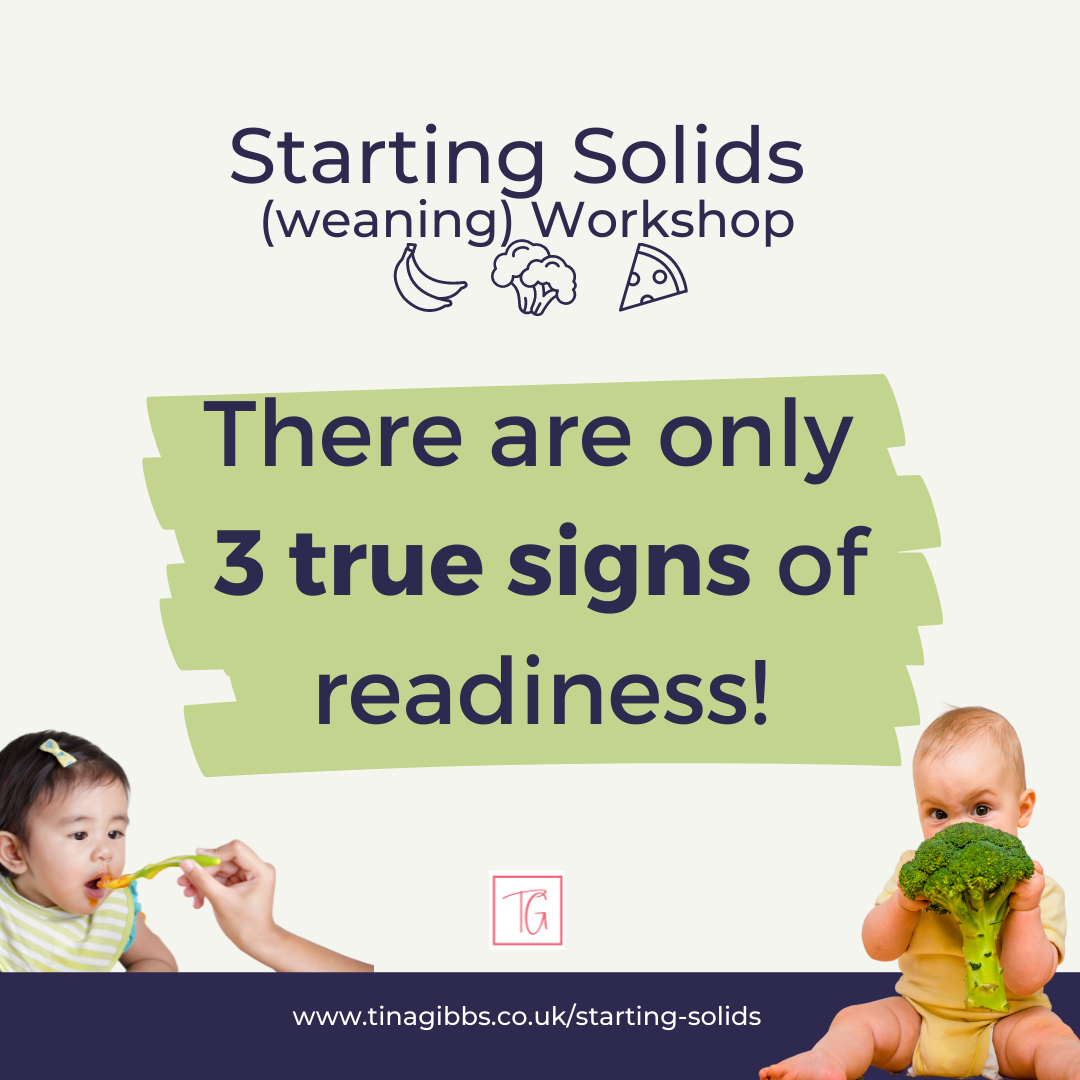
There are (only) three true signs of readiness

Your baby…

  1. can sit up unaided and hold their head steady.
  2. puts things to their mouth accurately
  3. has lost their tongue thrust reflex and can swallow

The golden rules – How to start

When introducing solid foods to your baby and during their first year of life follow these golden rules:

  • Offer simple and unprocessed foods – Make the main part of the meal of simple and unprocessed foods.
  • Offer natural foods – Your child needs to see & touch their food so that they can
  • connect food tastes with how things look and feel – this enables them to learn how to choose foods for themselves.
  • Let your baby get involved in the eating experience – Make eating a pleasurable, calm and relaxed experience. Eat together with your baby. Starting solid foods is not just nutrition it is learning and play, too!
  • Avoid ultra-processed foods – If there are too many ingredients on the label (5+) avoid giving it to your little one!

Baby-Led Weaning or Purees?

Start introducing solids at about 6 months of age alongside breastmilk or infant formula. Your baby’s milk will still be the main source of energy and nutrients for your baby.

Whether to start off with purees, finger foods or a combination pretty much depends on your baby, your personal preferences and your life style.

Some babies will happily start off with finger and mashed foods, and may move on swiftly to a range of tastes and textures. However, other babies may progress
more slowly and start off eating smooth foods off a spoon. When spoon-feeding, offer foods they can hold themselves alongside, to encourage your baby to move on to mashed and finger foods.

  • Smooth foods have no big lumps, pips, seeds or skin.
  • Mashed foods are raw or cooked foods mashed to a slightly lumpy consistency.
  • Finger foods are raw or cooked foods shaped/cut into batons. It is best to cut them bigger than a baby’s hand, so that your baby can hold them more easily. Use your (adult) finger as a sizing guide.

Always pay attention to your baby when they are eating. Never leave them alone.

Finger foods – tips for parents
  • Remove any pips, stones or stringy bits
  • Cut foods such as grapes, blueberries in half or quarters
  • Avoid nuts, popcorn and any hard-ish chunks of food
  • Stay with you baby when they are eating
  • Start off with soft and cooked foods such as vegetables and fruit
  • Wash your raw foods thoroughly

Learn more about weaning your baby

If you’d like to learn more about weaning your baby, book a starting solids (weaning) workshop with me! I offer the workshop in different formats:

1:1 (up to two adults with their baby/babies) or group (up to 8 adults with their babies). You can book these in-person to be held in Scarrington, Nottinghamshire at my home or I can travel to your home with a 10-mile radius of Scarrington/Bingham. Alternatively, I also offer a online live video course option.

In addition to the traditional starting solids workshop, I also offer a live online cook-along version. This is available online and as a 1:1 format only.