Posted on Leave a comment

Re-usable nappies aka washable nappies

reusable nappies

Re-usable or washable nappies, are they worth it? How do you use them? How can I persuade my husband or partner to give them a go? How can I persuade myself?

Read this funny take on a wife persuading her hubby about re-usable or washable nappies! My husband actually wrote the article years ago. It was for an NCT (National Childbirth Trust ) newsletter. We was pretending to be me [the wife] and chose a pseudonym to publish it under….

Anyway, I still think it is a really great way to convince your partner, or yourself, to give re-usable or washable nappies a try. Doing your bit for the environment while saving lots of money!

reusable nappies
reusable/cloth nappies hanging on a washing line

Persuading the Hubby, part 1: “Re-usable nappies”.

 “I think we should go for use re-usable nappies, what do you think?” I asked my hubby as I rested my hand on my bump.  It was one of those seemingly innocuous questions in the last couple of months of my pregnancy which brought a strange look of fear and horror across his face, closely followed by a barrage of reasons why he thought we really should do something else.  It was the same response that came after I said “I think we should have a doula at the birth, what do you think?” and the time we were having a cup of tea and I proposed “I think we should hire a birthing pool and have a water birth in the kitchen!”.  (All of which, incidentally were great ideas and turned out very well indeed after I eventually won him round). But back to the re-usable nappies…  Mr Hubby’s initial reaction was that it was going to cost a mountain of money, we would forever be needing to change the baby, the nappies would wear out, the house would smell, the washing machine would be contaminated and according to his mothers aunts best friend (who was apparently once a health visitor), the baby would get permanent nappy rash.  I admit it did sound bad the way he said it… …but I couldn’t bear the thought of all those disposable nappies going to land fill so I set about putting his mind at rest.  Of course, in the end, it wasn’t all plain sailing, so here are my tips and tricks for making re-usable nappies work:

The cost argument: Yes, with new re-usable nappies costing £15 (2011) a piece it could have cost quite a bit up-front, but in the end I got £30 back from the Real Nappy Incentive Scheme by filling out a form online. I also won several bundles of nappies from freecycle, preloved, netmums and ebay, which of course Mr Hubby was sent out to pick up and gave me the added bonus of some nice quiet time in the evenings. I admit, second hand re-usable nappies does sound a bit rank, but most of them were good as new!  With a bit of cunning, it’s worked out much more economical than disposable nappies and as an additional cost-saver, rather using wet-wipes I use mini “top-n-tail” muslin squares from MotherCare dipped in water to clean the botty which then go in the wash with the nappies!

The frequency of nappy changing argument:  In the end I used a mix of disposables and re-usables.  The re-usables would stay dry for around 3-4 hours, which just wasn’t practical at night, but during the day as any mother will tell you the baby always seems to wait until just after you’ve changed them to release a sub-atomic explosion in the lower regions.  So regardless of what nappies you’re using you end up changing them just about the same number of times.  Disposables were also useful in the first couple of weeks, when all I wanted was some sleep, and even just thinking about turning on the washing machine an additional time was not an option.

The house will smell argument: In the first week of using re-usables I followed the mother in laws advice (always a bad idea of course, but since she came from the generation of the Terry’s square I thought I’d give her the benefit of the doubt) which was to put the used nappies in a bin containing some sterilising fluid until it came time to wash them.  This sounded ok in principle, but turned out to be grim in practise, especially when two days later I tried to transfer the dripping nappies from the sterilising fluid bin to the washing machine. Yuk! In the end I found that a few drops of tea-tree oil in a sealed nappy bin with a tight fitting lid did and keeping the nappy bin dry did the trick.  Better still was to hang a washable cloth bag inside the nappy bin, so I could just transfer them from the bin to the washing machine, bag and all without needing to touch a single nappy.

The baby will have permanent nappy rash argument: Maybe in the old days that was the case, but it seems that the modern day re-usable inserts really do take the moisture away from the baby’s skin.  I did find it useful to use different types of nappies as the children grew up though, as some more bulky types of nappies seem to hold more water for longer.  I started with BumGenius nappies, then added an additional insert as the children grew older, and then moved on to TotsBots, but of course there are many options so it’s worth trying a few varieties cheaply off friends or freecycle if possible.  Despite hours in front of youtube I never got the hang of folding a Terry’s square, although once I did produce something resembling a napkin at a fancy restaurant. If the baby does get nappy rash and needs sudocrem for a few days, then most manufacturers recommend you put the baby in disposable nappies but just so that the cream doesn’t damage the absorbancy of the re-usable inserts.

Finally, the nappies would wear out argument: Well, they haven’t yet! Two years on and my second son is using the same nappies that were previously worn by his brother and which were probably previously sported by the son of the nice freecycle family.  Indeed, if you keep an eye out, those same nappies will no doubt be on freecycle from me again in a couple of years… …unless of course I can persuade Hubby to go for a “number 3”… but I suspect that is going to be another one of those fear / horror reaction moments!

See The art of persuasion, part 2: “Water birth in the kitchen” in the next blog post.
Posted on 5 Comments

What to pack in my hospital bag for childbirth?

Hospital Bag for Childbirth Homebirth Bag

Top tips on how when and what to pack in your hospital bag for childbirth.

You can pack your birth bag whenever you like but ideally would like to have it ready at least 3 weeks before your due date.

If you have a birth partner, get them involved in packing the hospital bag. That way they know where things are for the birth!

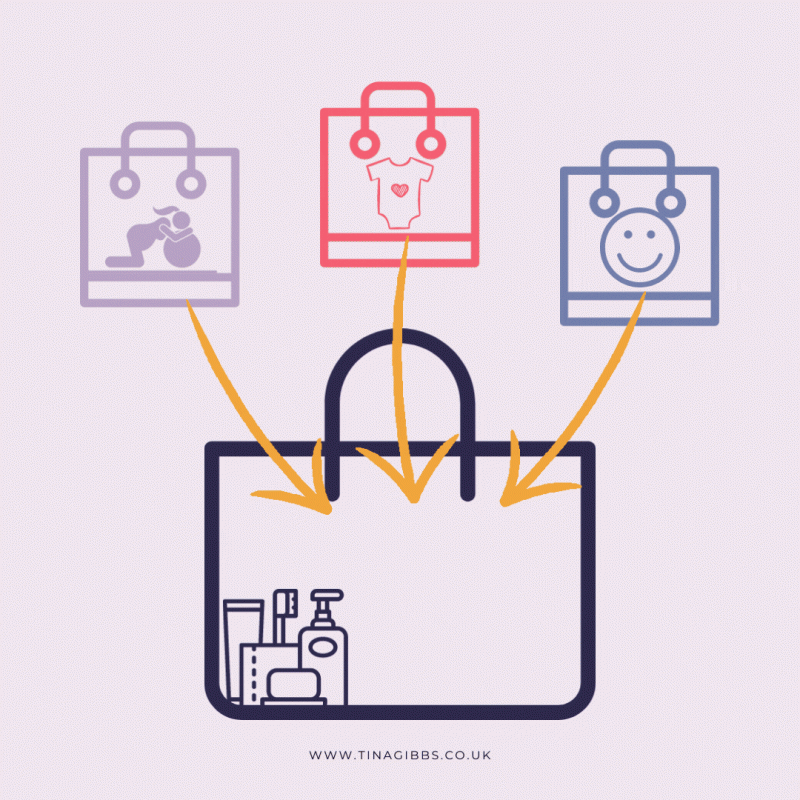
Use one large bag as your hospital bag which will contain your ‘overnight stuff’. Then pack three smaller bags to fit into you large hospital bag for childbirth!

Hospital Bag for Childbirth Hombirth Bag
Top Tip for your Hospital Bag: Pack Smaller bags into one larger bag or suitcase!

Bag for mum/birthing person

  • Your birth plan and maternity notes
  • Comfy, lose-fit dressing gown
  • Nighties  (ideally ones that opens at the front for breastfeeding access)
  • Comfy loose clothes – big baggy jogging bottoms, zip-up hoodie, tops that undo down the front for skin-to-skin/feeding
  • Slippers that you can slide your feet into rather than pulling on – if you have a Caesarean Birth bending over is tricky.
  • Socks – often women get cold feet during labour
  • Slip-on shoes
  • Flip-flops to wear in the shower
  • Hand Sanitiser
  • Wash bag including shower gel with a hook, so you don’t have to bend over in the shower, hand cream as constant hand gel use makes hands very sore,
  • lip balm as air is dry
  • Packs of waisted Bridget Jones massive cotton knickers in case you have a Caesarean Birth – dark colours are best and a couple of sizes up from your usual
  • Arnica and/or witch hazel for piles and bruising relief
  • Maternity pads packs
  • Nursing bras
  • Large pack Breast pads in case of boob leakage or washable ones
  • Pillow and/or pillowcase from home
  • Towel – hospital ones are scratchy
  • Eye mask (it’s never dark!)
  • Face mask (if you’d like your washable ones)
  • Earplugs (it’s never quiet!)
  • Hairbands
  • Headphones
  • Phone with labour playlist downloaded (you’re usually allowed to take your phone into theatre and can play music via Bluetooth)
  • Small tripod to prop up your phone/camera
  • Phone charger
  • Phone Power Bank
  • Snacks. If having a Caesarean Birth maybe apricots/prunes to ease constipation – you may not have a bowel movement for several days, and it can be a strain
  • Peppermint Tea Bags. In the case of a Caesarean Birth, it helps to get rid of wind caused by the operation.
  • Sports drink
  • Books/magazines/puzzles – in case you have to stay in hospital beforehand, or after.
  • Tissues for all the crying
  • Photo of your partner for times when they cannot be with you or maybe something that they have given you i.e. love notes
  • Photo of older children
  • Photo of you pet(s)

Bag for baby

  • Muslins 
  • Nappies – newborn size 1 fits most babies – newborns go through approx 12 nappies a day
  • Cotton wool pads/balls
  • Baby clothes – at least vests,  sleepsuits/babygrows,  jumpers/cardigans, hat  including a going home outfit
  • Baby blankets  (cotton or cellular or wool)

Bag for partner

  • Change of clothes
  • Snacks
  • Phone & Chargers or power bank
  • Change for vending machines (shops may not be open for as long) and car park
  • Phone list (if you’d like to tell people right away)
  • Car seat to take your baby home. Practice putting in/out car beforehand!
  • Maybe keep a book/magazine in the car in case you have to wait in the car until after mother’s initial assessment (This is a ‘new’ thing which started during the COVID-19 pandemic. Not all hospital trusts will still operate that way. Ask your midwife/trust to check).

I hope this list is useful for some of you and please if you have anything to add or adapt contact me and I’ll add it to the list!

Posted on

Baby Weaning – signs of readiness

starting solids baby weaning

Baby Weaning or starting solid foods with your baby. How do you know when, how and where to start? Where can we find some tried and tested recipes? Are we exploring baby-led-weaning (BLW) or are we starting our baby on purees first? So many questions new parents have with regards of weaning their baby.

The current recommendation (at the time of writing) is to start weaning your baby around 6 months of age.

Baby Weaning – Signs of readiness

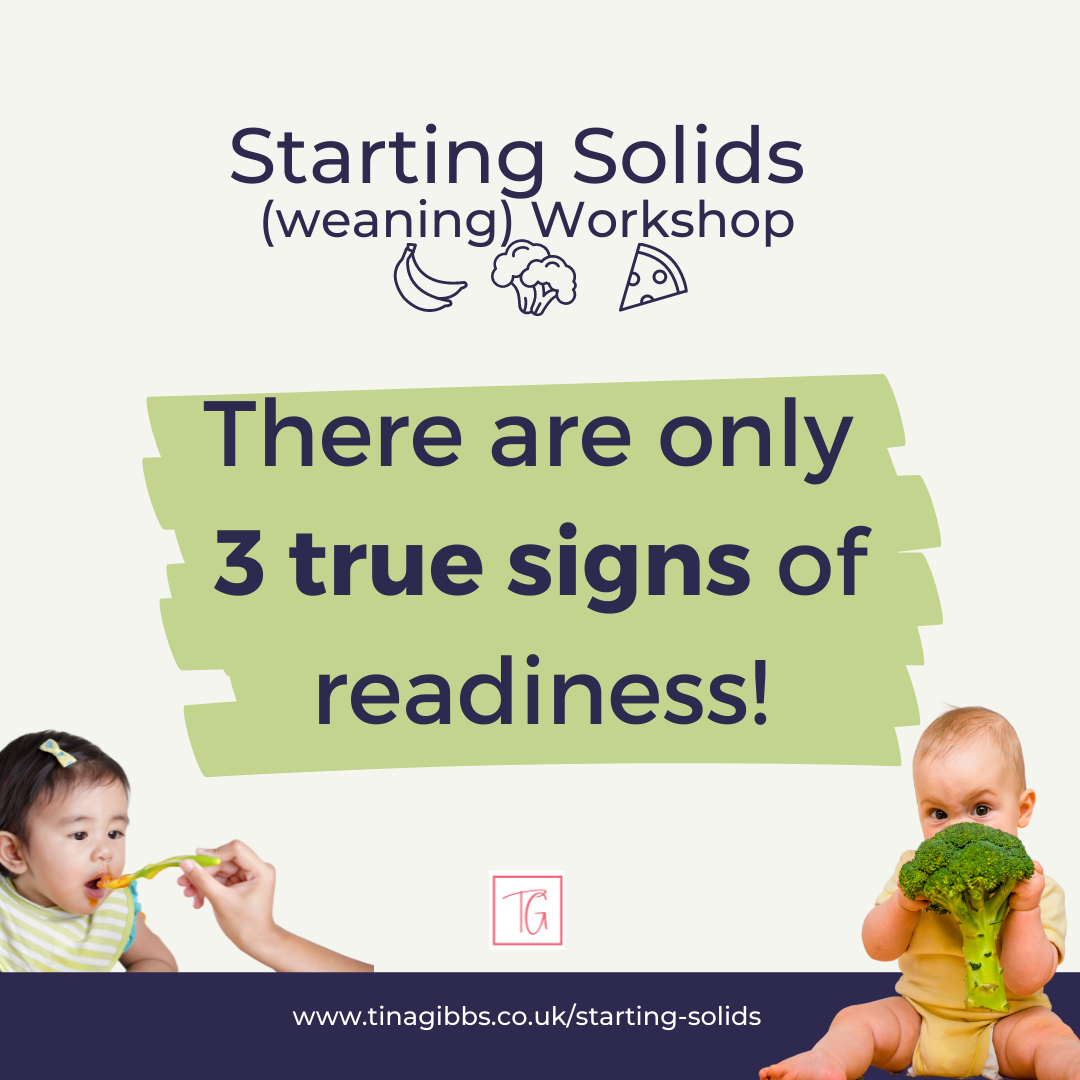
There are (only) three true signs of readiness

Your baby…

  1. can sit up unaided and hold their head steady.
  2. puts things to their mouth accurately
  3. has lost their tongue thrust reflex and can swallow

The golden rules – How to start

When introducing solid foods to your baby and during their first year of life follow these golden rules:

  • Offer simple and unprocessed foods – Make the main part of the meal of simple and unprocessed foods.
  • Offer natural foods – Your child needs to see & touch their food so that they can
  • connect food tastes with how things look and feel – this enables them to learn how to choose foods for themselves.
  • Let your baby get involved in the eating experience – Make eating a pleasurable, calm and relaxed experience. Eat together with your baby. Starting solid foods is not just nutrition it is learning and play, too!
  • Avoid ultra-processed foods – If there are too many ingredients on the label (5+) avoid giving it to your little one!

Baby-Led Weaning or Purees?

Start introducing solids at about 6 months of age alongside breastmilk or infant formula. Your baby’s milk will still be the main source of energy and nutrients for your baby.

Whether to start off with purees, finger foods or a combination pretty much depends on your baby, your personal preferences and your life style.

Some babies will happily start off with finger and mashed foods, and may move on swiftly to a range of tastes and textures. However, other babies may progress
more slowly and start off eating smooth foods off a spoon. When spoon-feeding, offer foods they can hold themselves alongside, to encourage your baby to move on to mashed and finger foods.

  • Smooth foods have no big lumps, pips, seeds or skin.
  • Mashed foods are raw or cooked foods mashed to a slightly lumpy consistency.
  • Finger foods are raw or cooked foods shaped/cut into batons. It is best to cut them bigger than a baby’s hand, so that your baby can hold them more easily. Use your (adult) finger as a sizing guide.

Always pay attention to your baby when they are eating. Never leave them alone.

Finger foods – tips for parents
  • Remove any pips, stones or stringy bits
  • Cut foods such as grapes, blueberries in half or quarters
  • Avoid nuts, popcorn and any hard-ish chunks of food
  • Stay with you baby when they are eating
  • Start off with soft and cooked foods such as vegetables and fruit
  • Wash your raw foods thoroughly

Learn more about weaning your baby

If you’d like to learn more about weaning your baby, book a starting solids (weaning) workshop with me! I offer the workshop in different formats:

1:1 (up to two adults with their baby/babies) or group (up to 8 adults with their babies). You can book these in-person to be held in Scarrington, Nottinghamshire at my home or I can travel to your home with a 10-mile radius of Scarrington/Bingham. Alternatively, I also offer a online live video course option.

In addition to the traditional starting solids workshop, I also offer a live online cook-along version. This is available online and as a 1:1 format only.

Posted on

Pregnant again

pregnant again

Congratulations! Being pregnant again is especially challenging when the next older child is still very young. Having a toddler and being pregnant can be very hard work! You are of course tired because you’re pregnant but also, you cannot nap in the day as easily. The best thing for you and your family in this situation is to accept help. If you are lucky enough to have family or friends offering to look after  the older one(s), take it! If your older one(s) is/are in school or nursery, rest when you have some time to yourself.

When and how are you going to tell your older child or children?
Well, everyone is different. Some parents tell their children as soon as they know, others like to wait longer. There is no right or wrong. Sometimes it depends on the age of the older ones. If you have a toddler to explain the situation to, it might be a good idea to get a baby doll for them. They can then explore how to treat a baby and get used to the idea of having a baby around.
There are some things you can do to prepare yourself and your toddler or child for the new arrival:

  • If you are thinking of moving older siblings to new rooms, it may be easier for them if you do it before the new baby arrives. They may be less jealous if your new baby was not the most obvious reason. Maybe saying you are moving to a big-boy/girl-room now…
  • A new baby could give older siblings (especially if they are very young) a present to start off on a good note 🙂
  • Maybe you’d like the older sibling(s) to get involved in packing your birth bag?!
  • Think about who would be able to look after older siblings, while you are pregnant and need a rest, when you give birth and for the early days
  • Only because you feel like you don’t give your second child as much attention as you did your first one, that does not mean that you are less attached to one or the other.
  • It is okay to sometimes use the TV or other electronic devices to keep the older child or children occupied while you are resting and once your new baby is born 🙂
  • Eat healthily and get plenty of fresh air and sunlight that will help with the tiredness, while you have to limit your caffeine intake.
  • Look after yourself and remember to take folic acid from the time you start trying to conceive and until at least 12 weeks of pregnancy.
  • Practice your breathing and relaxation techniques for labour and birth daily.
  • Try to gently exercise / go for a walk regularly; this will keep your energy levels up!
  • Maybe you’d like to watch some birth videos with the older sibling(s). I suggest that you watch them by yourself first and then choose one or two to watch together. I have created a library of birth videos. There is even a section of other mammals giving birth!
  • You can also book a private 1:1 antenatal session with me for you to prepare yourself and your partner for the birth. In addition to that, I have my lovely Mamamor dolls, which I can use to demonstrate vaginal as well as caesarean birth to children or adults (see demo videos below).

If you are pregnant again and your previous birth was traumatic, it may be beneficial to speak to a doula or perinatal educator who is trauma informed. A non-jugemental approach to your new pregnancy and birth experience to help you to achieve a positive birth experience this time round. My wonderful colleague Sheryl (@simplynatal) calls it your Healing Birth.

You’ve got this!!

Posted on 1 Comment

New baby sleep arrangements… Moses basket? Crib? Cot?

moses basket to cot bed size comparison

When you have a new baby, deciding on sleep arrangements can be challenging. Where will the baby sleep? What type of bed fits in our room? How long can they use that bed? Will a Moses basket be suitable? Can twins sleep in a bedside crib? These are important questions. A cot bed is often the best value since babies can use it until they are toddlers, lasting about 4 years. However, cot beds are large and may not fit alongside your bed.

A Moses basket is small and easy to carry, so it doesn’t take up much space in the living room or bedroom. However, most babies outgrow it before six months old. Parents then need to find another sleep space in their bedroom, as it’s recommended for babies to sleep in the same room as at least one parent for six months.

A crib is a little bigger than a Moses basket and sturdier and should last you for the 6 months.

A bedside crib is a little bigger again, well, wider at least and is a great Moses basket alternative for co-bedding twins.

A cot is big enough and so is a cot bed. Just depends on whether either of them fit into the same room as you and your bed

moses basket to cot bed size comparison
Size comparison moses basket to cot bed

For most up-to-date sleep recommendations and advice, please visit the Lullaby Trust and BASIS Online.