Posted on — Leave a comment

Recovery after Caesarean Birth

Are you planning a caesarean birth, or have you recently had one? Here’s what to expect during your recovery.

Recovery after caesarean birth

Emotional recovery

How you feel after a caesarean birth depends on what you expected and on what happened before and during the birth.

Almost half of all births in England are now by caesarean (NHS Maternity Statistics, 2024–25), so there’s always a chance you may have one. You may feel happy that your baby is finally here, but disappointed if you were hoping for a vaginal birth. If you can, try to be open to all possibilities before the birth – births rarely go exactly to plan. Learning about your options in pregnancy can help prepare you for different outcomes.

Talking through your caesarean birth with a health professional soon afterwards may help your emotional recovery. You should have the chance to talk to your midwife or obstetrician before you leave hospital. If you don’t, ask for an appointment as soon as possible – this is also a good time to discuss how the caesarean may affect future pregnancies.

Physical recovery

Physical recovery after a caesarean usually takes about six weeks. A caesarean is major surgery, and you will have some pain and discomfort – even laughing, coughing or small movements can make your scar hurt. Supporting your wound with your hands or a pillow helps.

Driving: you can drive again once you can wear a seatbelt comfortably and do an emergency stop without pain – usually after about six weeks. Check with your car insurance provider first, as some have specific rules after surgery.

Tips to aid your recovery and ease discomfort:

  • Eat and drink as soon as you feel hungry or thirsty, and drink plenty. Choose high-fibre foods to help prevent constipation.
  • Keep your wound clean by washing and drying it every day. A freshly washed flannel works well; if you use soap, rinse thoroughly. Pat the wound dry with a clean towel rather than rubbing, and change your towel and flannel daily.
  • Empty your bladder regularly to reduce pressure on your scar.
  • Wear loose clothes and soft cotton knickers one or two sizes bigger than usual (or borrow your partner’s!). You can also buy special post-caesarean knickers that sit above your scar.
  • Tell your midwife if you notice any signs of infection, such as redness, increased soreness or discharge from the scar, or if you have a high temperature.

You’ll be encouraged to start moving gently the day after your operation to help your recovery. You may see a physiotherapist, or at least be given a leaflet by your midwife. Take it slowly, and don’t start more strenuous exercise until your healthcare professional says it’s okay.

Pain relief

Pain relief will be available in hospital, and you’ll be given something to take at home too. The options depend on how much pain you’re in. Most painkillers are safe while breastfeeding – please discuss your options with your midwife, obstetrician or other health professional.

Your scar

If you’d like to know what your scar will look like, visit Caesarean Birth and VBAC Information, which has caesarean scar pictures and a wealth of information about caesarean birth, recovery and VBAC (vaginal birth after caesarean).

Breastfeeding

You can start breastfeeding straight after a caesarean. Extra skin-to-skin and support can help. Because of the wound, breastfeeding can be more challenging in the early days, so please ask for help when you need it, and tell your health professional you’re breastfeeding when discussing pain relief.

Future pregnancies

Having one baby by caesarean doesn’t necessarily mean you’ll need a caesarean for future births. You can discuss this with your midwife, GP or obstetrician. Whether you have another caesarean will depend on:

  • the risks and benefits of a caesarean for you and your baby
  • your personal preferences and priorities

However, if your first caesarean was due to something that won’t change in future pregnancies, such as the shape of your pelvis, it’s very likely that a caesarean will be recommended for future births.

Online course including caesarean information

Please also check out my online course! No videos, just text and images to learn in your own time. Includes hypnobirthing mp3s, scripts, workbook, handouts, infographics and much more! Lots and lots of information at your fingertips! Includes:

  • hypnobirthing mp3s
  • hypnobirthing scripts
  • written information
  • infographics and other imagery
  • printable handouts
  • printable workbook/journal

Further information

Posted on — Leave a comment

8 tips for self-care in pregnancy

Why does self-care in pregnancy matter?

During pregnancy, many expectant parents focus on what’s best for their baby – and one of the most important things you can do for your baby is to look after yourself. While there’s a lot to prepare before your baby arrives, your physical and mental health matter too. These self-care tips may help you prioritise your health and wellbeing, for the benefit of you, your baby and your family.

8 self-care tips for pregnancy

Not sure where to start? Here are my 8 tips for self-care in pregnancy:

  1. Keep a diary or try journaling. Many people find being creative relaxing and soothing. These free affirmations can help you get started!
  2. Enjoy some bonding time. Bond with your baby while listening to hypnosis tracks, meditating or simply sitting and relaxing. Stroke your bump and tune in to your little one! Read more in Bonding with your baby in pregnancy.
  3. Have a bath or shower, or go for a swim. Being in water can help you feel weightless again – many pregnant people love floating in a swimming pool! Or have a relaxing bath with some music or a good book.
  4. Try a pregnancy massage. If you love massages, a pregnancy massage is a wonderful way to practise self-care. Look for a local massage therapist who offers pregnancy massage.
  5. Enjoy early nights. Growing a baby is exhausting!
  6. Eat well. Check with your healthcare provider which foods are recommended or best avoided in pregnancy. Advice changes over time and varies between countries, so check your current local guidance.
  7. Enjoy (long) walks in the fresh air. Try ‘nature bathing’ – inspired by the Japanese practice of forest bathing, it simply means being outside and mindfully enjoying nature. Switch off your phone, clear your mind and stroll through your local countryside. Lots of studies show this is good for mental wellbeing.
  8. Talk to a friend or family member. Talking to a loved one can really boost your wellbeing, so phone a friend or meet up for a cuppa and a chat!

What do you do to relax? Share your ideas with me and other expectant parents in the comments!

Prepare for birth at your own pace with my online course

Please also check out my online course! No videos, just text and images to learn in your own time. Includes hypnobirthing mp3s, scripts, workbook, handouts, infographics and much more! Lots and lots of information at your fingertips! Includes:

  • hypnobirthing mp3s
  • hypnobirthing scripts
  • written information
  • infographics and other imagery
  • printable handouts
  • printable workbook/journal
Posted on — 1 Comment

Clothes checklist for your winter baby

Having a baby this winter? Congratulations! You may be wondering how many clothes, and which types and layers, your baby will need.

When buying baby clothes, make sure they are machine washable, flame-resistant and made from soft, comfortable materials. Choose clothes that open at the front or have wide, envelope-style necks.

The checklist below is a minimum guide only. A winter baby needs a few more items than a summer baby, and you may like to have a few spares of each if your budget allows.

Clothes checklist for your winter baby

  • 4 sleepsuits/babygrows
  • 4 vests or bodysuits (check for a wide neck opening) – you may prefer long-sleeved ones
  • 4 cardigans or jackets
  • 1 hat (for outdoors only)
  • 2 pairs of socks
  • 2 pairs of mittens (many sleepsuits have built-in mittens, so you may not need any)
  • 1 baby blanket
  • 1 snowsuit or pramsuit (optional)
  • 1 baby sleeping bag (optional)

As well as clothes, your baby will need nappies (reusable or disposable) – and you’ll want plenty of muslin squares! They’re very handy for protecting your clothes, mopping up sick and other bits and bobs, and can even double as an emergency nappy or breast pad 😉

Not sure how many layers your baby needs? My baby clothing layers guide shows you at a glance. Expecting a summer baby instead? See my clothes checklist for your summer baby.

How many layers should my baby wear at night?
Posted on — 2 Comments

Massage during labour and birth

man massaging his pregnant partner head and smiling

Massage during labour and birth: what is it, and why might it help?

Massage involves one person using touch to work on another person’s soft tissues. It’s often used to ease tense muscles and can help people relax.

Different massage techniques suit different people during labour. Some find firm, intense massage over the lower back most helpful, while others find light effleurage[1] or soothing strokes more relaxing.

You can practise massage techniques during pregnancy, which helps you relax now, too! My self-paced online childbirth preparation course includes simple techniques to try. If you’re a birth worker, my Childbirth Massage Techniques flashcards are a great way to teach them in your classes.

Massage techniques for childbirth

Research suggests several ways massage may help during childbirth:

  1. It may lower stress hormones and increase levels of serotonin[2] and dopamine[3] in the brain.
  2. Gentle, non-painful massage may flood the body with pleasant sensations, so the brain notices painful sensations less.
  3. Deep, intense massage may work through a mechanism called Diffuse Noxious Inhibitory Control: it stimulates the brain to release endorphins, the body’s own painkillers, which help you feel less pain from contractions.
Man massaging his pregnant partner's head and smiling
Head massage with a hand-held scalp massager

Things to bear in mind when using massage during labour and birth:

  1. Aromatherapy: essential oils are powerful and can interfere with contractions if used incorrectly. Before buying or using them, speak to an accredited aromatherapist and your healthcare professional, and always dilute them. Your midwife may be trained in aromatherapy and able to advise you directly.
  2. Communication: say whether the massage is helping and how it could be better – firmer, lighter and so on.
  3. Continuous touch: always keep at least one hand on the person’s body during the massage.
  4. Oils: massage can feel more soothing with an unscented oil, such as organic cold-pressed sunflower oil. Don’t use oils on broken skin.
  5. One-handed massage: if you’re using one hand, rest the other on their body so they know they have your full attention and where your other hand is.
  6. Positions: the person being massaged may be kneeling, sitting, lying on their side or standing – and the birth partner needs to be comfortable too.
  7. Previous injuries: don’t massage areas affected by previous injuries without checking with a healthcare professional first.
  8. Timing: some people like massage during contractions; others prefer it in between.

Further reading and sources:


[1] Effleurage: a form of massage using repeated, gentle circular strokes with the palm of the hand.

[2] Serotonin: a chemical messenger (neurotransmitter) that helps regulate mood.

[3] Dopamine: a chemical messenger (neurotransmitter) linked to pleasure and reward, and a precursor of adrenaline.

Posted on — Leave a comment

Potty Training – Toddler-led toileting

Potty Training Workshop for parents in Nottinghamshire

Potty training – or, as I prefer to call it, toddler-led toileting – is a journey every parent goes on with each of their children.

What is toddler-led toileting?

Learning to use the toilet or potty is just one step in your child’s development, like learning to walk, talk or eat solid foods (baby-led weaning). Toddler-led toileting means approaching ‘potty training’ in the same way.

Follow your child’s lead. Trust the process. Make it fun! Allow for mistakes and setbacks. Be body positive. Normalise going to the toilet – letting them watch you go will help them learn.

Getting started with toddler-led toileting

  1. Normalise it
    • 🚽 Everybody wees and poos.
    • 🚽 Let them see you on the toilet.
    • 🚽 Let them flush.
    • 🚽 Point out animal poo.
    • 🚽 Share picture books about potties, toilets and poo (borrow them from your local library or buy them).
    • 🚽 Let their teddies and toys have a go on the (clean!) potty.
    • 🚽 Let them watch and learn.
    • 🚽 Let them learn through play.
  2. Observe
    • 🧐 Notice when your child goes still.
    • 🧐 Use words to help them understand: “Did you just do a wee/poo?”
    • 🧐 Reassure and affirm, with no pressure: “Your body is working well.”
  3. Play
    • 🧸 Buy a potty and let them play with it (or go straight to the toilet if you prefer).
    • 🧸 Pretend to put teddy or a doll on the potty.
    • 🧸 Let them sit on it with their nappy on.
    • 🧸 Avoid pressure – they’ll do it in their own time.
  4. Be body positive
    • 👍 Use positive language about your own body.
    • 👍 Going to the toilet is a normal bodily function, so talk about it factually. Use the correct names for body parts – vulva, vagina, penis, buttocks, bottom, anus and so on – rather than pet names.
    • 👍 Avoid emotional pressure.
    • 👍 Help them feel happy with their body.
    • 👍 Explain that people use different words for bodily functions, and talk about the common ones in your area, language or culture.

Here is my free top tips crib sheet to get you started. Let me know how you get on!

Are you a family support worker or educator? My toddler-led toileting handout bundle is ready to share with the families you support.

Posted on — 2 Comments

Breathing techniques for childbirth

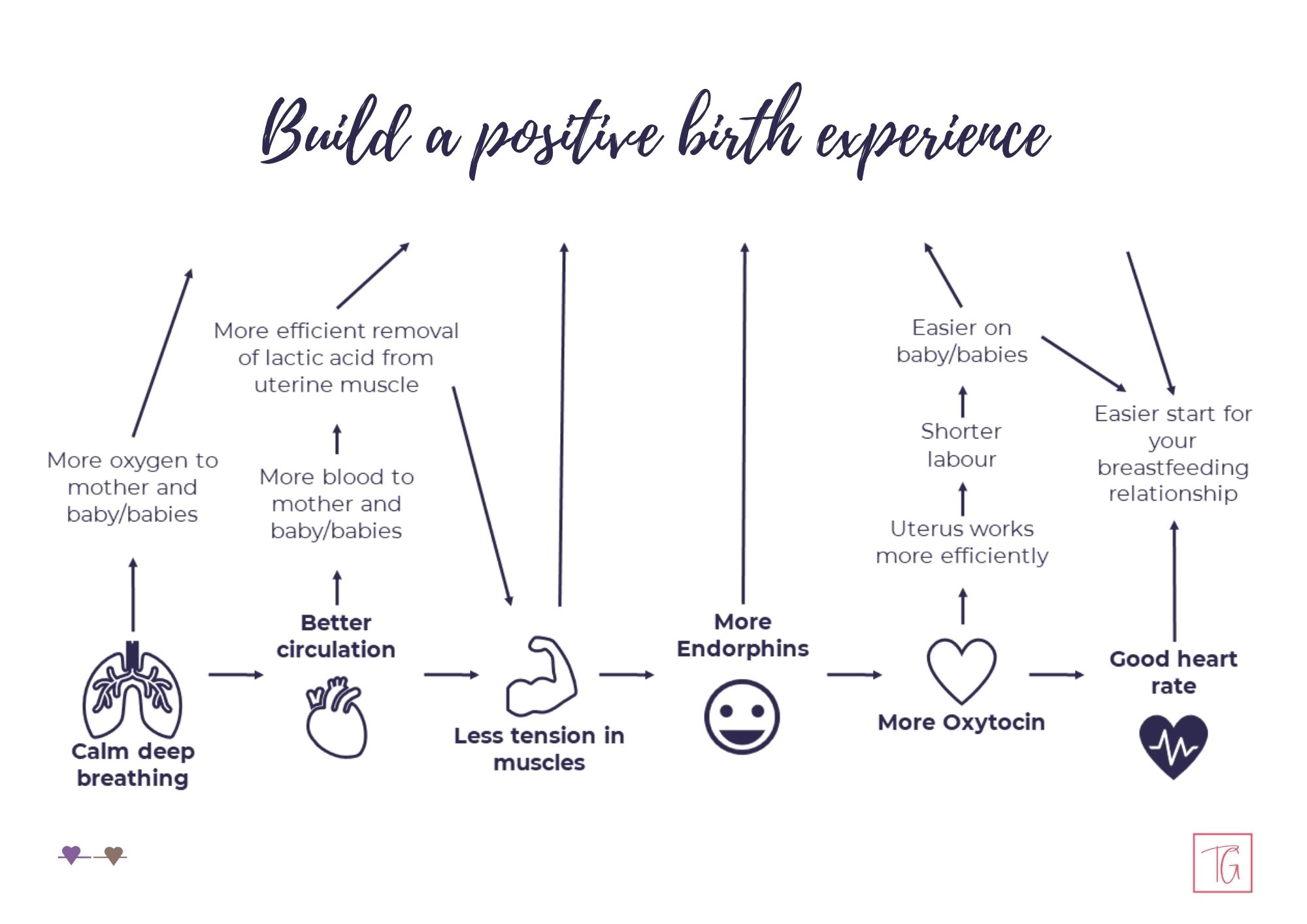
Breathing techniques for childbirth can help you stay calm during the birth and support the birth process. Being calm and relaxed can make the birth of your baby easier, quicker and more comfortable. There are many ways to help yourself, or your partner, stay calm during childbirth – breathing techniques are just one of them.

Build a positive birth experience

How can breathing techniques help the birth process?

Researchers think breathing may support the birth process as a form of pain management in a couple of ways. Focusing on your breathing may interrupt pain and discomfort signals to your brain by giving you something else, more positive, to focus on. Being aware of and focusing on your breathing may also stimulate the release of endorphins, your body’s natural pain-relieving hormones.

Breathing techniques are a useful tool to help you and your partner build a positive birth experience. There is a catch, though… to make them work well for you, you need to practise regularly. The more you practise, the more easily and effectively the techniques will work during your baby’s birth.

Top tip: practise the techniques, and your comfortable breathing pattern, together with your birth partner. When your birth partner knows your comfortable breathing pace, they can help you get back to it by counting you in and out, or by keeping eye contact and breathing at your pace with you.

Want to know more? Read How to Teach Breathing Techniques That Actually Stick and Why You Should Teach Breathing Techniques for Labour and Birth.

Breathing techniques worksheets are included in my self-paced online childbirth preparation course!

Please also check out my online course! No videos, just text and images to learn in your own time. Includes hypnobirthing mp3s, scripts, workbook, handouts, infographics and much more! Lots and lots of information at your fingertips! Includes:

  • hypnobirthing mp3s
  • hypnobirthing scripts
  • written information
  • infographics and other imagery
  • printable handouts
  • printable workbook/journal
Posted on — Leave a comment

How long does labour last?

How long does labour last?

How long does labour last? What is the average length of labour and birth?

In medical terms, labour is divided into three stages:

  • First stage – your uterus and body are getting ready. Your cervix softens and begins to open until it is fully open (dilated). This is sometimes called the “up stage”, because the sensations pull upwards.
  • Second stage – this begins when you feel the urge to push. It’s sometimes called the “pushing stage” or “down stage”, because the sensations push downwards. At the end of this stage, your baby is born!
  • Third stage – the birth of the placenta, the final stage of labour.

So, how long does labour last? According to the NHS, a first labour lasts on average 8–12 hours, and later labours are usually much quicker (around 5 hours). However, midwives only start timing from when you are in established labour – when your cervix is around 4cm dilated. The contractions and sensations you experience before then aren’t officially counted, although birthing people usually include that time when they describe their experience. From your baby dropping (lightening) to the start of established labour can take hours, or sometimes days with a first baby. Use this time to rest when you can, stay hydrated and keep your positive energy up!

Although the NHS and other healthcare providers divide labour into three stages, it isn’t always that simple. Each stage can be broken down into smaller steps, and people who have given birth or attended births often describe many more stages. Milli Hill, for example, divides birth into 15 steps in The Positive Birth Book (affiliate link).

Here is a graphic showing a timeline of childbirth:

How long does labour last?
Childbirth/labour timeline
Posted on — Leave a comment

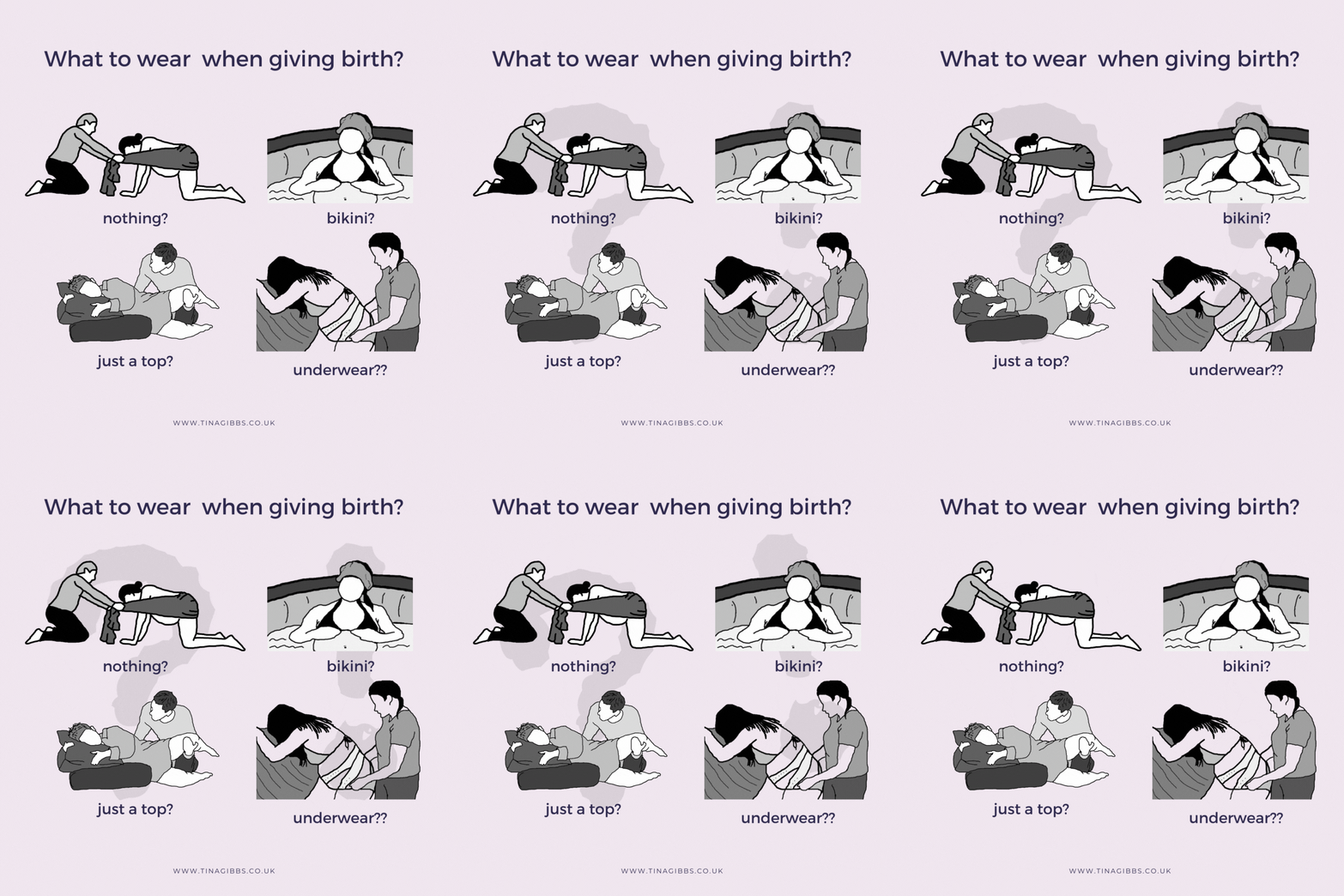
What to wear during childbirth?

what to wear during childbirth

“What should I wear during childbirth?” is a question expectant parents ask a lot.

The answer is: whatever feels comfortable for you! Here are a few things you may wish to consider when deciding what to wear:

  • The birth environment. At home you control the temperature, but hospital birth rooms tend to be very warm!
  • Are you giving birth in water? If you’re planning to use a birth pool, you may prefer not to wear anything on your bottom half once you get in. Clothes are much harder to take off when they’re wet!
  • Are you planning a caesarean birth? Think about easy access for skin-to-skin after the birth, and ask your care provider about your options. Most NHS trusts in the UK support skin-to-skin after a planned caesarean, and many are happy for you to wear your own clothes instead of a hospital gown. See also 7 ways to personalise your caesarean birth.
  • Skin-to-skin straight after birth is important for you and your baby. It helps with breastfeeding and bonding, and helps pass good bacteria to your baby. Check that skin-to-skin will be easy in the clothes you choose.
  • Feeding your baby. If you’re planning to breastfeed or chestfeed, wear clothes that give easy access to your breasts or chest.
  • Personal comfort and body confidence matter too. In the end, it’s your choice – pick clothes that make you feel comfortable, or choose not to wear any at all!

In short: wear comfortable, loose-fitting clothes that give easy access to your chest for the golden hour. And don’t forget to pack them in your hospital bag!

Posted on — Leave a comment

Positions for Childbirth

Positions for Childbirth

Which positions do women and birthing people use during labour and birth? Let’s look at positions that support the birth process and can help your baby’s birth go more smoothly.

Positions for childbirth
Some examples of positions for childbirth, with and without a partner

Changing position and staying active during labour can help the birth process and reduce the need for interventions. Choose positions that feel comfortable for you.

Positions for childbirth explained

Walking sideways up and down the stairs can help if your labour has slowed down or you’d like to speed it up a little.
The lunge opens up your pelvis and may help bring back or speed up contractions when they’ve slowed down. Lunge during contractions, between them, or both.
Rest. If you need a rest, try sitting backwards on a chair or sitting on a birth ball. Keeping your feet lower than your bottom helps keep your pelvis open. Massage may help you relax and rest, too.
Physical contact and massage. Close contact with your partner and/or massage can help you relax and help your body release oxytocin.
A rebozo has many uses during labour and birth, for example:
– to help realign your body and encourage your baby to rotate into a more favourable position
– to lift your bump and relieve back pressure
– to wrap around your whole body like a hug, for comfort and to ease anxiety
Side-lying. Lie on one side, preferably your left – a great position for resting. To open your pelvis a little more, keep your lower leg straight and bend your upper knee as much as you can, resting it on a pillow. With a birth partner holding up your upper leg, you can even give birth in this position, making full use of the space in your pelvis.
Double hip squeeze. Your birth partner presses firmly into your buttocks with the palms of their hands, fingers pointing towards your spine. You could also try this with a warm or cold compress. It’s great for relieving pressure on your back during labour.
Stay upright and use gravity! Gravity is one of your best friends in labour. When you’re upright – standing, sitting or kneeling – the weight of your baby presses on your cervix, encouraging it to open. Being upright may also help your baby get into the best position for birth.
Sitting on the ball takes the weight off your legs and helps relax your lower back. Your birth partner can sit behind you to offer massage, warmth or support. Also try sitting cross-legged on the floor or bed.
The birth pool is great for pain relief and can help you relax. You can sit in the pool, or kneel and rest your upper body on the side.
Leaning on the birth ball lets you rest your weight on the ball instead of your hands, and encourages movement, which opens your pelvis and helps your baby rotate. Also try sitting backwards on a chair or the toilet, leaning into a pillow. Being monitored doesn’t mean you have to stay in bed or lie down – you can still use upright positions and movement!
The squat is a great position for giving birth. It opens up your pelvis and maximises the room for your baby to rotate and move through the birth canal. You can use a ball, rebozo, chair or your birth partner for support.

If you’re a birth worker, such as a doula or antenatal teacher, these positions are available as a set of 30 individual positions for childbirth cards, or as a poster, in my shop.

Posted on — Leave a comment

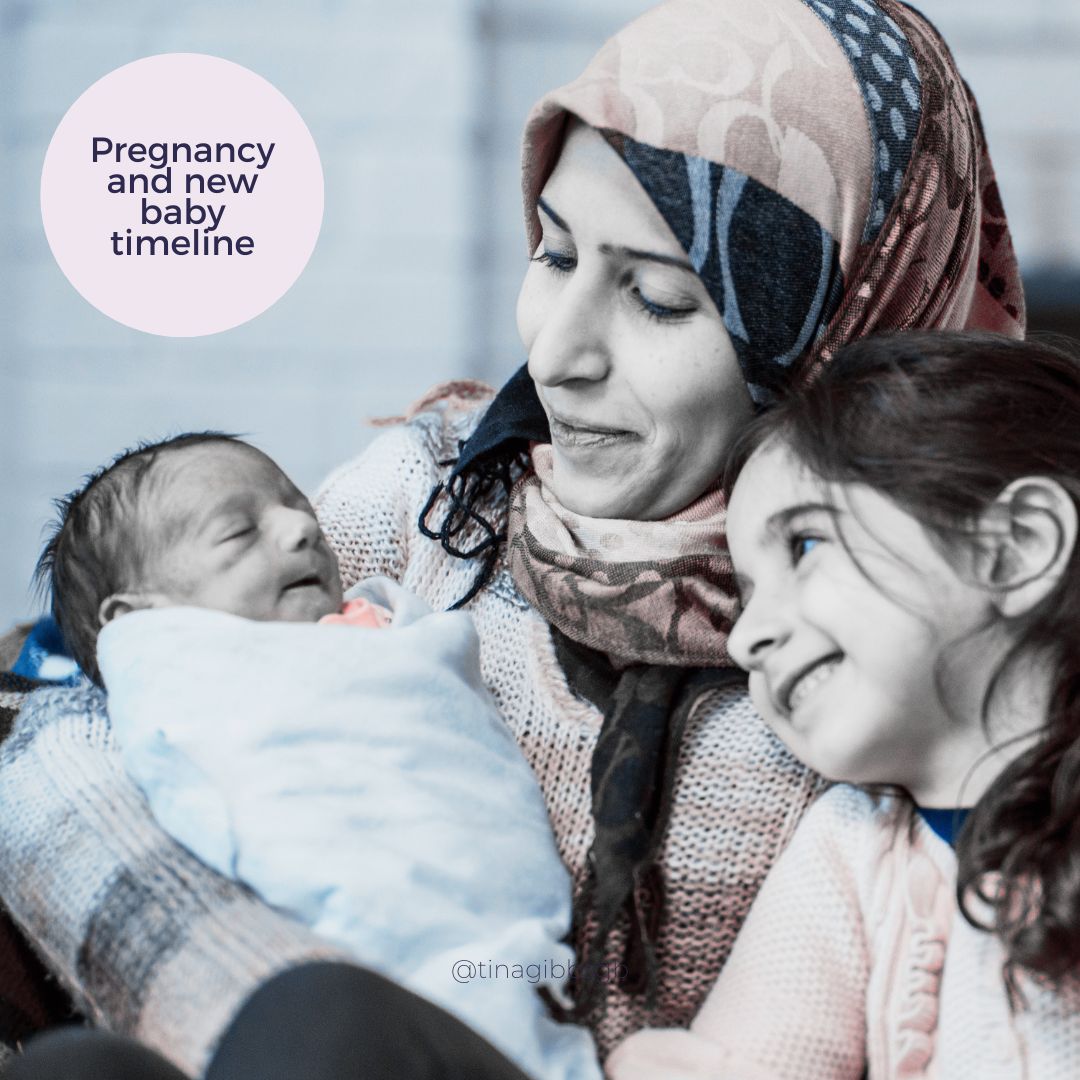
Pregnancy and new baby timeline – What to expect

pregnancy and new baby timeline

You’re pregnant – congratulations! Now you may be wondering what to expect before and after your baby arrives. Here is a rough guide to what happens during pregnancy, on the day your baby is born, and in your first few weeks as a new parent. This guide is for expectant and new parents in the UK.

During pregnancy

  • Start pelvic floor exercises – the NHS has a guide to pelvic floor and other exercises during pregnancy. See also my post on pelvic floor exercises for labour and birth.
  • Antenatal appointments with your midwife (and consultant, if needed) – the NHS website explains what happens at each one.
  • Antenatal tests and scans
  • A home visit from your health visitor and/or midwife
  • Book and attend childbirth preparation classes (optional), such as hypnobirthing
  • Consider hiring a birth and/or postnatal doula
  • Research your birth options and rights – Birthrights is a great place to find out about your rights in childbirth

Day one – the day your baby is born

  • Apgar score for your baby
  • Vitamin K offered for your baby
  • A midwife or member of the paediatric team checks your baby over before you leave the hospital or midwife-led unit
  • Newborn hearing screening – before you leave hospital or within the first few weeks
  • Going home: after a straightforward birth, if you and your baby are well, you can often leave the same day. After a caesarean birth, you can usually go home after about two days.
  • You’ll receive the red book for your baby’s growth charts, vaccinations and more – some areas also offer an online red book.

Once you’re home

Please note that timings vary across the UK.

  • Midwife home visits for you and your baby, usually on days 1, 3 and 5 (more often if needed)
  • Emotional high for mum: days 1–3
  • Baby may develop jaundice: days 2–3, usually clearing by week 2
  • Milk comes in: days 3–5
  • Baby blues: days 3–5
  • Newborn blood spot (heel prick) test: day 5
  • Umbilical cord stump falls off: around day 7
  • Lochia (postnatal bleeding) stops: 2–6 weeks
  • Discharged from midwifery care: between 10 and 28 days
  • Postnatal check for mum and baby with your GP: 6–8 weeks
  • Light exercise and sex can usually resume after your postnatal check, from 6–8 weeks

These timings are a rough average only, and this list does not replace medical advice. If you’re worried about yourself, your partner or your baby, please contact your healthcare professional.

References and further reading: