Posted on Leave a comment

How long does labour last?

How long does labour last?

How long does labour last? What is the average time for labour & childbirth?

In medical terms labour is divided into three stages:

  • 1st stage – where your uterus and body are getting ready. Your cervix is softening and will begin to open until it is fully open (dilated). It is sometimes referred to as the “up stage” because the sensations are pulling/moving upwards. .
  • 2nd second – the second stage begins when you’ll feel the urge to push. It is sometimes referred to as the “pushing stage” or “down stage” because the sensations are pushing downwards. At the end of this stage, your baby will be here.
  • 3rd stage – the birth of the placenta. After your baby is born, you’ll have to give birth to the placenta. This is what is happening in the 3rd and final stage of labour.

So, how long does labour last? According to the NHS, the average first labour lasts between 8-12 hours and subsequent births will be significantly quicker (approx. 5 hours). However, your midwives will only record the timing from when you are considered to be in established labour, which is when your cervix is already around 4cm dilated (open). That means that the contractions and sensations that you are experiencing until then are not officially ‘counted or measured’. However, birthing folk themselves will usually add that time on when they describe their experience. It will take hours or sometimes days (first birth) from your baby dropping (lightening) to the beginning of established labour (4cm). Use this time to rest when you can, hydrate and keep your positive energy up!

Although the NHS and other healthcare providers divide labour and birth into three stages, it is not always that simple… Each medical stage can itself be divided into further smaller steps and stages. When speaking to women and people who have given birth and/or attended births, they describe the birthing process in many more steps. Milli Hill, for example, divides the birth into 15 steps in her Positive Birth Book (affiliate link).

Here is a graphic to show a timeline of childbirth:

How long does labour last?
Childbirth/labour timeline

Posted on Leave a comment

What to wear during childbirth?

what to wear during childbirth

A question that comes up frequently during my childbirth preparation classes is “What to wear during childbirth?”.

The answer is, whatever feels comfortable to you. There are a few things you may wish to consider when deciding what to wear during childbirth

  • The birth environment – While you are in control of the temperature of your home, hospital birthing rooms tend to be very hot!
  • Are you giving birth in water? – if you are using/planning on using a birthing pool, you may wish to consider to not wear anything on your bottom half once you get into the pool. Clothes are more difficult to take off when they’re wet!
  • Are you planning a caesarean birth? Think about accessibility for skin-to-skin after the birth. Ask your care provider about your options. Most NHS trusts in the UK support skin-to-skin after a planned caesarean birth and do also support alternative clothing instead of the hospital gown.
  • Skin-to-skin straight after birth is important for your and you. It helps initiate breastfeeding and bonding but also helps to transfer good bacteria to your baby. Think about the clothing you are wearing during the birth of your child and check, whether skin-to-skin would be easily possible with your chosen clothing.
  • Breastfeeding/chestfeeding/bodyfeeding/nursing – If you are planning on nursing your baby, it is important to wear clothing which allow easy access to your breasts/chest.
  • Personal comfort & body confidence are also an important factor when choosing clothing for childbirth. At the end of the day it’s your choice and you’ll choose clothing which make you feel comfortable! You may of course choose to not wear any clothing!

In conclusion, wear comfortable, loose fitting clothes which allow access to your chest for the golden hour.

Posted on Leave a comment

Positions for Childbirth

Positions for Childbirth

Learn about Positions for Childbirth. Which positions do women and birthing people use during birth? Positions which support the birthing process and can make the birth of your baby easier and go more smoothly.

Some examples of positions for childbirth. With and without a partner.

Changing positions and keeping active during childbirth can help the birthing process and reduce the need for interventions. Chose positions which feel comfortable to you.

Positions for childbirth explained
Walking sideways up and down the stairs can be helpful if your labour has slowed down or you’d like to speed it up a little.
The Lunge opens up your pelvis. Open up the pelvis and may help to speed up / bring back contractions when they have slowed down. Lunge during or between contractions or even both.
Rest. If you need a rest, try resting sitting backwards on a chair or sitting on a birthing ball. Keeping your feet lower than your bottom helps to keep your pelvis open. Massages may help you relax and rest, too.
Physical contact and massages. Close physical contact with your partner and/or being massaged may help you to relax and your body to release oxytocin.
A Rebozo can have many uses during labour and birth. A few examples are:
– to help realign and adjust your body to encourage your baby
– to rotate into a more favourable position
– to lift your belly to relieve back pressure during labour
– to wrap around the entire body like a hug, to offer you some comfort and ease anxiety
Side-Lying. Lie down on one side, preferably your left side. This is a great position to rest. To open up the pelvis a bit more, try to have your lower leg straight, and bend your upper knee as much as possible. Rest it on a pillow. With a birth partner, holding up your upper leg (see picture on the right), you can even give birth in this position making full use of the space in your pelvis.
Double hip squeeze. Have your birth partner press firmly into your buttocks with the palms of their hands, while their fingers point towards your spine. You might also like to try this with a hot or cold compress. A great exercise to relieve some of the pressure on your back during labour.
Stay upright and use gravity! Gravity is one of your best friends during labour! When you are in an upright position either standing, sitting or kneeling, the weight of your baby presses on your cervix. This encourages it to open. An upright position may also help get your baby into the best position for their birth.
Sitting on the ball allows you to take the weight off your legs and relax your lower back. Your birth partner can sit behind you and offer some massages, warmth or support. Also try: sitting cross-legged on the floor or your bed.
The Birthing Pool. Is great for pain relief and may help to relax you. You can sit in the pool or try kneeling and resting your body on the side of the pool.
The Birth Ball allows you to put your weight on the ball instead of your hands. The ball also encourages movement. Movement opens your pelvis to allow the baby to rotate. Also try: sitting backwards on a chair or toilet seat, leaning into a pillow. Being monitored doesn’t mean you have to stay in bed / lie down. You can still use upright positions and movement!
The Squat is a great position to give birth to your baby. This position opens up your pelvis and maximises the room for your baby to rotate and pass through the birth canal. You can use a ball, rebozo, chair, your birth partner as support.

If you are a birth worker such as a doula you can purchase these positions on cards (30 different positions for childbirth on individual cards) or as a poster from my shop.

Posted on Leave a comment

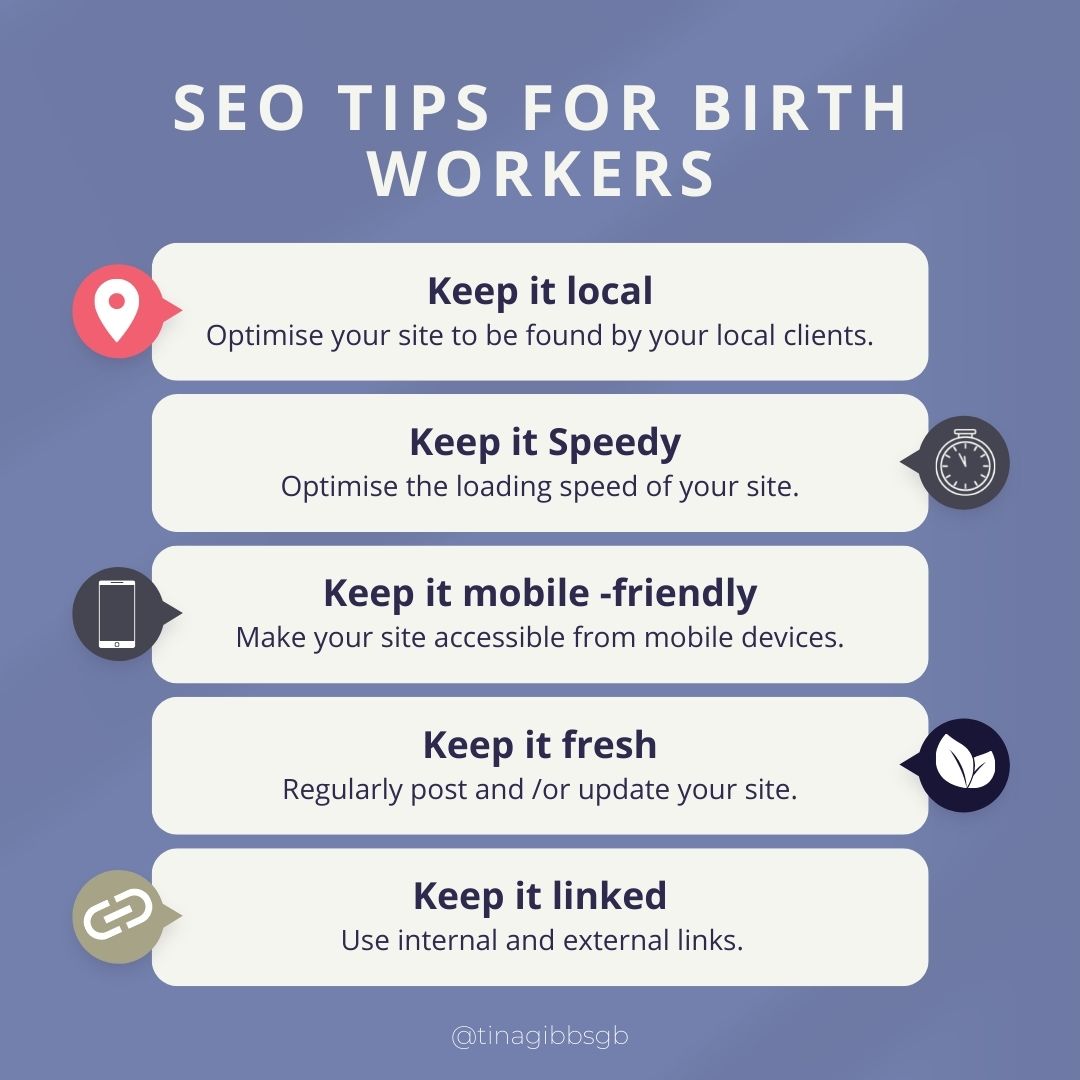
SEO tips for birth workers

As a self-employed birth worker, it is essential that your potential clients can find you. Here are some SEO (search engine optimisation) tips for birth workers to get you started. Some may think that social media will do all the work for you, but does it?

You are a doula, antenatal teacher, hypnobirthing practitioner or other birth worker and have very short window of getting your clients’ attention and to book your services. We do rely on word of mouth, and us in the search results!

Where do you go when you look for a service? Do you check your social media or do you use an internet search engine?

4 out of 5 people use search for local services and businesses using search engines such as Google, Bing or Yahoo. Optimising your website for local search results can make a huge difference to the number of (potential) clients finding out about you and the services you offer. Even better, SEO is free!!

SEO tips for birth workers

Here are my top SEO tips for birth workers

Keep it local!

Optimise your about and services pages for local searches! Make sure to include your town, city, area you work in in your description.

To display your website to your (potential) clients, search engines need to understand three very important things,

  1. Who you are
  2. What you do
  3. Where you are

You can do that in one or two sentences, ensuring you include this information on your home, about as well as service pages!

Example: Hello I am <Your name >, a <job/role i.e. hypnobirthing practitioner> in <area you are working in>, I offer a local support/services including <add some examples>.

Keep it speedy!

Optimise the speed of your website. Search engines are more likely to suggest your site higher up in the search results when your site is loading faster. Here are some free tools to check the speed of your website:

Use Google’s Page Speed Insights Test to find out how quickly your website loads.

Keep it mobile-friendly!

The vast majority of internet users and your (potential) clients search and access information via their mobile phones or other mobile devices. Make sure, that you website is accessible and user-friendly for mobile phone/devices. Here is a free tool to check what your site looks like on mobile devices:

Use this google tool to find out if your website looks great on mobile devices.

Keep it fresh!

Nobody likes outdated content, so the search engines will check when you have last updated the information/anything on your website. They’ll show ‘fresher’ pages higher up in the results as they are more likely up-to-date. So simply, log on to your site now and again and write a blog post, or change a few things round. Keep it fresh!

Keep it linked!

Creating backlinks, is another important tool. If other local businesses or other birth workers are linking to your content, it is a little star for you. It makes you seem more ‘trustworthy’ in the eyes of a search engine at least! Careful! Use links/linkbacks to and from relevant and natural content. Think about swapping links with other local related businesses with the same or very similar audience, such as family photographers, holistic therapists, perinatal fitness, etc.

Now, get yourself a cuppa and optimise your SEO following my tips for birth workers above!

Posted on Leave a comment

Pregnancy and new baby timeline – What to expect

pregnancy and new baby timeline

You are pregnant! Congratulations! Now you are wondering about the pregnancy and new baby timeline and what to expect before and after the birth of your new baby? Here is a rough guide of what to expect during your pregnancy, on the day of the birth of your baby and in the early few weeks as a new parent! This is a guide for expectant and new parents living, birthing and parenting in the UK.

During pregnancy
  • Start Pelvic Floor Exercises – here is a guide from the NHS on how to do your pelvic floor and other exercises during pregnancy!
  • Antenatal appointments with your midwife and consultant (where applicable) – here is an explanation on the NHS website.
  • Antenatal tests and scans
  • Health Visitor and/or Midwife visits your home
  • Book and attend your childbirth preparation courses (optional), such as hypnobirthing.
  • Look into hiring a birth and/or postnatal doula
  • Research and learn about your childbirth options and rights – Birthrights is a great place to find out more about your rights in childbirth
Day one – the day your baby is born
  • APGAR score for baby
  • Vitamin K offered to be given to your baby/babies
  • Midwife or a member of the paediatric team check your baby over before you’ll leave the hospital or midwife-led unit.
  • Newborn hearing screening – before you leave the hospital or within the first few weeks
  • Mum and baby/babies can leave the hospital. After a straightforward birth and with healthy mum and baby/babies they can leave the hospital on the same day. After a Caesarean Birth, you can usually leave 2 days after giving birth.
  • You’ll receive the red book for your baby’s growth charts and vaccination schedule etc. – some areas also offer an online red book.
Once at home – please note that the timescale varies in different parts of the UK
  • Mother and baby/babies will get midwife home visits for checks on day 1, 3 and 5. More often if necessary.
  • Mother on emotional high: days 1-3
  • Baby might develop jaundice: 2-3 days. Usually clears by week 2.
  • Milk comes in, days 3-5
  • Baby blues, days 3-5
  • Newborn blood spot test, day 5
  • Umbilical cord stump falls off, day 7
  • Lochia (postpartum blood loss) stops, 2-6 weeks
  • Discharged from midwifery care, between 10-28 days
  • Mother and baby postnatal check by GP: 6-8 weeks
  • Resume light exercise and sex: from after GP postnatal check, from 6-8 weeks

The dates are a rough guide and average only. This list does not give or replace medical advice. If you are concerned about yourself, your partner or your baby, please see your health care professional for help.

References and further reading:
Posted on 2 Comments

Informed decision-making for birth

Why is Informed decision-making for birth so important?

Often, pregnancy is a woman’s or pregnant person’s first significant introduction to the healthcare system. Suddenly, you have to make all sorts of decisions for you, your baby and your family unit. You’ll be faced with difficult choices around your healthcare during your pregnancy and birth. Often you’ll be influenced by healthcare professionals, your family and friends, media, social media, books, memories, etc. All claiming to know what’s best for you and your baby and in the end leaving you torn…

Whatever choices you are contemplating, you can positively impact your ability to make informed choices you’ll be happy with and you’ll feel empowered by. You can help yourself making informed decisions for your birth.

One frequently used acronym in childbirth education or hypnobirthing classes is BRAIN(S) or BRIAN. Here is a visual to help you remember it:

meet brian

BRIAN aka BRAIN is a simple acronym to help you in gathering all the information you need to make informed decisions about your own and your baby’s health care. When you join my hypnobirthing classes you’ll get to meet BRIAN (my weighted baby doll). We will help you with your informed decision-making for birth! 

Alternatively, if you prefer a self-paced online course, you can now enrol in my online childbirth preparation course. The online course includes all my antenatal mp3 recordings, the scripts as well as a 20 page printable workbook!

Benefits:
What are the benefits of the treatment/procedure/etc? Is this what is usually done? How do the usual benefits apply to your personal, individual care?

Risks:
Are there any risks? What risks are there with the treatment/procedure/etc? Is this what is usually done? How do these apply to your personal and individual care?

Intuition:
How do you feel about the treatment/procedure/etc. offered? What does your gut tell you?

Alternatives:
What are the alternatives? Where can I get a second/third opinion?

Nothing:
What would happen if I do nothing? Is it an emergency? How much time have we got to think about it? Do we have to make a decision now?

With this simple and memorable acronym you can make informed decisions without having to memorise or read all the available statistics and research. You will feel more in control of the birth as well as more empowered and happier with your individual birth experience.

And that’s why informed decision-making for childbirth is so important.