Posted on Leave a comment

The role of the birth partner after the birth

postpartum doula support nottingham

What is the role of the birth partner after the birth of your baby? How can your (birth) partner support you and your baby in the early post-partum period and where can your partner find support for themselves?

Giving birth is a transformative experience for every parent and their immediate support network. After the arrival of your baby, the role of the birth partner becomes even more crucial. In the early postpartum period, there are several ways your partner can support you and your precious little one.

First and foremost, your birth partner can provide emotional support. They can offer words of encouragement, understanding, and reassurance during this beautiful yet challenging time. They can listen to your thoughts and feelings, allowing you to process your emotions and adjust to the changes that come with becoming a parent.

Your partner can also assist with practical tasks. This can include helping with nappy changes, bathing your baby, rocking them or taking them for a walk. By taking on these responsibilities, your partner can allow you some much-needed rest and physical recovery. They can also help maintain a clean and comfortable environment for both you and the baby.

In addition to taking care of you and the baby, the birth partner should also prioritize their own well-being. Caring for a newborn can be overwhelming, and your partner needs to find support for themselves as well. Parents should encourage each other to reach out to friends, family, or support groups to share their experiences and seek advice. You can also seek professional guidance if needed, as many hospitals and clinics offer resources specifically designed to help birth partners navigate their new role.

Remember, this is a time filled with joy, but it can also be challenging. Open communication and mutual support between you and your birth partner are key. Together, you can navigate the joys and challenges of early parenthood and create a strong foundation for your new family unit.

In addition to the above, you may also want to consider hiring a postpartum (postnatal) doula. A doula can support your family in the early postpartum emotionally as well as practically.

If you have any specific questions or concerns about postpartum support, feel free to ask!

Posted on Leave a comment

Comfort Nursing

Comfort Nursing


Understanding Comfort Nursing as a new parent can help your nursing experience & confidence.

First of all, you and your baby need to get to know each other. You may find that you and your baby have certain preferences for positioning etc.

If you are now nursing one of your subsequent babies, then you may notice that your experience is different this time around. Different babies come with different preferences and also you may be approaching nursing differently than before.

With each baby, you and your baby will be learning together as a team.

Babies also suck for other reasons than “just” nutrition. You will experience some flutter-sucking or comfort nursing towards the end of a feed and sometimes between feeds. Your baby will be sucking to:

  • Find reassurance
  • Find warmth
  • Help them sleep/fall asleep
  • Calm down
  • Relieve pain
  • Develop a closer and deeper bond with you
  • Increase their comfort

Often these other needs are satisfied while nursing or by sucking on your breast. This type of sucking is sometimes referred to as comfort nursing or non-nutritive sucking. This type of sucking is in addition to sucking for nutrition.

Comfort sucking is normal and a quick and very reliable way to calm, quieten and comfort your baby. Nursing is so much more than just food/nutrition!

There are many benefits for both you and your baby when it comes to comfort nursing. These include:

  • Nursing releases oxytocin, the love hormone, the same hormones which is released when you are having an orgasm…
  • Relaxing together
  • Forming and strengthening the bond between you and your baby
  • Sharing comfort and warmth
  • Cuddling
  • Relieving pain/discomfort for your baby

It is important to understand that your baby will only feed from you for as much nutrition as they need. The rest is comfort sucking without taking in any milk. You cannot overfeed when nursing/breastfeeding.

Sucking also releases hormones that induce sleep such as cholecystokinin which gives a feeling of fullness and sleepiness and triggers the release of oxytocin in your baby. This means that allowing some comfort nursing may lead to some more sleep for you and for your baby.

Have a look at the UNICEF Mini Breastfeeding Masterclass:

Online Birth Preparation Course only £35!

Please also check out my online course! No videos, just text and images to learn in your own time. Includes hypnobirthing mp3s, scripts, workbook, handouts, infographics and much more! Lots and lots of information at your fingertips! Includes:

  • hypnobirthing mp3s
  • hypnobirthing scripts
  • written information
  • infographics and other imagery
  • printable handouts
  • printable workbook/journal

Sources and further reading

  • Cohen Engler A, Hadash A, Shehadeh N, Pillar G. Breastfeeding may improve nocturnal sleep and reduce infantile colic: potential role of breast milk melatonin. Eur J Pediatr. 2012 Apr;171(4):729-32. doi: 10.1007/s00431-011-1659-3. Epub 2011 Dec 29. PMID: 22205210.
  • Kellymom: https://kellymom.com/bf/normal/comfortnursing/
  • Nancy Mohrbacher: http://www.nancymohrbacher.com/articles/2015/8/21/what-does-it-mean-to-use-your-breast-as-a-pacifier
  • Nowak R, Lévy F, Chaillou E, Cornilleau F, Cognié J, Marnet PG, Williams PD, Keller M. Neonatal Suckling, Oxytocin, and Early Infant Attachment to the Mother. Front Endocrinol (Lausanne). 2021 Feb 8;11:612651. doi: 10.3389/fendo.2020.612651. PMID: 33628199; PMCID: PMC7897683.
  • Uvnäs-Moberg K, Marchini G, Winberg J, Plasma cholecystokinin concentrations after breast feeding in healthy 4 day old infants. Archives of Disease in Childhood 1993;68:46-48. https://adc.bmj.com/content/68/1_Spec_No/46
Posted on Leave a comment

Affirmations for new parents

What are affirmations? And how can they help new parents?

Affirmations, aka positive affirmations, are phrases that you repeat to yourself over and over again to change your mindset. You can say them out loud our in your head. Receive them as part of treatment with your hypnotherapist or other therapist. Most commonly they help you to change a negative into a positive thought or negative into positive thinking.

Affirmations can help you feel more in control and empowered during your experience as a new parent and also when nursing your new baby!

Affirmations can improve your ability to problem-solve and decision-making while under stress such as sleep deprivation or peer pressure. Making the right decisions for you and your baby enables you to feel empowered while being the good enough parent for your baby.

You can download all my affirmations for new parents for free here.

Here are some videos you can loop if you like for when you are nursing your baby:

Using affirmations can really help new parents to focus on what they can control and let go of what is outside of their control.

Create a bubble of calm, confidence and control. Set aside a few minutes every day to focus on yourself and your bond with your baby. Imagine, that you and your baby are inside a bubble, your safe space. Leave all the daily chores, visitors, etc. outside that bubble. It’s just you and your baby. Focus on your breathing. Use a calm breathing technique which suits you. You can use the moving circle in gif below if you like. For that designated time, it is just you and your baby. In a safe space, focusing on your bond.

Circle of calm, confidence and control – a technique for new parents

Alternatively, you may also focus on your positive parenting affirmations while you are inside your bubble of calm, confidence and control.

Practice your affirmations daily. You’ll feel better for it. Look after yourself and your mental health. Making time for yourself and your baby will strengthen your bond, improve your mental wellbeing and may also improve postpartum healing.

Having a baby means that your time for yourself, for you as a couple and time with friends and family will have to be divided differently. You have to find a new balance which works for you and your family. Both mothers and fathers benefit from bonding with their baby and taking care of themselves. Your family benefits from parents allowing time and space for themselves, as a family together as well as parents as a couple.

Have a look at the images below. Each circle represents an person. The larger ones (grey and blue) are the parents and the smaller one is the baby (lilac). Where the circles overlap is how much time they spend together. There may be very little or no couple time possible unless you get some help such as a postpartum doula or babysitters… One parent may spend more time with the baby than the other. The time where there is no overlap with a person, is the time you’ll have to divide between chores, you-time, work, family and friends, pets, hobbies etc. The process of re-balancing your personal time to a balance that works for you and your family, may take some time. Give it time. Use some time every day with positive affirmations to help you re-balance your time and life.

Sources and further reading

  • F, H. R., Supriyana, S., & Runjati, R. (2021). Self-Empowerment, Affirmation And Relaxation Training Against Stress Levels And Cortisol Levels In Pregnant Women: Systematic Literature Review. STRADA Jurnal Ilmiah Kesehatan10(1), 335–343. https://doi.org/10.30994/sjik.v10i1.636
  • Hill Zoelene, Spiegel Michelle, Gennetian Lisa A., Pride-Based Self-Affirmations and Parenting Programs, Frontiers in Psychology, Vol. 11, 2020, https://www.frontiersin.org/articles/10.3389/fpsyg.2020.00910/full
  • Sari, R. P., Vivi Silawati and Putri Azzahroh (2022) “The Effectiveness of Positive Affirmations Combination of Face Acupressure and Aromatherapy Against Anxiety in Preoperative Sectio Cesarean Patients At Sentosa Hospital Bogor”, Science Midwifery, 10(3), pp. 2164-2170. doi: 10.35335/midwifery.v10i3.629.
  • Wiesenfeld, B.M., Brockner, J., Petzall, B., Wolf, R., & Bailey J. (2001). Stress and coping among layoff survivors: A self-affirmation analysis. Anxiety, Stress and Coping: An International Journal, 14, 15–34.
  • Worthman C.M., Plotsky, P.M., Schechter, D.S., & Cummings, C.A. (editors). (2010). Formative Experiences: The Interaction of Caregiving, Culture, and Developmental Psychobiology. New York: Cambridge Univ. Press

Posted on Leave a comment

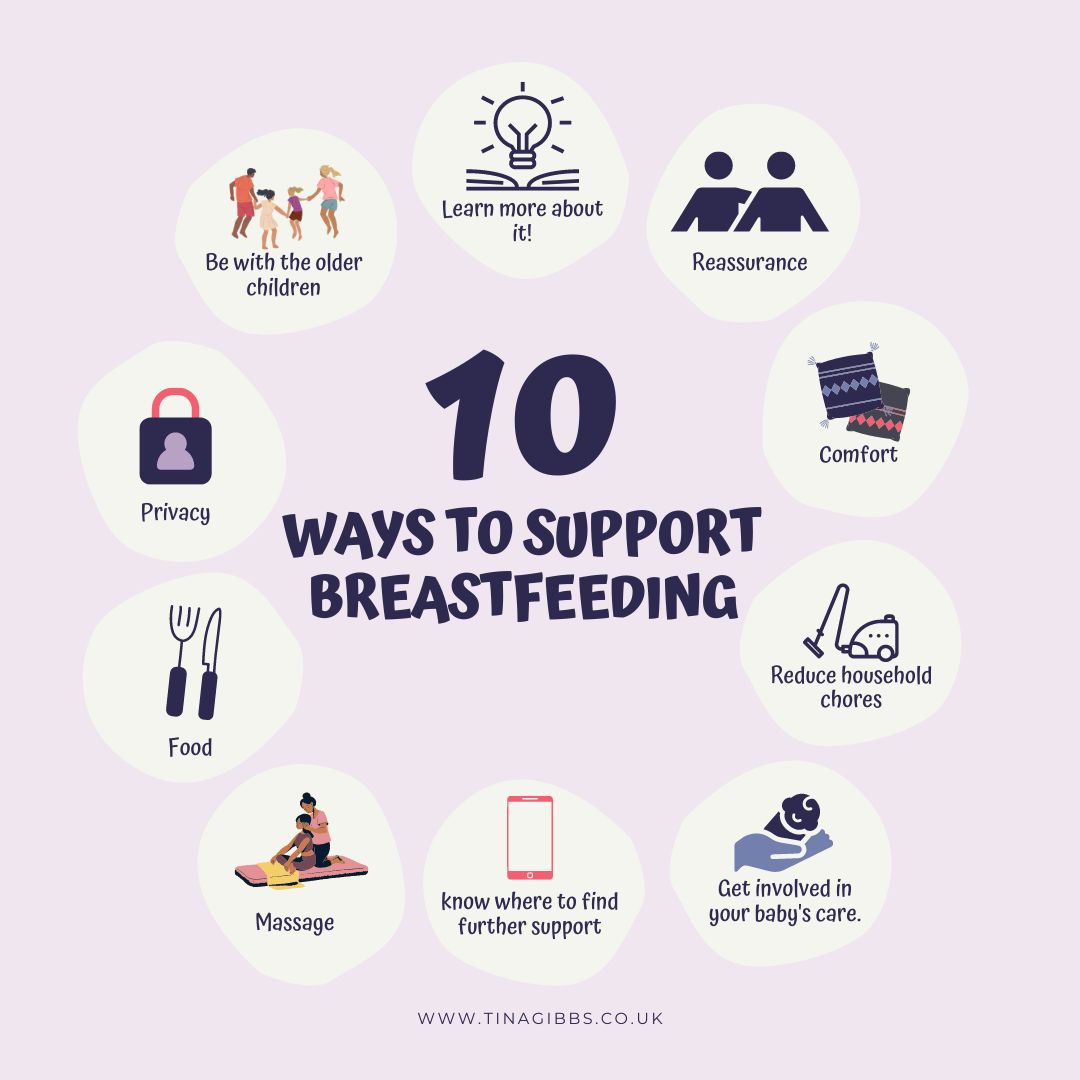
10 ways for partners to support breastfeeding

Fathers/Partners support breastfeeding

10 ways for partners to support breastfeeding. You are a new parent and your partner is breastfeeding/nursing/chestfeeding your baby or they are planning to. During antenatal classes I often get ask how partners, dads, friends and family members can support the breastfeeding/nursing/chestfeeding mother/parent.

Knowledge – Learn about breastfeeding

The first step to support someone who is nursing is to have some [basic] knowledge about how it works. Put in some time and effort to learn about the physiology of breastfeeding/nursing/chestfeeding, then you’ll be the best support your partner can hope for. An interesting and fun to read book is Kate Evan’s “Food of Love” (amazon affiliate link). For further websites and books, please see the sources and further reading section at the bottom of this page.

Reassurance

Reassuring your partner that you are there for support, encouraging words and being positive about their progress, will help your partner on their breastfeeding/nursing/chestfeeding journey. Like with every new skill a person is learning, reassurance and praise are a great help!

Comfort

Your partner may be feeding your baby for quite some time. That there is a comfortable, relaxing space for them is important. Ideally help set up a nursing nest with cushions, snacks, remote control, a book, muslin squares, a drink! (hydration is important for the milk production and flow) etc… A lot of parents chose to have a little basket that they keep nearby when they are feeding their baby.

Reduce household chores

Help and support by reducing household chores. Take on more than your usual household chores and/or get help such as a doula, cleaner, dog walker… The more your partner can focus on feeding your baby the more successful the journey will be.

Get involved in your baby’s care in other ways

Other than feeding, your baby will need a lot more than that. Get involved in their care by playing with them, reading stories, bathtime, changing nappies, taking them for a walk, cuddles…. That way your partner will be able to find some time for themselves to recharge, have a shower etc. and you can bond with your baby also.

Know where to find further support

It is important to know where you can get further support. Many places in the UK run regular breastfeeding peer support groups in-person and online. It is a good idea to find out about them while your partner is still pregnant. Encourage your partner to go along to one or more while you are waiting for your baby to be born. You can also find lots of valuable support and information on the Breastfeeding Network’s website!

Massage

Offering a massage can be really helpful to encourage milk flow and increase comfort. The hormone oxytocin lets the milk flow. Not everyone is a fan of massages but if you are, it’s a great way to support the milk flow!

Food

Feeding the breastfeeding/nursing/chestfeeding mother/parent is feeding your baby. Ensuring that there are plenty of nutritious food and some treats available is key to comfort, milk production and a rewarding feeding experience. Top tip: food that can be eaten with one hand and without cutlery is the most practical while feeding a baby. A pizza cutter, to cut any food can be helpful, as you can operate it with just one hand!

Privacy

Too many visitors in the first few weeks as a new parent can negatively influence the baby feeding experience. Help by keeping visitors to a bare minimum or inviting them for after breastfeeding/nursing/chestfeeding is established.

Other/older children

If you have older children, look after them while your baby is being fed. It can be incredibly helpful to be able to just focus on feeding your baby without having to worry about the wellbeing of the older siblings.

Posted on Leave a comment

Bottle-feeding for breast-fed babies

love cute kids baby

Bottle-feeding for breast-fed babies

How to get my breast-fed baby to take a bottle?

To be perfectly honest, just like many things when it comes to birthing your baby and raising your children, it is a lot of trial and error. There is no one-fix or quick-fix solution. Every baby and baby-parent relationship are unique. Your journey is unique.

The following suggestions on how to introduce bottle-feeding to your breast-fed baby, come from years of experience of working with new parents.

When to start introducing a bottle to my breast-fed baby?

Depending on why you are planning on introducing a bottle and whether you wish to continue to breast-feed or mixed-feed, timing is up to you. Some parents have to stop breastfeeding before they wanted to due to medical reasons, or because they are going to be away from their baby. Others choose to stop completely or to start mixed-feeding as their personal preference. Anything is possible. There is no one best time to start as again, you, your family and circumstances are unique.

How to start introducing a bottle to my breast-fed baby?

  • Choose a day when your partner or primary support person will be available
    • Your baby may accept a bottle more easily from someone other than you / the breastfeeding mother or person. They know their milk comes from you and may not understand why it is now offered from this new object (the bottle).
  • Choose a time when your baby is settled and patient.
    • An settled baby is usually more receptive of changes and new things
  • Offer the bottle about 1 hour after a breastfeed at first. Start with a small amount of breastmilk or formula milk such as 1/2 ounce.
  • Offer the milk at the “right” temperature.
    • Breastfed babies are used to drinking their milk at a body temperature of approximately 37 degrees Celsius. They can be a little more particular about the milk temperature. Warm up refrigerated milk in a bowl of warm water, in a bottle warmer or under warm running water. Cool down freshly prepared formula milk in a bowl of cold water or under cold running water.
  • Leave the room/house
    • Sometimes it may be necessary for the breastfeeding mother or parent to leave the room or even the house, so that your baby cannot smell your milk.
  • Be patient
    • Tickle your babies upper lip with the bottle teat, letting your baby “latch on” to it like they would to your breast. If they get upset and haven’t eaten anything after 10 minutes, stop and try again later or the next day. Responsive bottle-feeding or paced bottle-feeding
  • Bond with your baby
    • Talk to them, look them in the eyes. Skin-to-skin when introducing a bottle can help, too. Skin-to-skin contact helps your baby to relax and settle, while it’s stimulating their digestion and interest in feeding.
  • The teat and bottle
    • try different teats and bottles. You may be lucky that the first one you try works for you and your baby but if it isn’t there are many more…
      • short round teats with a wide base are believed to be the encourage a similar experience and movements to breastfeeding.
      • some babies gag on longer teats, therefore, shorter teats seem preferable.
      • warm the teat with warm water before feeding
  • Positions
    • Try different positions. Preferred positions for breastfeeding are often different than those preferred for bottle-feeding. Maybe try a facing out position, so your baby can look around the room. Sometimes walking around the room while feeding can help, too.
  • Try feeding from a spoon, sippy cup, doidycup or small open cup
    • If you don’t wish to use a bottle or you’ve tried everything and it hasn’t worked out for you and your baby, you may try feeding the baby with a spoon, sippy cup, doidycup (baby/toddler training cup) or small open cup. Hold the baby in your lap in an upright, supported position. Bring the spoon or cup to the baby’s mouth and allow the baby to take the milk herself by just touching the milk in the spoon or cup to the baby’s upper lip. Let the baby set the pace. Be very careful to not dump the milk into the baby’s mouth to avoid choking.

Responsive bottle-feeding or paced bottle-feeding

For any parent who chooses to feed their baby with a bottle, responsive or paced bottle-feeding is the current recommendation by the NHS (at the time of writing this in 2022).

Recognize feeding cues. Feed your baby when they are showing signs of hunger.
Hold baby close, in a semi-upright position during feeds.
Tickle your baby’s nose with the teat to encourage them to open their mouth wide. Keep the bottle in a horizontal position.
Watch your baby and follow the cues for when they need a break.
Your baby will know how much milk they need. Follow their lead.
Responsive Bottle-feeding or paced bottle-feeding
Responsive Bottle-feeding or paced bottle-feeding – a visual guide

Here is a video on paced bottle feeding:

Sources, References and Further Reading

DiSantis KI, Hodges EA, Johnson SL, Fisher JO. (2011) The role of responsive feeding in overweight during infancy and toddlerhood: a systematic review. International Journal of Obesity. 35:480-492.

https://www.nature.com/articles/ijo20113

First Steps Nutrition Trust

https://www.firststepsnutrition.org/parents-carers

https://www.firststepsnutrition.org/infant-milks-overview