Posted on — 1 Comment

Top 9 Childbirth Affirmations

positive birth affirmations

Before I share my personal top 9 childbirth affirmations, I’d like to explain a little bit more about them.

What are affirmations?

Affirmations, aka positive affirmations, are phrases that you repeat to yourself over and over again to change your mindset. You can say them out loud our in your head. Receive them as part of treatment with your hypnotherapist or other therapist. Most commonly they help you to change a negative into a positive thought or negative into positive thinking.

Affirmations can help you feel more in control and empowered during your birth experience.

Affirmations can improve your ability to problem-solve and decision-making while under stress such as during labour and birth. Making the right decisions for you and your birth enables you to feel empowered while birthing your baby!

My top 9 affirmations for childbirth are:

Writing your childbirth affirmations

Remember, that our conscious and subconscious usually only process the key words. Words such as “don’t” or “no” get lost in the process. So rather than saying to yourself “I mustn’t forget to take my keys” say “I must REMEMBER to take my keys”. For example, if I ask you to NOT think about pink elephants, all you can do is think about just them, the pink elephants. The elephants in the room. So, when you are writing your affirmations for birth, remember to pick statements and trades that are true and important to you.

Now, you are all set up to write your affirmations!

I also have a hypnobirthing affirmation script (including recording) available from my shop. The script has room for your own affirmations and tick-boxes for the ones that you like!

Please also check out my online course! No videos, just text and images to learn in your own time. Includes hypnobirthing mp3s, scripts, workbook, handouts, infographics and much more! Lots and lots of information at your fingertips! Includes:

  • hypnobirthing mp3s
  • hypnobirthing scripts
  • written information
  • infographics and other imagery
  • printable handouts
  • printable workbook/journal

Sources and Further Reading

Posted on — Leave a comment

Teaching about induction

Teaching about augmentation and induction of labour as part of childbirth education classes has become an essential topic. Expectant parents need to know the pros and cons, different options and reasons for the recommended induction of labour.

In my opinion, teaching about induction and augmentation of labour means to explore:

  • Common reasons for the recommendation, and why the recommendations are made, how important the reason is, what evidence there is to support the recommendation
  • Different options of for induction and augmentation, i.e. membrane sweep, drip, etc
  • Timeline of induction and augmentation of labour – what may be offered when and why
  • Options of “self-induction” – how can we encourage labour to start on its own?
  • Reputable sources of information to support informed decision-making (some are listed below)
  • Their Birthrights (Human Rights in Childbirth)
  • How to feel empowered once/if they’ve agreed to an induction (support, informed decision making, best for them and their baby in their individual situation…)
  • How to adapt their birth plan

Teaching about induction and augmentation of labour ideas

Discussion

Have a discussion in class about reasons, ways and pros and cons of inducing labour. My induction discussion prompt cards are a visual way to encourage expectant parents to discuss the topic. They are also available as ready printed version and both versions include full instructions including links and references.

Timeline

Explore what methods of induction and augmentation may be offered/happening when, using one of my labour timeline banners.

timeline banner - induction and augmentation of labour

Informed Decision Making Game

One of my personal favourites is an informed decision making scenario game. This also works for teaching about induction and augmentation of labour! The way it works is that you start off with one scenario and give two or more options. Let participants choose one of the options. Each option/choice develops the story further. You’ll get different outcomes when making different choices. Some are choices others are chance as you roll a die or two. This is a fun way to explore how different choices may impact your birth experience. This game works in a in-person class, virtual class as well as for homework.

I also offer workshops on how to write and build your own interactive informed decision making game!

Teaching about induction of labour using visuals

To help include all different learning styles and your clients’ preferences use a mixture of visuals, taktile interactions as well as the written word! I have a range of visual learning aids ready printed as well as digital downloads available from my shop.

Posters

I like to use posters and hang them up on the wall or in the windows during sessions. Posters support the information and retention during the course. I have created these beautiful posters on “self-induction” called “How to encourage childbirth/labour to start”. They are a very recent (2023) addition to my shop and classes and are very positively received by clients as well as birth workers!

Workbooks/Journals/Worksheets

I also provide my clients with a journal/workbook the workbook includes images and information about childbirth and infant feeding. They can take it home and recap and/or take notes during the workshop.

I can also create personalised workbooks, activities, posters and powerpoints for you to fit your branding and content preferences. Please get in touch!

Posted on — Leave a comment

Hypnosis and Mindset Iceberg

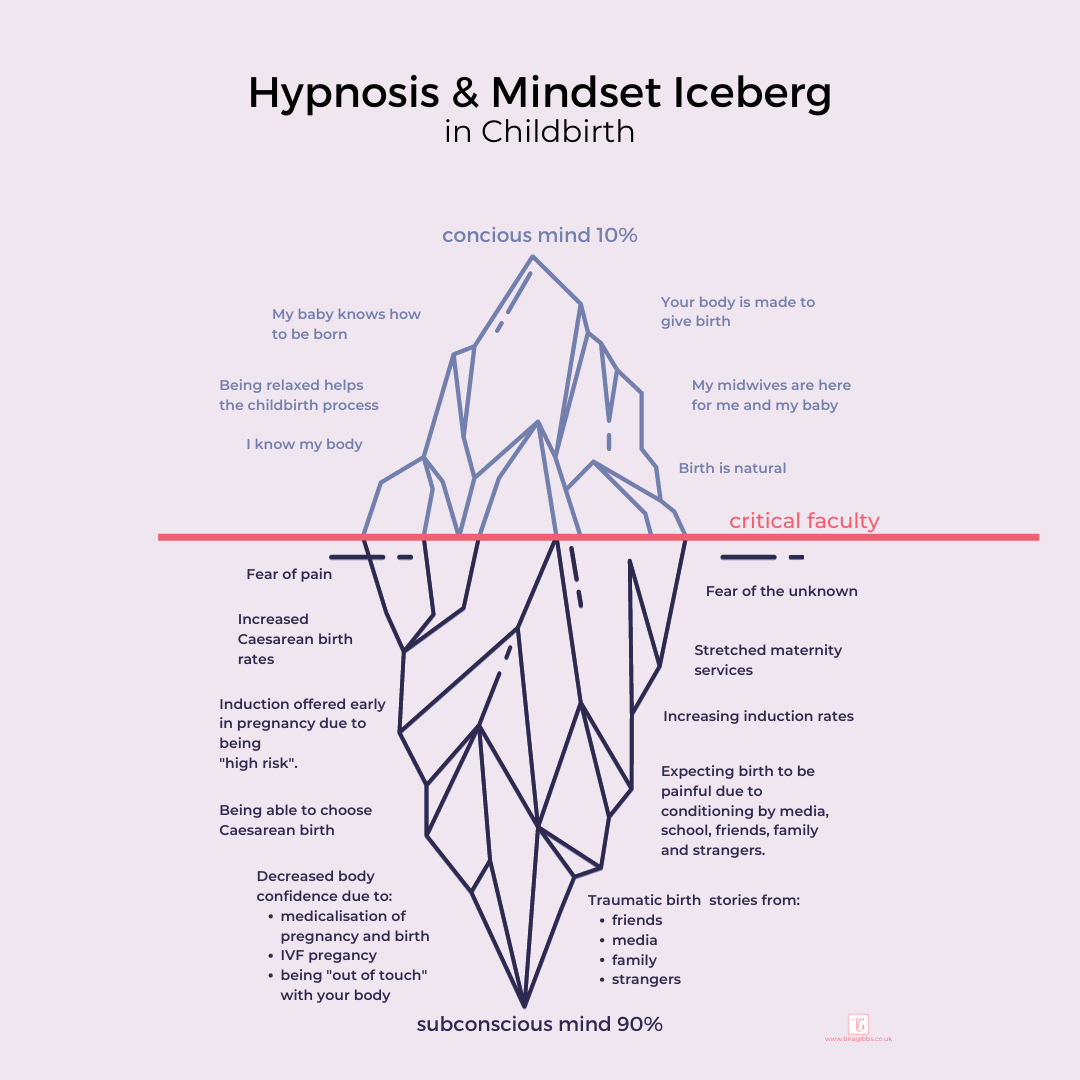
The Hypnosis and Mindset Iceberg. The conscious and subconscious mind and the critical faculty. How does that apply to childbirth?

Let’s think about that. When you look at an iceberg and you can see the tip of it, you can only see a small part of it. The majority is hiding underwater. So now how does that apply to hypnosis and your mindset for childbirth?

Consciously you know, that childbirth is a natural process and the majority of babies can be born without assistance. We know that when we relax, more oxytocin flows, which gives helps the birthing process along by giving you strong regular contraction waves. So why do so many expectant parents struggle to relax during the birth or even during their pregnancy? Because throughout our lives we hear and start to believe that childbirth is painful. The media, family or friends are telling us so. When you are pregnant tests, appointments, scans, precautions etc reinforce the believe that birth needs interference. You sometimes even hear a traumatic birth story from a stranger while waiting at the checkout!

So your conscious mind is the tip of the iceberg and your subconscious mind is the base. This is your Hypnosis and Mindset Iceberg:

Overcoming the Iceberg

When you practise self-hypnosis and mindfulness during your pregnancy, you can use these techniques to help to turn down or off your subconscious mind. It’ll help you to focus on the here and now and make the right decisions for and during your birth experience! Remember, practice and reinforcement of the techniques is the key to an empowered birth experience!

Book your 1:1 mindful hypnobirthing experience with me to learn your techniques to combat the Hypnosis and Mindset Iceberg.

Please also check out my online course! No videos, just text and images to learn in your own time. Includes hypnobirthing mp3s, scripts, workbook, handouts, infographics and much more! Lots and lots of information at your fingertips! Includes:

  • hypnobirthing mp3s
  • hypnobirthing scripts
  • written information
  • infographics and other imagery
  • printable handouts
  • printable workbook/journal

For perinatal educators:

The “Hypnosis and Mindset Iceberg” poster shows an image of an iceberg, where you can see the tip of the iceberg as well as the underwater base of the iceberg. Use it in antenatal or parenting classes to explore expectant parents’ feelings. Where they come from and how the subconscious can influence your decision-making, mindset as well as birth, feeding or parenting experience. An excellent resource for your perinatal education setting!

Hypnosis Iceberg Sources and Further Reading

All were accessed on the 24th January 2023.

Please note that I am in no affiliation with the owners of the websites above.

Posted on — Leave a comment

Teaching physical skills for childbirth

Teaching physical skills for childbirth

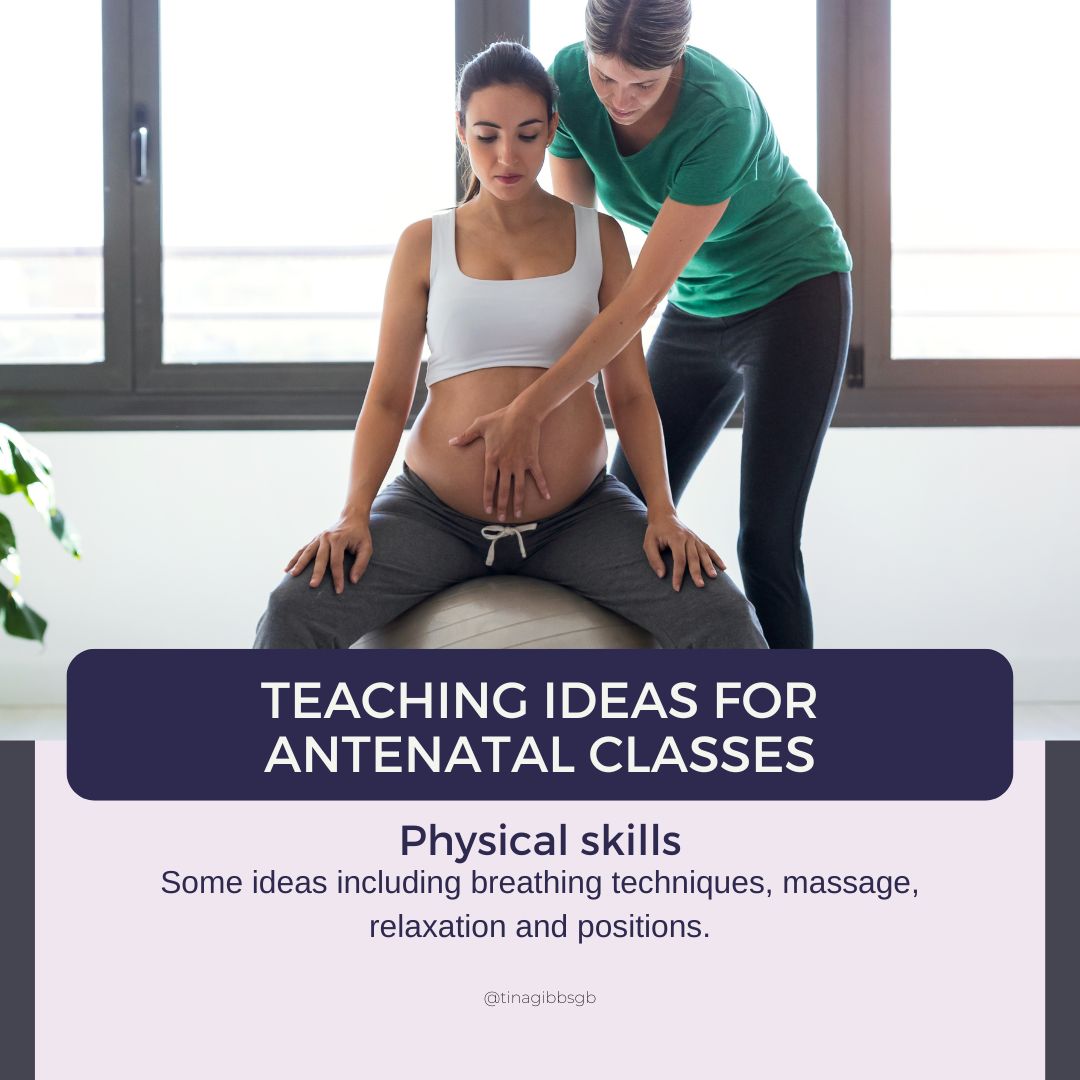
Teaching physical skills for childbirth is one of the most important lessons of your childbirth preparation classes! So how to go about it? It is important to note that your clients usually want to practice their physical skills, rather than just hear about them. From experience, I’d say you spend about 10% of the available time explaining the activity, then another 10% demonstrating and then let your clients have 80% of practice time. You can go around and give them individual feedback and guidance while they are practicing their new skills.

For example if you have 20 minutes for an activity, you spend a maximum of 2 minutes explaining, followed by a maximum of 2 minutes demonstration. Following that, your clients have 16 minutes to crack on with it! Alternatively, you could divide your time into two 10-minute slots. For example 1 for a deep breathing technique and the other for a massage technique. Then while trying out the massage technique, ask your clients to combine it with the learnt breathing technique from the previous part…

One idea which is always well received when teaching about physical skills for childbirth is the Ice Cube technique. Parents-to-be hold an ice cube and practise learnt or new coping skills to help them cope with the strong sensation. Parents-to-be can physically experience how breathing, massage, etc. can help them during labour and birth! A fantastic interactive and memorable way to facilitate learning physical skills for labour and birth!

Another great way is a labour rehearsal. Set up the room with some relaxing music, dim the lighting etc. Encourage parents to practice different positions for labour and birth using worksheets, cards or a poster. Alternatively, you could you my labour board game!

Observe others how they teach physical skills. Give each other feedback and share what worked for your clients and yourself and what didn’t go so well. Please feel free to share your experiences and ideas here in the comments or email me!

References and further reading:

  • Buckley SJ. (2015) Hormonal physiology of childbearing: Evidence and implications for women, babies, and maternity care. Washington, D.C.: Childbirth Connection Programs, National Partnership for Women and Families. Available from: https://www.nationalpartnership.org/our-work/resources/health-care/maternity/hormonal-physiology-of-childbearing.pdf [accessed: 9th January 2023]
  • Declercq, E. R., Sakala, C., Corry M. P., et al. (2014). “Major Survey Findings of Listening to Mothers(SM) III: Pregnancy and Birth: Report of the Third National U.S.
    Survey of Women’s Childbearing Experiences.” J Perinat Educ 23(1): 9-16.
  • Gupta, J. K., Sood, A., Hofmeyr, G. J., et al. (2017). “Position in the second stage of labour for women without epidural anaesthesia.” Cochrane Database Syst Rev
    5: CD002006.
  • Kibuka, M. and Thornton, J. G. (2017). “Position in the second stage of labour for women with epidural anaesthesia.” Cochrane Database Syst Rev 2: CD008070.
  • Odent M. (1999) The Scientification of Love. London. Free Association Press.
  • Thies-Lagergren, L. (2013). The Swedish Birth Seat Trial. Published by Karolinska Institute. Printed by US-AB digitaltryck.