Posted on

Baby Weaning – signs of readiness

starting solids baby weaning

Baby Weaning or starting solid foods with your baby. How do you know when, how and where to start? Where can we find some tried and tested recipes? Are we exploring baby-led-weaning (BLW) or are we starting our baby on purees first? So many questions new parents have with regards of weaning their baby.

The current recommendation (at the time of writing) is to start weaning your baby around 6 months of age.

Baby Weaning – Signs of readiness

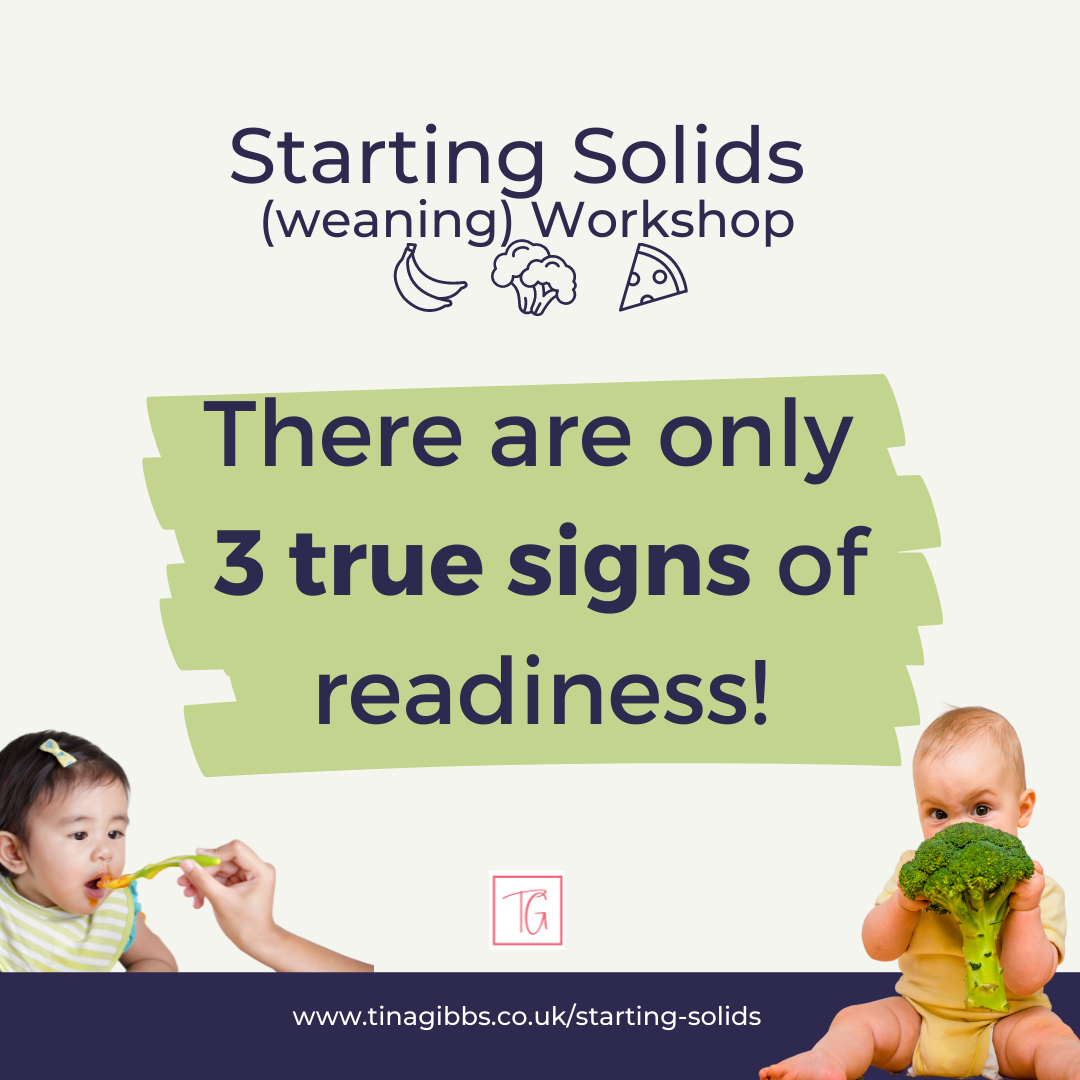
There are (only) three true signs of readiness

Your baby…

  1. can sit up unaided and hold their head steady.
  2. puts things to their mouth accurately
  3. has lost their tongue thrust reflex and can swallow

The golden rules – How to start

When introducing solid foods to your baby and during their first year of life follow these golden rules:

  • Offer simple and unprocessed foods – Make the main part of the meal of simple and unprocessed foods.
  • Offer natural foods – Your child needs to see & touch their food so that they can
  • connect food tastes with how things look and feel – this enables them to learn how to choose foods for themselves.
  • Let your baby get involved in the eating experience – Make eating a pleasurable, calm and relaxed experience. Eat together with your baby. Starting solid foods is not just nutrition it is learning and play, too!
  • Avoid ultra-processed foods – If there are too many ingredients on the label (5+) avoid giving it to your little one!

Baby-Led Weaning or Purees?

Start introducing solids at about 6 months of age alongside breastmilk or infant formula. Your baby’s milk will still be the main source of energy and nutrients for your baby.

Whether to start off with purees, finger foods or a combination pretty much depends on your baby, your personal preferences and your life style.

Some babies will happily start off with finger and mashed foods, and may move on swiftly to a range of tastes and textures. However, other babies may progress
more slowly and start off eating smooth foods off a spoon. When spoon-feeding, offer foods they can hold themselves alongside, to encourage your baby to move on to mashed and finger foods.

  • Smooth foods have no big lumps, pips, seeds or skin.
  • Mashed foods are raw or cooked foods mashed to a slightly lumpy consistency.
  • Finger foods are raw or cooked foods shaped/cut into batons. It is best to cut them bigger than a baby’s hand, so that your baby can hold them more easily. Use your (adult) finger as a sizing guide.

Always pay attention to your baby when they are eating. Never leave them alone.

Finger foods – tips for parents
  • Remove any pips, stones or stringy bits
  • Cut foods such as grapes, blueberries in half or quarters
  • Avoid nuts, popcorn and any hard-ish chunks of food
  • Stay with you baby when they are eating
  • Start off with soft and cooked foods such as vegetables and fruit
  • Wash your raw foods thoroughly

Learn more about weaning your baby

If you’d like to learn more about weaning your baby, book a starting solids (weaning) workshop with me! I offer the workshop in different formats:

1:1 (up to two adults with their baby/babies) or group (up to 8 adults with their babies). You can book these in-person to be held in Scarrington, Nottinghamshire at my home or I can travel to your home with a 10-mile radius of Scarrington/Bingham. Alternatively, I also offer a online live video course option.

In addition to the traditional starting solids workshop, I also offer a live online cook-along version. This is available online and as a 1:1 format only.

Posted on 2 Comments

How does hypnobirthing work?

How does Hypnobirthing work and what is the difference between hypnobirthing and mindful hypnobirthing?

Hypnobirthing is a method to help women and birthing people to keep calm during pregnancy and childbirth.

There is not much research around hypnobirthing available. However, from my experience of giving birth to my four children and supporting families since 2010, I would encourage any family to explore hypnobirthing.

So how does hypnobirthing work? Do you have to be a Hippie?

Hypnobirthing [Hypnosis] works with the power of suggestion. Your practitioner works with you using affirmations, visualisations and suggestion to help you [the birthing mother/person] to relax your body and mind, guide your thoughts as well as control your breathing. Your practitioner does not need to be present during the birth, but you’ll have to practice your techniques thoroughly to fully benefit from them and for hypnobirthing to work for you!

You can learn the techniques during an in-person workshop, or online in a group or a private 1:1 setting. Some parents chose to simply do a self-paced online course or read a book.

Benefits of Hypnobirthing

  • Alternative for anyone who is looking for a non-medical pain relief method
  • Can be used alongside medical and other pain management methods
  • Non-invasive
  • Accessible to anyone who practices
  • No adverse health outcomes / side-effects known
  • Inexpensive
  • The skills learnt are transferrable

Disadvantages of Hypnobirthing

  • Learning the techniques takes time and effort and requires practice
  • The language used in a hospital setting may disrupt the hypnotic state
  • Not provided by the NHS
  • Not everyone can afford a workshop or practitioner
  • Families [mostly first-time parents] have reported that their relaxed state was misinterpreted by medical professionals [midwives] at arrival at the hospital and seen as not ‘far along enough to stay’.
  • May not meet your expectations
Hypnosis + Mindfulness = Magic

WHAT IS HYPNOBIRTHING?

Hypnobirthing is a range of hypnosis techniques to help keep you calm and relaxed during the birth.

Why is being calm and relaxed during birth so important?

Well, it’s pretty basic. Our survival instinct makes it important!

Naturally and instinctively, all mammals – including humans – have a fight or flight response when in danger. So when we are scared or anxious our bodies produce stress hormones to help us deal with the situation. Some situations will require us to run and act quickly and the stress hormones help us do so. These protective stress hormones (including adrenaline) block any non-essential systems such as our digestive system and raise our blood pressure and heart rate. Our blood is diverted away from our brain, uterus etc. into our legs and arms.

Adrenaline, while it is a life-guard hormone also slows down labour by inhibiting the hormone oxytocin…

Oxytocin is the hormone of love, labour and lactation. It gives us uterine contraction but also clouds our perception of the intensity. Your natural oxytocin makes you feel better, happier and let’s your body-own pain killers (endorphins) thrive, too.

Nobody wants to give birth in an uncomfortable or unsafe environment

The way our body responds to the environment around us is rooted in the basic survival instinct that we used thousands of years ago. Of course we all know know that your midwives and other healthcare professionals won’t hurt your baby, but we are still ‘triggered’ by the ‘strangers’ in the room and/or the unfamiliar environment. These triggers make us feel out of control and maybe unable to birth our babies without fear and pain taking over. Hypnobirthing techniques aim to deal with your anxieties around childbirth, and to help you create a ‘safe place’ inside your head that you can retreat to at anytime. Other techniques include the toning down of unwanted sensations and thoughts.

What is Mindful Hypnobirthing?

Mindful Hypnobirthing was first introduced by Sophie Fletcher in her book Mindful Hypnobirthing. Sophie Fletcher was the first to combine Hypnosis with Mindfulness for Childbirth.

Hypnosis

Hypnosis is the being in a state of consciousness in which one seemingly loses the power of voluntary action. Furthermore they are highly responsive to suggestion or direction. The recipient is always in control of how deep the hypnosis goes and will only accept suggestions/changes which they are willing to make.

Mindfulness

Mindfulness is a state of mind where you are aware and live ‘in the moment’. You are paying attention to the here and now. Your awareness is in the present moment while you are calmly acknowledging and accepting your feelings, thoughts, and sensations.

Mindful Hypnobirthing combines both self-hypnosis as well as mindfulness techniques to enable you and your partner to have an empowered, calm and positive birth experience. I am offering 1:1 mindful hypnobirthing sessions online and in the comfort of your own home.

Mindful Hypnobirthing in Bingham and online with Tina Gibbs
positive birth affirmations
Posted on

Pregnant again

pregnant again

Congratulations! Being pregnant again is especially challenging when the next older child is still very young. Having a toddler and being pregnant can be very hard work! You are of course tired because you’re pregnant but also, you cannot nap in the day as easily. The best thing for you and your family in this situation is to accept help. If you are lucky enough to have family or friends offering to look after  the older one(s), take it! If your older one(s) is/are in school or nursery, rest when you have some time to yourself.

When and how are you going to tell your older child or children?
Well, everyone is different. Some parents tell their children as soon as they know, others like to wait longer. There is no right or wrong. Sometimes it depends on the age of the older ones. If you have a toddler to explain the situation to, it might be a good idea to get a baby doll for them. They can then explore how to treat a baby and get used to the idea of having a baby around.
There are some things you can do to prepare yourself and your toddler or child for the new arrival:

  • If you are thinking of moving older siblings to new rooms, it may be easier for them if you do it before the new baby arrives. They may be less jealous if your new baby was not the most obvious reason. Maybe saying you are moving to a big-boy/girl-room now…
  • A new baby could give older siblings (especially if they are very young) a present to start off on a good note 🙂
  • Maybe you’d like the older sibling(s) to get involved in packing your birth bag?!
  • Think about who would be able to look after older siblings, while you are pregnant and need a rest, when you give birth and for the early days
  • Only because you feel like you don’t give your second child as much attention as you did your first one, that does not mean that you are less attached to one or the other.
  • It is okay to sometimes use the TV or other electronic devices to keep the older child or children occupied while you are resting and once your new baby is born 🙂
  • Eat healthily and get plenty of fresh air and sunlight that will help with the tiredness, while you have to limit your caffeine intake.
  • Look after yourself and remember to take folic acid from the time you start trying to conceive and until at least 12 weeks of pregnancy.
  • Practice your breathing and relaxation techniques for labour and birth daily.
  • Try to gently exercise / go for a walk regularly; this will keep your energy levels up!
  • Maybe you’d like to watch some birth videos with the older sibling(s). I suggest that you watch them by yourself first and then choose one or two to watch together. I have created a library of birth videos. There is even a section of other mammals giving birth!
  • You can also book a private 1:1 antenatal session with me for you to prepare yourself and your partner for the birth. In addition to that, I have my lovely Mamamor dolls, which I can use to demonstrate vaginal as well as caesarean birth to children or adults (see demo videos below).

If you are pregnant again and your previous birth was traumatic, it may be beneficial to speak to a doula or perinatal educator who is trauma informed. A non-jugemental approach to your new pregnancy and birth experience to help you to achieve a positive birth experience this time round. My wonderful colleague Sheryl (@simplynatal) calls it your Healing Birth.

You’ve got this!!