Posted on Leave a comment

The role of the birth partner

role of the birth partner at a caesarean birth

The role of the birth partner includes many different ‘hats’. But it could be as simple as being there… The key is the partner’s presence. Being there in the moment, being the guardian of oxytocin, the birth keeper, the advocate. Your role will be led by the birthing mother/person who you are supporting.

Who can be a birth partner?

A birth partner could be the father or other parent of the baby, the pregnant woman’s/person’s partner, a friend, a family member or a professional birth partner such as a doula.

What does the birth partner’s role include?

During the birth, the role of the birth partner may include:

  • offering massages
  • reading hypnobirthing scripts
  • advocating for the birthing mother/person
  • reminding to go to the loo
  • keeping the birthing woman/person hydrated and engergized
  • supporting words and touch
  • protecting the birthing space
  • ….

Here is a great example of a birth partner advocating for the birthing woman’s options:

How can I prepare for the role of the birth partner?
  • Have a discussion with the pregnant mother/person about their wishes and birth preferences.
  • Plan the route to hospital/birth centre and which entrance to use at different times of the day or night – although google maps timings are pretty accurate
  • Know where the birth bag is
  • Familiarise yourself with the contents of the birth bag aka hospital bag, maybe get involved in packing it, so that you can find things quickly if you need them
  • Think about ideas how to time contractions without a watch/clock – watching the clock may create unwanted tension in the mother’s/birthing persons’ mind and body. Be creative!
    • I’ve seen families watching a series with approx. 30 minute-length episodes and they’d count how many contractions they had in 30/60 minutes.
    • Others had a 30/60 minute playlist and would count the number of contraction waves they had during that time.
  • You may need to speak to the health care professionals during the birth, if the person you are supporting cannot. Knowing the birth plan/birth preferences and being able to communicate wishes and symptoms clearly is beneficial
  • Look after your own needs, too. You can only support others when you are well and comfortable. The birth may take quite some time, so bring spare clothes and refreshments for yourself, too.
  • Bring a charger for your phone so that you are able to contact your family and friends when you need to (if that is what you have decided/agreed to do).
  • Most vending machines and car parks accept contactless payments now or you can pay by phone. You may not need loose change, but you may wish to check with your local hospital/chosen birth place.
  • Join the pregnant mother/person for their antenatal appointments and childbirth classes
  • I also offer live virtual birth partner workshops, where we look at different practical support options and practice movement, massage and breathing techniques. A workshop for you both to attend, to work together as a family/team.
  • Do your research about options, procedures and birth.

Please also check out my online course! No videos, just text and images to learn in your own time. Includes hypnobirthing mp3s, scripts, workbook, handouts, infographics and much more! Lots and lots of information at your fingertips! Includes:

  • hypnobirthing mp3s
  • hypnobirthing scripts
  • written information
  • infographics and other imagery
  • printable handouts
  • printable workbook/journal
Posted on 2 Comments

Your Birth Plan


Your birth plan or better birth preferences can be an important part of your journey into parenthood.

You may have heard people talking about their birth plan going out of the window or saying it is not worth writing one… In my opinion, as a doula and mother of 4, it is worth thinking about your birth preferences (rather than “plan”). You may or may not wish to put them in writing, that’s up to you. However, sharing and discussing your preferences, personal thoughts and feelings about the birth with your birth partner(s) is important.

positive birth affirmations
Information is power – write down your birth preferences!

You can go all out and make it very detailed, of course, but the more details you choose the less realistic your expectations may become. So, let’s focus on your main 4-5 preferences for the birth. Things that you are likely be able to control.

You may wish to consider:

  • Your birth place – where do you wish to give birth
  • The birth environment
    • who will be there (birth partner(s), doula, …)
    • what (home) comforts would you like to be there (music, blanket, cushion…)
    • what is the lighting going to be like?
    • is there music?
  • Birth Method
    • vaginal
    • caesarean
    • induction
    • in water
    • out of water
  • Your religion/beliefs/traditions
  • Your medical history and your individual options
  • Mention your medical pain relief preferences
    • don’t want any or
    • let me know when I can have the epidural or
    • I would like x but avoid y
  • You are allowed to decline all/any vaginal examinations at any point as well as any other form of physical touch. You can change your mind at any point. However, most women are happy to vaginal examinations, and consenting to them may help your midwife do their job.

The NHS website has a very detailed birth plan template, which you may wish to use to check that you’ve considered all your different options. However, you may not wish to use it as your actual birth preferences.

Think about it in a chronological order:

  • Early labour / at home
  • active labour / on the way to the hospital / while waiting for the midwives to arrive
  • established labour / at the birth place under midwifery care
    • transition
  • second stage / pushing
  • third stage / the placenta
    • the golden hour with your baby

If there are any of your preferences which don’t align with your health care provider’s recommendations, negotiate before the day, not on the day. In addition to that, it may be helpful to have a doula to help with your birth preferences and to ensure you have good evidence-based information. I offer private online or local in-person birth planning sessions.

Please also check out my online course! No videos, just text and images to learn in your own time. Includes hypnobirthing mp3s, scripts, workbook, handouts, infographics and much more! Lots and lots of information at your fingertips! Includes:

  • hypnobirthing mp3s
  • hypnobirthing scripts
  • written information
  • infographics and other imagery
  • printable handouts
  • printable workbook/journal

Some sources for good evidence-based information:

Posted on Leave a comment

Hypnobirthing FAQ

Hypnobirthing FAQ

Who is a hypnobirthing course for?

My hypnobirthing workshops are aimed at anyone who wants to give their baby a gentle and loving start in life. If you want a positive experience of birth that you can look back and treasure – for the rest of your life, then my workshops are for you. Suitable for all types of birth including induction and caesarean birth. Expectant parents are bombarded with images, videos and stories of childbirth as a negative event. During my hypnobirthing workshops we’ll explore your thoughts, fears and experiences and help you regain your faith in your body and choices. Empowering you to make the right choices for your positive birth experience; and look forward to your birth experience.

When should I go to a hypnobirthing course?

Hypnobirthing courses are suitable from 20 weeks of gestation. Ideally, you’d like to give yourself and your partner some time to practice the techniques you learn during the course. The more you practice, the better it’ll work for you. However, most expectant parents join a class around 32-35 weeks of pregnancy.

Does my birth partner have to attend the course?

I strongly encourage birth partners to attend the course. Your birth partner is an essential part of your day and they’ll benefit from learning about your options and challenges during birth. It’ll help them to be more confident in supporting you.

Do I have to have a birth partner?

That’s up to you. Some mothers decide to have their partner or/and a doula or friend present at the birth, others chose to be on their own. It can be beneficial for the birthing process to have a familiar face in the room to keep you grounded, calm and comfortable. If you do have a birth partner, please encourage them to come along to the workshop!

I have experienced a birth trauma/negative birth experience – is hypnobirthing for me?

I am a trauma-informed doula and hypnobirthing practitioner. Hypnobirthing is your chance to do things differently this time, and maximise your body’s ability to have a positive and satisfying birth experience. Depending on whether you have or not dealt with your experience, you may also benefit from my birth trauma services before you are giving birth or trying to conceive.

What if I had a previous caesarean birth?

My hypnobirthing workshops can help you towards a VBAC (vaginal birth after caesarean) by helping you to stay calm and confident throughout the birth. I have worked with many clients towards a positive VBAC experience. If you would like another caesarean birth this time, my hypnobirthing workshop can help you towards a gentle caesarean birth.

Does hypnobirthing replace medical pain relief options?

The short answer is no. The techniques you learn can be used instead of or alongside medical pain management options. However, using hypnobirthing techniques does increase your chances of using fewer pharmaceutical pain management options.

How does hypnobirthing work?

See my post “how does hypnobirthing work?”

What do midwives think about hypnobirthing?

That depends of course on the midwife… However, many midwives are also trained in hypnobirthing and teach hypnobirthing. If your midwife is not supportive, ask for a different one!

Do I have to have a homebirth?

No. Hypnobirthing is suitable for any birth environment.

Does hypnobirthing work for subsequent births?

Yes. Hypnobirthing works (if you practice!) for any birth.

How can my partner support me with hypnobirthing?

Coming along to the hypnobirthing workshop is a great start! Your partner may also wish to read up about hypnobirthing but that’s not essential. Have a look at my blog post “How does hypnobirthing work?” to find out about the science of hypnobirthing.

Posted on 2 Comments

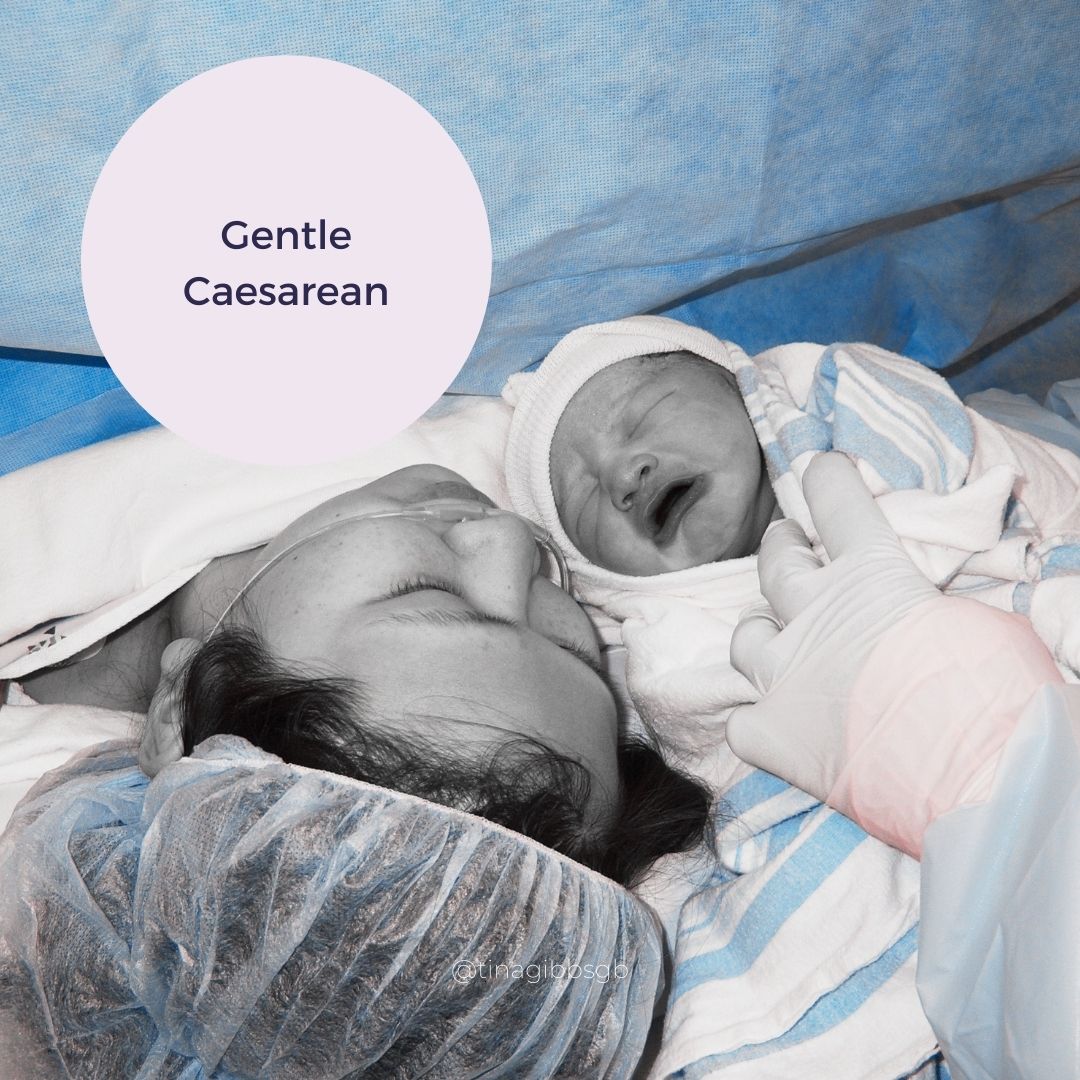
What is a gentle Caesarean Birth?

What is a gentle Caesarean Birth or Caesarean Section and why should expectant parents know about it?

Gentle Caesareans mimic some of the natural processes of giving birth:

  • A drug to encourage uterine contractions is given to the mother, so that your baby gets ‘pushed’ out by your uterus rather than pulled by the obstetrician.
  • A better view of the birth. You can ask for transparent drapes or have the drapes lowered early so that you can see your baby being born.
  • Immediate skin-to-skin contact (Most NHS trusts offer/encourage this as part of any birth, your baby’s health permitting).
  • Optimal (aka delayed) cord clamping. Wait until the umbilical cord stops pulsating.
  • Less restrictive equipment. Your IV line may be put in your nondominant hand, leaving your dominant hand free to hold your baby. The EKG leads can be placed on your back or lower chest instead of your upper chest, so they don’t get in the way of skin-to-skin. (Most NHS trusts offer this as part of any caesarean birth).
  • Dimmer lighting, especially at the time of your baby’s birth. (Most NHS trusts offer this as part of any caesarean birth).
  • Reduced noise and background music of your choice. (Most NHS trusts offer this as part of any caesarean birth).
Video of a gentle Caesarean at Nottingham City Hospital – Note: due to some graphic content shown in the video, the video is age-restricted and you’ll have to login to youtube and watch it there.

A gentle Caesarean Birth seems less like a major abdominal surgery for the mother and more like a vaginal birth. However, although the gentle caesarean is gentler to the baby the recovery post surgery for the mother remains the same. It still is major abdominal surgery.

Who is in the theatre during my gentle caesarean birth?

As in the video above, there are usually quite a few people in the room. They will all introduce themselves with their name and role. Have a look at the video below, it shows one example of a possible setup in the operating theatre.

Regardless of whether you are planning a caesarean birth from the get go, or something has come up during your pregnancy and a caesarean birth seems to be the safest option for you, it is worthwhile exploring your options. What choices do you have for your birth experiences? Which aspects of your birth can you control?

Book a 1:1 birth planning session with me! For just £60 you’ll get 2 hours on zoom with me exploring your options and planning your birth!