Posted on — 3 Comments

Positive Birth Affirmations

Free positive birth affirmations to support you in your hypnobirthing journey.

Positive birth affirmations – also known as positive self-talk – are short, positive statements about birth.

Positive birth affirmations help programme your subconscious to tune into your natural ability to give birth, and into your strength and resilience. Letting go of fears and building confidence in your body is a big part of hypnobirthing, and helps you work towards a more positive birth experience. Remember: your job is to focus on your comfort and the birth you want – your midwives are there to support you and your baby.

You can write your own positive birth affirmations on cards or sticky notes and put them up around your home to read, take in and practise daily. Make them colourful and eye-catching, or keep them all the same – it’s up to you! Your body, your baby, your birth experience!

I have designed a few different styles of affirmations for you to download for free.

Print them and put them up around your home to create a wonderful, safe and inspiring environment in which to enjoy your pregnancy and prepare for your baby’s birth!

Top tip:

Print or make two sets of positive birth affirmations: one to keep around your home, and one to take to your birth space or put on a portable vision board for birth!

When it’s time for your baby’s birth, take your affirmations with you into the birth space. Every time you notice one, or your partner reads one to you, it will act as a trigger to help you relax, feel resourceful and welcome each contraction wave.

Every time you spot an affirmation in your home, look at it and take a moment to slow down, breathe and connect with your body and your baby!

You can download these positive affirmations for FREE and print them here:

Posted on — 1 Comment

Bonding with your baby in pregnancy

Bonding with your baby in pregnancy

Bonding with your baby can begin during pregnancy, while your baby is still growing in the womb. Pregnancy is a perfect time to start, and this early attachment is important for your baby’s development after they are born.

What can babies experience in the womb?

Sound

From around 18 weeks of pregnancy, your baby begins to hear sounds – all the gurgling noises inside your body, as well as your heartbeat. Babies still find a heartbeat comforting and familiar after they are born! From around 26 weeks, your baby may start reacting to sounds from outside. You could play music to them, or your partner could read them a story – a great way for the non-pregnant parent to start bonding. When they are born, your baby will recognise their parents’ voices (and those of anyone else you live with or spend lots of time with). As well as remembering sounds from their mother’s language, babies may remember music played to them in the womb.

Bonding with your baby in pregnancy

Sight

Your baby opens their eyes at around 22 weeks of pregnancy and can sense light. Their sight continues to develop after they are born.

Smell and taste

Your baby takes in smells and tastes through the amniotic fluid. Their taste buds are formed as early as 13 weeks of pregnancy, and their sense of smell starts working at around 16 weeks.

Touch

From around 18 weeks, your baby often sleeps while you are awake, as your movement can rock them to sleep. They develop the sensation of pain at around 22 weeks, and by 26 weeks they may move in response to a hand being rubbed on your bump.

Language development

From about 32 weeks, your baby may start to recognise certain vowel sounds from your language. Some research suggests that very early language development begins before birth.

How to start bonding with your baby during pregnancy

Here are some ideas to help you start bonding with your baby during pregnancy:

  • Talk and sing to your baby, knowing they can hear you. Top tip: point a cardboard tube at the bump and talk, read or sing through it to amplify your voice slightly.
  • Relax, look after yourself and try not to stress. Evidence shows that when a mother feels calm and relaxed during pregnancy, her baby’s health outcomes are better. Your partner or a close friend can be a great support if you need someone to talk to.
  • Gently rub or massage your bump, and press back gently when your baby kicks.
  • Play music to your baby – some mothers like to place headphones on their bump. Choose calming music such as lullabies, or music with a heartbeat-like rhythm (around 60 beats per minute).

Bonding for fathers, partners, non-birthing mothers and parents

  • Massage the bump, if the pregnant mother or person is happy for you to do so.
  • Feel the baby kicking as often as you can.
  • Go to antenatal appointments and classes together to prepare for the birth and life with your baby.
  • If you’re going to be a birth partner, join in with classes such as hypnobirthing too. It’s important that you both explore and understand your options so you can make informed decisions during the birth.
  • Read stories to the bump, so your baby gets used to your voice.

Bonding for older siblings

Preparing your toddler or child for the new arrival can help them bond with the baby. Have a look at my post Pregnant again for tips for siblings!

You may not fall in love with your baby the moment they are born, and that’s okay. Starting the bonding process in pregnancy can help your baby bond with you, and your own feelings may grow once you get to know each other a little better.

References

Schaal B et al. Human foetuses learn odours from their pregnant mother’s diet. Chem Senses 2000;25:729-37.

Lecanuet JP, Schaal B. Fetal sensory competencies. Eur J Obstet Gynecol Reprod Biol 1996;68:1-2.

Posted on — 2 Comments

Aromatherapy for Childbirth

Studies have found that people who use aromatherapy during childbirth report greater comfort and satisfaction with their birth experience. Whether you’re planning to give birth at home, in hospital or in a midwife-led unit, aromatherapy has become very popular. Many NHS trusts now offer aromatherapy during labour, and their midwives are trained and keen to use it.

Aromatherapy for childbirth

How does it work?

Different essential oils have different uses: some may help ease nausea and vomiting, while others may reduce anxiety.

In one large study, more than half of mothers rated aromatherapy as helpful for coping with labour and birth. In general, aromatherapy may promote relaxation, ease anxiety and lead to greater satisfaction with the birth experience. So far, no research has shown harm to mothers or babies from using aromatherapy during labour and birth. However, essential oils can cause allergic reactions and skin irritation, so always check with your midwife first.

How can you use it during labour?

You could use your chosen essential oil, or a blend of oils, in any of these ways:

  • in a diffuser, to scent the room
  • a few drops on a (paper) fan
  • on a warm or cool flannel
  • on a cotton wool pad or ball
  • on aromatherapy jewellery worn during labour

Benefits of aromatherapy for childbirth

  • Affordable
  • Simple to use
  • Non-invasive
  • May be an alternative to medical pain relief
  • Can be used alongside medical pain relief
  • May help ease anxiety and promote calm
  • No evidence of harm to mother or baby
  • Your midwives may enjoy the relaxing effects too!

References:

Burns EE, Blamey C, Ersser SJ, Barnetson L, Lloyd AJ. An investigation into the use of aromatherapy in intrapartum midwifery practice. J Altern Complement Med. 2000 Apr;6(2):141-7. doi: 10.1089/acm.2000.6.141. PMID: 10784271.

Tabatabaeichehr M, Mortazavi H. The Effectiveness of Aromatherapy in the Management of Labor Pain and Anxiety: A Systematic Review. Ethiop J Health Sci. 2020;30(3):449-458. doi:10.4314/ejhs.v30i3.16

Posted on — 5 Comments

What to pack in my hospital bag for childbirth?

Hospital Bag for Childbirth Homebirth Bag

Top tips on when, how and what to pack in your hospital bag for childbirth.

You can pack your birth bag whenever you like, but ideally have it ready at least three weeks before your due date.

If you have a birth partner, get them involved in packing the bag – that way they’ll know where everything is on the day!

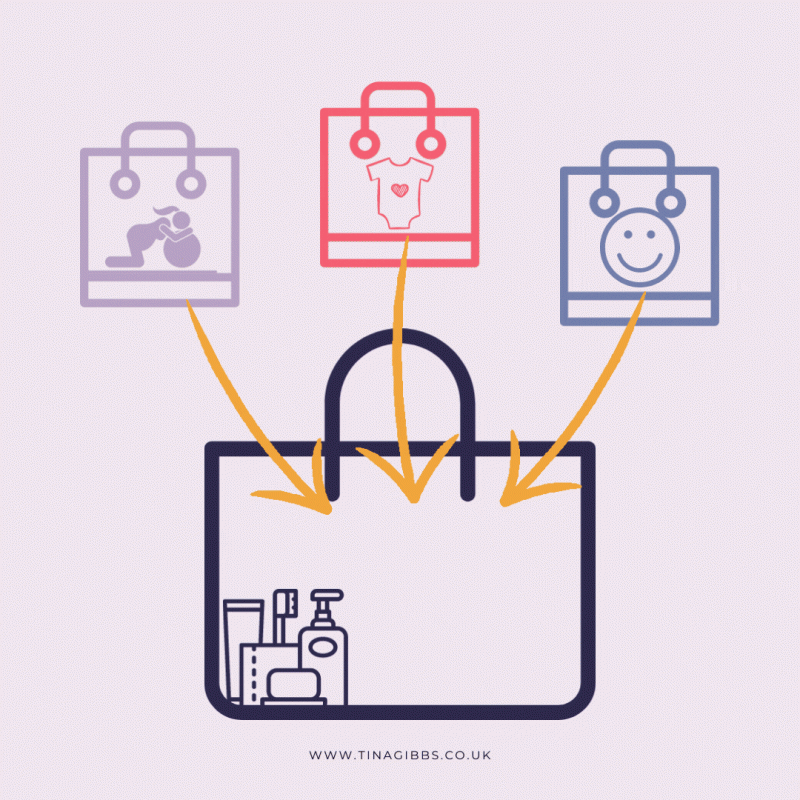
Use one large bag or suitcase for your ‘overnight stuff’, then pack three smaller bags to go inside it: one for you, one for your baby and one for your birth partner.

Hospital bag or home birth bag for childbirth
Top tip: pack smaller bags inside one larger bag or suitcase!

Bag for mum/birthing person

  • Your birth plan and maternity notes
  • A comfy, loose-fitting dressing gown
  • Nighties (ideally ones that open at the front for breastfeeding)
  • Comfy, loose clothes – baggy joggers, a zip-up hoodie, and tops that undo at the front for skin-to-skin and feeding
  • Slippers you can slide your feet into – if you have a caesarean birth, bending over is tricky
  • Socks – many people get cold feet during labour
  • Slip-on shoes
  • Flip-flops for the shower
  • Hand sanitiser
  • Wash bag, including shower gel with a hook (so you don’t have to bend down in the shower) and hand cream (frequent hand gel makes hands sore)
  • Lip balm – hospital air is dry
  • High-waisted, “Bridget Jones” cotton knickers in case you have a caesarean birth – dark colours are best, a couple of sizes up from your usual
  • Arnica and/or witch hazel for piles and bruising
  • Maternity pads (several packs)
  • Nursing bras
  • A large pack of breast pads, or washable ones, for any leaks
  • Your own pillow and/or pillowcase
  • A towel – hospital ones are scratchy
  • Eye mask (it’s never dark!)
  • Earplugs (it’s never quiet!)
  • Hairbands
  • Headphones
  • Your phone with a labour playlist downloaded (you can usually take your phone into theatre and play music via Bluetooth)
  • A small tripod to prop up your phone or camera
  • Phone charger and power bank
  • Snacks – if you’re having a caesarean birth, dried apricots or prunes can ease constipation, as you may not have a bowel movement for several days
  • Peppermint tea bags – after a caesarean birth, they can help ease trapped wind caused by the operation
  • A sports drink
  • Books, magazines or puzzles – in case you need to stay in hospital before or after the birth
  • Tissues for all the happy tears
  • A photo of your partner for times they can’t be with you, or something they’ve given you, such as love notes
  • Photos of older children and pets

Bag for baby

  • Muslins
  • Nappies – newborn size 1 fits most babies, and newborns can go through about 12 nappies a day
  • Cotton wool pads or balls
  • Baby clothes – at least vests, sleepsuits, cardigans and a hat, including a going-home outfit
  • Baby blankets (cotton, cellular or wool)

Bag for your birth partner

  • A change of clothes
  • Snacks
  • Phone, charger and power bank
  • Change for vending machines (hospital shops may have limited opening hours) and the car park
  • A list of people to call or message with the news
  • The car seat to take your baby home – practise fitting it in the car beforehand!

I hope you find this list useful! If you have anything to add, please get in touch and I’ll add it to the list.

Posted on — 2 Comments

Birth Partner Hacks

Birth Partner Hacks

Here are five simple hacks every birth partner should know about!

Are you a birth partner who isn’t sure where to start when it comes to supporting the birthing mother or person? Would you like to know more about how to help during labour and birth?

Here are some Birth Partner Hacks to get you started!

💜 The Hip Squeeze – a favourite of many birthing mothers/people

Apply firm, steady pressure to both hips during contractions, leaning your weight in towards the birthing person.

💜 Figure of 8 ball sit – some gentle movement

During surges, the birthing mother/person sits on an exercise/birth ball and moves their hips in a figure of eight pattern while leaning forward over the back of a chair.

💜 The slow dance – more gentle movement

Have a slow dance together, with the birthing person’s hips swaying from side to side. This can help you both find a rhythm in labour.

💜 Shake the apple tree – relaxes pelvic floor area

Place both hands on one of the birthing person’s thighs and gently shake it, then repeat on the other thigh. This can help relax and release the pelvic floor to support the birth.

💜 Effleurage – light/gentle touch to engage the parasympathetic nervous system

Effleurage means “light, gliding touch”. Use both hands to gently sweep over the birthing person’s body. This helps to engage the parasympathetic (rest and relax) nervous system.

Want more ideas? Have a look at my Birth Partner Do’s and Don’ts and The role of the birth partner.