Posted on Leave a comment

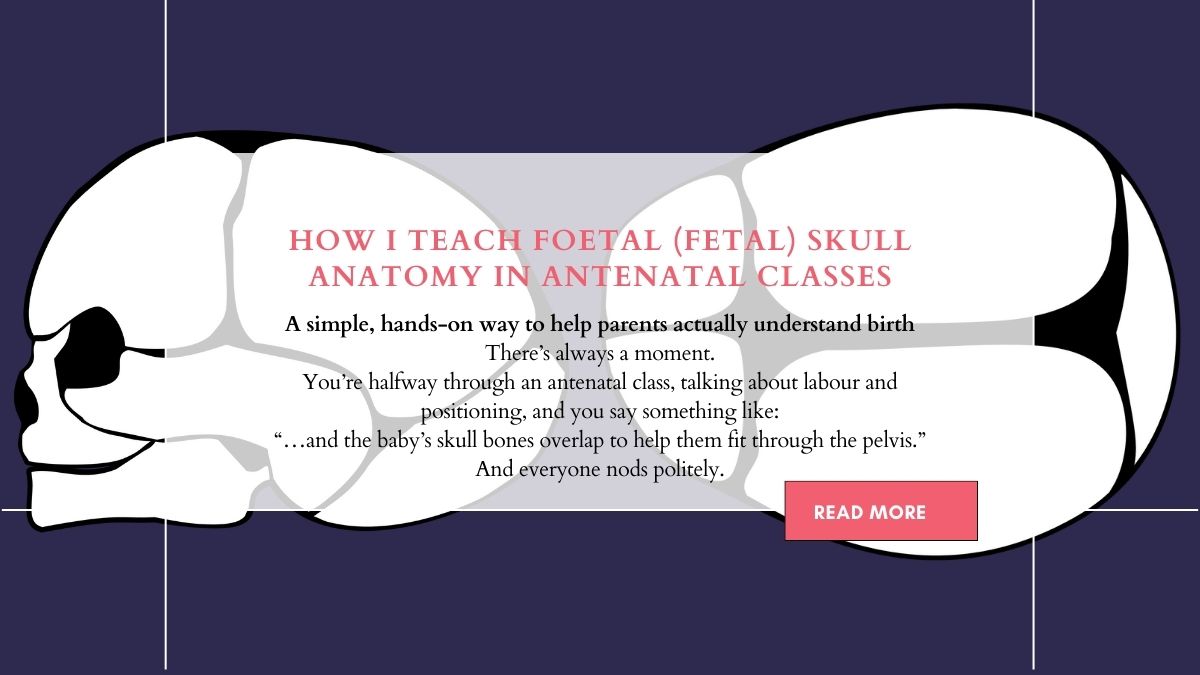
How I Teach Foetal (Fetal) Skull Anatomy in Antenatal Classes

foetal fetal skull anatomy

A simple, hands-on way to help parents actually understand birth

There’s always a moment.

You’re halfway through an antenatal class, talking about labour and positioning, and you say something like:

“…and the baby’s skull bones overlap to help them fit through the pelvis.”

And everyone nods politely.

But you can see it.

They don’t really see it.

Unless you work in birth or anatomy every day, these phrases might as well be in another language. Terms like sutures, fontanelles, moulding, and occiput can be confusing.

I used to explain it with words alone.
Then with a quick sketch.
Then with a slightly wobbly pelvis model that got passed around the room like a party prop.

It worked… sort of.

But when I started using clear, printable foetal (fetal) skull anatomy worksheets, something changed completely.

People stopped nodding.

They started going,
“Ohhhhhh — THAT makes sense now.”

And honestly? That’s the best sound in teaching.


Why foetal skull anatomy matters so much in birth education

If you teach antenatal classes, childbirth education, or Family & Consumer Science, you already know this:

Understanding the foetal skull unlocks everything else.

Suddenly parents understand:

  • how babies rotate during labour
  • why labour can take time
  • what “moulding” really means
  • how the fontanelles (soft spots) protect the brain
  • why positioning matters
  • what midwives and doctors are feeling for during exams
  • why some births feel straightforward and others need a bit more patience

It takes birth from mysterious and scary…
to logical and manageable.

And when something feels logical, it feels less frightening.

That’s huge.

Especially for first-time parents.


The problem with teaching it from memory (or a textbook)

Foetal skull anatomy is very much a see-it-to-get-it topic.

It’s 3D.
It moves.
The bones overlap.

A flat textbook diagram or slide doesn’t quite cut it.

And not everyone has a pelvis and doll model handy (or enough for a whole group).

Plus, drawing skull diagrams on a whiteboard while everyone waits?
We’ve all done it. It’s not our finest artistic hour.

This is where simple, printable foetal/fetal skull anatomy diagrams and labelling worksheets quietly save the day.

Low tech. Zero stress. Surprisingly effective.


What this looks like in my classes

Here’s the flow I use now — and it works every time.

We start with curiosity

I ask:
“What do you think is different about a baby’s skull compared to ours?”

People guess:
“Softer?”
“Not joined yet?”
“More flexible?”

Perfect.

They’re already halfway there.


Then we look at it together

I hand out a clear labelled foetal skull diagram — side view and top (bird’s-eye) view.

Straight away, the pieces click:

Parietal bones.
Sutures.
Fontanelles.
Occiput.

Instead of abstract words, they’re real shapes they can point to.

You can almost see the mental puzzle assembling.


Next comes the hands-on bit (the magic part)

I give them an unlabelled worksheet or understood cut-and-stick labels and let them mark it themselves.

It slows things down in the best way.

There’s chatting.
Comparing answers.
Little “wait, is this the anterior fontanelle?” moments.

That active learning sticks so much better than listening to me talk for ten minutes.

Less lecture. More discovery.


Finally, we talk about moulding

We slide paper pieces over each other or use our hands to show how the skull bones overlap during labour.

And that’s when someone always says:

“So that’s how they fit through!”

Yes. Exactly that.

Suddenly birth mechanics make total sense.

Not scary. Not mysterious. Just clever biology.


Why printable worksheets work so well (especially for busy educators)

I love teaching tools that don’t require:

  • batteries
  • Wi-Fi
  • apps
  • or 20 minutes of prep

Simple printable foetal/fetal skull anatomy worksheets are brilliant because they’re:

  • easy to print for any class size
  • available in colour or black and white
  • great for labelling activities and revision
  • accessible for visual and kinaesthetic learners
  • ideal for antenatal classes, doula training, midwifery education, and Family & Consumer Science lessons
  • something learners can take home to revisit

Laminate them and they’ll last forever.

Pop them in a folder and you’ve got a ready-to-go childbirth education activity any time you need one.

Future you will be very grateful.


The bigger picture

At the end of the day, this isn’t really about memorising anatomy terms.

It’s about confidence.

When parents understand how their baby’s head is designed for birth, you can almost see their shoulders drop.

They trust the process more.

They feel less overwhelmed.

They ask better questions.

And that’s what good birth education is all about.

Clear information.
Less fear.
More “I can do this”.

All from a few small bones and a simple diagram.

Not bad for a bit of paper, really.


If you like having ready-to-print foetal/fetal skull anatomy worksheets, diagrams, and cut-and-stick activities on hand, a set prepared makes life much easier. This is especially true on days when your brain is already juggling ten other things.

Because your time is better spent supporting families… not sketching skulls at the last minute with a dying whiteboard pen.

Find my printable here on my website or for the international market in my TPT shop.
Posted on Leave a comment

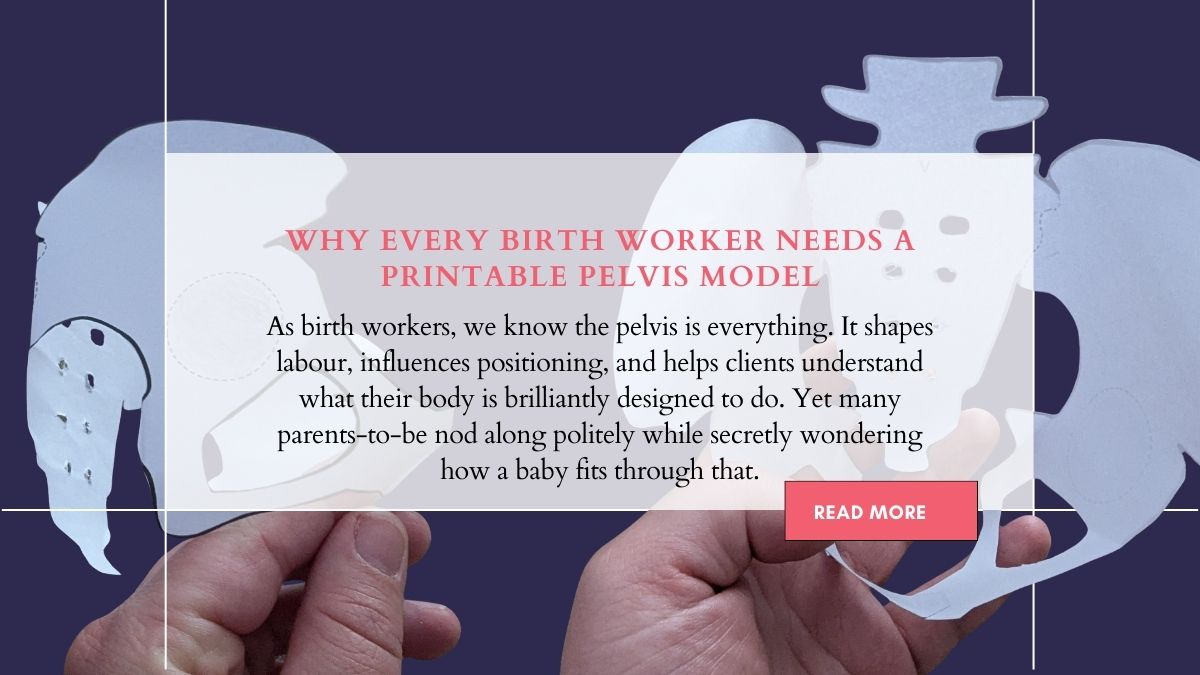
Why Every Birth Worker Needs a Printable Pelvis Model (and Why Your Clients Will Thank You)

printable female pelvis model

Let’s be honest: explaining the pelvis using only words is a bit like explaining childbirth using interpretive dance. Possible… but not ideal.

As birth workers, we know the pelvis is everything. It shapes labour, influences positioning, and helps clients understand what their body is brilliantly designed to do. Yet many parents-to-be nod along politely while secretly wondering how a baby fits through that.

That’s where a hands-on, buildable pelvis model comes into its own.


Why visual learning matters in birth education

Many people are visual and tactile learners. They don’t just want to hear about inlet, mid-pelvis, and outlet — they want to see it. Better still, they want to hold it.

Using a physical model:

  • Makes abstract anatomy concrete and memorable
  • Boosts confidence and understanding
  • Encourages questions and meaningful discussion
  • Reduces fear by replacing mystery with knowledge

In short: less “huh?” and more “ohhh, that makes sense!”.


The power of building the female pelvis

The Build-a-Female-Pelvis printable model isn’t just something you show — it’s something clients do.

By assembling the pelvis themselves, parents:

  • Learn the names and positions of the pelvic bones
  • Understand how the pelvis is not one fixed shape
  • See how movement and positioning matter in labour
  • Remember the information long after the session ends

And let’s be real: anything that keeps hands busy and brains engaged during an antenatal session is a small miracle in itself.


Perfect for so many birth work settings

This printable pelvis model works beautifully for:

  • Antenatal classes
  • One-to-one birth prep sessions
  • Doula client meetings
  • Student midwife teaching
  • Birth education workshops
  • Home study packs

Because it’s printable, you can:

  • Use it again and again
  • Print multiple copies for group work
  • Offer it as a take-home resource
  • Keep one in your teaching kit without lugging around bulky models

Lightweight. Budget-friendly. No cupboard space arguments required.


Why birth workers love this printable female pelvis model

Birth workers choose this resource because it is:

  • Clear and anatomically focused (without being overwhelming)
  • Engaging for adults and older teens
  • Easy to prep (print, cut, assemble — done)
  • Ideal for starting conversations about movement, positions, and physiology

It supports informed choice and body literacy — two things at the heart of good birth work.


A small resource with a big impact

When parents understand how birth works, they trust their bodies more. When they trust their bodies more, fear loosens its grip.

A simple printable pelvis model can be the difference between:

  • “I hope my body knows what to do”
  • and “I understand what my body is doing.”

That’s powerful stuff.


Ready to add it to your birth toolkit?

If you’re looking for a practical, engaging way to teach pelvic anatomy — without expensive plastic models or complicated explanations — this printable is ready and waiting.

You can find the Build-a-Female-Pelvis printable model here:
👉 https://tinagibbs.co.uk/product/build-a-female-pelvis

Your clients will learn more. Your sessions will flow better. And you’ll get to say, with a smile, “Let’s build a pelvis.”

Honestly, that alone is worth it 😉

Save some money and buy my resources through my Teachers Pay Teachers (TPT) shop!

Posted on Leave a comment

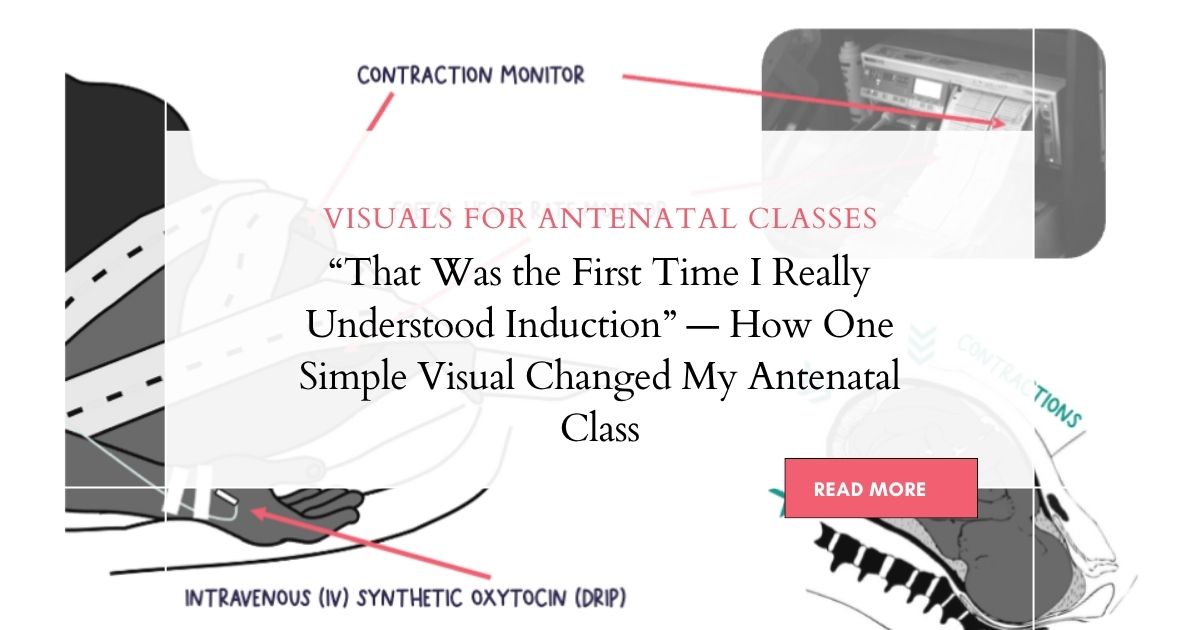
“That Was the First Time I Really Understood Induction” — How One Simple Visual Changed My Antenatal Class

It was a Tuesday evening class — the kind where everyone comes in with a mix of excitement, nerves, and a few birth horror stories whispered over a cuppa.
I was halfway through setting up when one of the parents asked, almost in a whisper,

“Can we talk about induction tonight? My midwife mentioned it… and honestly, I’m a bit scared.”

I could feel that question ripple through the group — nods, quiet agreement, and the sort of attentive silence that means everyone wants to know too.

So I pulled out my Induction of Labour Poster Set.

Eight visuals, each one showing a different method of induction and augmentation — from the sweep to the hormone drip. I pinned them up, and suddenly the room changed. The tension eased. People started asking, “Wait, that’s different from breaking waters?” or “So it doesn’t always mean straight to the drip?”

By the end of the session, one dad-to-be smiled and said,

“That was the first time I’ve actually understood how it all works.”

And that’s when I realised — these visuals weren’t just pretty teaching aids. They were conversation starters, confidence builders, and clarity-makers.


Why Birth Educators Need Visual Tools

Whether you’re a childbirth educator in the UK, a doula in the US, or a midwife in Australia, we all face the same challenge:
explaining medical processes in a way that empowers rather than intimidates.

Induction of labour can be one of the most emotionally charged topics for expectant parents. They’ve heard stories, read online debates, and sometimes carry fears about losing control or being “told” what to do.

That’s where visual learning makes all the difference.

When clients can see the options — how each method works, what it involves, and when it might be used — the conversation shifts from uncertainty to understanding.

These posters give parents a chance to say, “I didn’t know there were choices,” or “Now I get what my midwife meant.”
And that’s exactly what we want as educators: informed, calm, confident families making decisions that feel right for them.


What’s Inside the Induction of Labour Poster Set

This digital birth education resource includes:

  • 8 illustrated posters explaining different methods of induction and augmentation
  • Sizes: US Letter, A4, A3, and A2 (perfect for printing in any country)
  • PDF format — easy to print, share, or display digitally
  • No watermark — just clean, ready-to-teach visuals
  • Editable (text only) Microsoft PowerPoint & Google slides

Each poster combines calm, clear imagery with gentle, accessible language — ideal for antenatal classes, doula consultations, hospital teaching rooms, or online workshops.


Creative Ways to Use These Posters

1. Antenatal Class Display:
Hang the posters around the room before class begins. Invite participants to walk around, read, and note any questions. It’s a brilliant icebreaker that sparks discussion from the start.

2. Visual Learning Stations:
Divide the posters into “stations.” Let small groups rotate between them, jotting down what they know, what surprises them, or what they’d like to ask. Then bring everyone back together for a guided conversation.

3. 1:1 Doula Sessions:
Print the posters smaller (two per A4 sheet) and bind them into a mini flipbook for client consultations. It’s a tactile, personal way to explore options in a comfortable, non-medical setting.

4. Virtual Teaching:
Share the PDF slides on Zoom or your teaching platform. The clear visuals hold attention beautifully online.

5. Clinic or Birth Centre Displays:
Add them to your waiting area or classroom wall — they instantly make the space feel calm, professional, and welcoming.


What Educators Are Saying

“These posters transformed my hospital classes. Parents said they finally understood what each method meant — and the visuals helped reduce their anxiety.”
— Sam, Midwife, Bristol, UK

“I laminated mine and use them every week with doula clients. They look gorgeous and make a tricky topic so much easier to explain.”
— Mags, Doula, Oregon, USA

“Perfect for our antenatal workshops here in Australia. The imaging is wonderful, and the design is both calm and professional.”
— Tori, Childbirth Educator, NSW, Australia


Why Birthworkers Love This Set

  • It’s inclusive and beautifully designed, using calm tones and gentle language.
  • It encourages informed discussions and supports birth without fear.
  • It’s ready to print and use immediately — no design work needed.
  • And it fits seamlessly into your existing teaching toolkit, no matter your setting or country.

Whether you teach in a community hall, hospital room, or your living room, these posters add professionalism and warmth to your teaching space.


Bring Calm and Confidence to Your Next Class

Birth education isn’t just about information — it’s about transformation.
It’s that moment when your clients’ eyes light up with understanding, when they move from anxious to assured.

These Induction of Labour\labor Posters are designed to help you create more of those moments — where information clicks, choices make sense, and families feel prepared for every possibility.

If you’re ready to bring clarity, calm, and confidence to your teaching…

👉 Download the Induction of Labour Poster Set today and watch your classes come alive.

Find them cheaper in my TPT store!

Posted on Leave a comment

Helping Families Feel Confident About Caesarean Births

Imagine your client walking into the operating theatre for their planned or unplanned caesarean birth — not trembling with uncertainty, but feeling calm, confident, and ready.

As birth workers, we support families through every kind of birth, and that includes surgical ones. But let’s be honest — even seasoned professionals know that the OR (or theatre) can feel intimidating. The sterile equipment, bright lights, and team in scrubs can make the whole experience feel distant and medical.

So how do we turn that environment from “What’s going to happen?” into “I know what’s happening — and I’m part of it”?

That’s where interactive, hands-on tools come in.


Why Caesarean Prep Matters in Helping Families Feel Confident About Caesarean Births

Many birthing people head into a caesarean feeling unsure about who will be there, what each person does, or what to expect step by step. A little clarity goes a long way toward easing those fears.

As educators, doulas, and midwives, we can help clients feel more empowered by teaching them what to expect — and by using tools that are simple, visual, and engaging.

Printable activities are perfect for this: no PowerPoint required, just real connection and interactive learning.


Two Tools to Bring Caesarean Birth Education to Life

Here are two printable activities you can use right away in your classes or client sessions:

🩺 “Who’s in the OR?” Role Play Activity

This interactive printable helps clients understand who’s in the room during a caesarean and what each person’s role is.
It’s a fun, visual way to explore the team dynamic — from the surgeon and anaesthetist to the partner and birth worker — and to talk about sterile vs. non-sterile zones.

It turns a daunting idea into something familiar, even friendly.

🧡 “Getting Ready for the OR” – Caesarean Prep Activity

This pack walks clients through what to expect before, during, and after surgery in a calm, empowering way.
It includes interactive elements, discussion prompts, and printable visuals — great for both group classes and one-to-one sessions.

Both sets come in A4 and US Letter sizes, so they’re easy to print wherever you are.

👉 Explore both printables in my TPT store here:

✨ Download the “Caesarean/C-Section Role Play – Who’s in the OR/Theatre? – printable”
✨ Get the “Getting Ready for the OR – A Caesarean Prep Activity (Printable A4 & US Letter)”

Why TPT store and not this website? Find out why I am moving all my digital resources to TPT.


Bringing It to Life in a Class or Client Session

Here’s how this looks in action:

You hand out cards from the prep pack — one person takes the “Anaesthetist” role, another the “Partner,” another the “Scrub Nurse.”
You mark out a “sterile zone” on the floor and walk through the steps of the caesarean: arrival, anaesthesia, birth, recovery.

Suddenly, what once felt cold and clinical becomes personal and clear.
Participants get it. They leave with less fear, more understanding, and better questions for their birth team.


Quick Tips for Birth Workers

  • Dedicate 15–20 minutes in a group class or one-to-one session for the activity.
  • Debrief afterward — ask: “How did that feel?” or “What part surprised you?”
  • Encourage clients to take the printables home to review with their partner.
  • Use it online too! The pack works beautifully for virtual classes — just screen-share or send PDFs.
  • Connect it to emotional prep — remind clients that knowing what to expect is a powerful antidote to fear.

Ready to Bring Confidence into the OR and Helping Families Feel Confident About Caesarean Births

When families understand what’s happening in the operating theatre — who’s there, what’s next, and why — they’re not just “getting through it.” They’re participating in their birth story.

You already help create calm, confident birthing experiences every day. These printable tools are here to make that easier, more engaging, and even a little fun.

✨ Download the “Caesarean/C-Section Role Play – Who’s in the OR/Theatre? – printable”
✨ Get the “Getting Ready for the OR – A Caesarean Prep Activity (Printable A4 & US Letter)”

Posted on Leave a comment

Teaching about the Right to Unpaid Parental Leave in the UK in Antenatal Classes

Hello lovely antenatal educators, doulas and birth-workers – Tina here with a bit of a rallying cry (with a wink) for something that might sound a little less sexy than birthing pools or birth-hormone dominoes, but is just as important: teaching expectant parents about their right to unpaid parental leave in the UK.

Why this matters (because yes, you absolutely need to bring this into your sessions)

Parenting is hard. Working parenthood? That’s a whole extra level of “what have I signed up for”. Lots of expectant parents panic about the juggle: “When do I go back? What if I’m exhausted? What if I realise I need time off but can’t quit the job?” This is where the sometimes-overlooked option of unpaid parental leave comes into the spotlight.

According to the UK Government guidance on unpaid parental leave, eligible employees are entitled to up to 18 weeks’ leave for each child (unpaid) until the child’s 18th birthday, with a maximum of 4 weeks per year for each child (unless the employer agrees otherwise). GOV.UK

What does that mean, in plain beautifully chaotic birth-world terms?

  • If the parent can afford some unpaid time, they don’t have to feel “I must quit / resign” if things get too much.
  • They get breathing space, a reset, a “gear down” time (instead of a full stop).
  • It helps them explore what their new life will look like: working parent, baby, juggling partner, baby whisperer… all of it.
  • It gives them a bit of mental and emotional head-space (and we know how important that is) to realign and come back to work as themselves (not just the wobbly tired parent version).

Why we should bring it into antenatal education

  1. Empowerment – Expectant parents often know about maternity leave or adoption leave, but not about this lesser-known chunk. Knowledge = power.
  2. Realistic planning – We talk about birth plans, feeding plans… why not the “return to work” / “time off” plan too? Educators who dig into this give parents more options, more control.
  3. Mental health & wellbeing – Transitioning to being a working parent is massive. Having an unpaid leave option gives them a buffer (a “pause” rather than a plunge).
  4. Prevention of regret – So many people say afterwards: “I wish I’d stayed a bit longer before heading back”. If they know the option, they might just do so.
  5. Inclusivity of voices – Doulas, midwives, antenatal teachers: you’re already supporting the “whole person”, not just the baby-in-the-birthing-pool. This extends that support.

What you can say when you teach this

  • “Have you heard about unpaid parental leave? Don’t cross your eyes and gloss over it—it’s worth a thought.”
  • “Imagine you get to say: ‘I’m taking a few weeks/months unpaid, so I don’t rush back into work while still finding my feet.’”
  • “Yes, finances matter (we know that). But if it is viable (even partially), this is a tool in your toolkit—not a forced path.”
  • “It doesn’t have to be all or nothing. You might take a week here, a week there; you might delay going back; you might test the waters.”
  • “Encourage them: look at their work contract, talk to HR, check eligibility. Knowledge is your super-birth-cape.”

Some nudges for you (because you’re fabulous and worth it)

  • In your session slides/printables: Include a one-pager on “Rights for working parents: unpaid parental leave” with bullet-points.
  • Add a short case-study or prompt: “What would it look like for you to take 4 weeks unpaid after the baby arrives? How might it help your stress levels?”
  • Suggest they chat with their employer early: “Hey, just so you know, you’re thinking of this option…” Pre-emptive conversation helps.
  • Make it part of the “return to work” discussion rather than tucking it in at the very end. Give it equal spotlight.
  • Reassure: it’s not quitting. It can be a strategic pause, a reset. That narrative helps shift mindset.

Final encouragement

You’re in this vital role of supporting families not just through labour and birth, but beyond. By weaving in the conversation about unpaid parental leave, you’re helping give expectant parents more choice, more time, more kindness to themselves.

They’re going to need resilience, flexibility, gentle strategy—why not start with knowing the options early? And yes, maybe you’ll hear some “Oh, I never knew that” moments. Those are gold. Those mean you’re doing your job with heart.

I have created a handout for you that you can use in your UK-based classes. You can download it here:

Posted on Leave a comment

How to become an Escape Room Maker

How a Free Challenge with Lisa from Thank Tank Teacher Turned Me into an Escape Room Maker Extraordinaire

A while back, I signed up for a free challenge with Lisa from Thank Tank Teacher, thinking it’d be a nice way to try something new. I didn’t expect it to change my whole approach to creating resources. But let me tell you – this wasn’t just a challenge. It was the gateway to a whole new (and ridiculously fun) world: escape rooms! After this free challenge, I am now a printable escape room maker!

Before this, I’d made all sorts of printables for birth workers and pregnancy-themed classroom resources. But escape rooms? That sounded like something better left to secret agents or overly enthusiastic parents. Still, curiosity won.

The Challenge That Changed Everything

Lisa’s challenge was packed with bite-sized lessons, practical ideas, and a whole lot of encouragement. She walked us through the basics of creating classroom escape rooms — not just how to design puzzles, but how to make them meaningful, engaging, and easy to set up (no glitter cannons or padlocks required, thank goodness).

It was one of those rare professional development experiences where I found myself saying, “Hang on, this is actually fun.” I could feel the creative cogs turning — faster than a caffeinated squirrel — and ideas started flowing.

From Learner to Creator – Escape Room Maker

By the end of the challenge, I wasn’t just inspired — I was obsessed. I began building my own printable escape rooms, themed around everything from woodland fairies to gender reveals. My puzzles got cheekier, my storylines got twistier, and I discovered that children (and grown-ups!) love cracking codes and solving mysteries.

What I loved most was how adaptable escape rooms are. Whether you’re teaching about birth hormones or celebrating a seasonal event in the classroom, there’s always a way to sneak in some secret messages and logic puzzles. Plus, they’re brilliant for teamwork and critical thinking — and let’s be honest, who doesn’t want to pretend they’re a codebreaker for a day?

The Next Level: Templates and Tools for Escape Room Makers

If you’re ready to go beyond the basics, Lisa also offers an in-depth online course, packed with even more tips, video tutorials, and — my personal favourite — editable templates. These are super helpful whether you’re just starting out or want to save time by adapting puzzles and storylines you can actually sell. It’s like having an escape room-making toolkit handed to you on a silver platter (minus the lock and key).

A Big Thank You to Lisa

So, to Lisa — thank you for offering that free challenge and opening the escape room door (literally). Your step-by-step guidance made the process so accessible, and your enthusiasm was absolutely contagious. I’m now officially hooked.

If anyone’s sitting on the fence about joining one of Lisa’s challenges: just do it. You might come out the other side with a full-blown printable escape room addiction… and no regrets.

👉 Want to join Lisa’s escape room challenge or course? That’s my affiliate link, so if you choose to sign up through it, you’ll be helping support my work too — thank you!

I have joined three of Lisa’s courses so far (all affiliate links):

I can highly recommend these courses, a total game changer!


Want to see the kind of escape rooms I now create? Take a peek at my Teachers Pay Teachers Shop (mainly gender reveals and pregnancy announcements) or My Etsy Escape Room shop for general party, seasonal, gender reveal, pregnancy announcements and engagement/marriage proposal escape rooms!— and maybe grab a magnifying glass while you’re at it. You never know what clues you might find…

Posted on Leave a comment

Time-Saving Tips for Antenatal Teachers & Birth Workers (Because You Can’t Pour from an Empty Teacup)

time saving tips for antenatal teachers

Time-Saving Tips for Antenatal Teachers & Birth Workers. Essential to apply! 🙂

Let’s be honest—being an antenatal educator or birth worker isn’t exactly a 9-to-5 kind of gig.

You’re prepping classes, updating resources, answering messages from anxious parents-to-be at all hours, packing your bag (again), driving to venues, and possibly squeezing in the occasional cuppa that isn’t cold.

So how do we save time without compromising the magic we bring to each class or client?

Grab your lukewarm brew, and let’s dive into some real-life, tested-by-teachers strategies to help you reclaim your hours (and maybe your sanity).


1. Template Everything

From emails to feedback forms, birth plan worksheets to course outlines—if you’re writing the same thing more than twice, it’s time to template it.

Top tip: Create a folder called “Grab & Go” and fill it with ready-to-edit templates. It’s a lifesaver when your brain’s too tired to think of the word “placenta.”


2. Batch Your Planning

Planning one session at a time? That’s adorable. But batch-planning multiple classes in one go? That’s next-level.

Set aside a block of time once a month to plan lessons, print materials, and stock up on markers (because we all know they’ll run out when you need them most).


3. Automate Where You Can

Use scheduling tools for social media, automated reminders for bookings, and email sequences for new clients.

Because spending 20 minutes writing the same “Hi, thanks for booking!” email? That’s time you could be using to not respond to WhatsApp messages during dinner.


4. Use Printables You Can Reuse

Invest in quality visual aids and printable activities that don’t need updating every month. Laminate your favourites and create a reusable ‘class kit’—just grab and go.

Need engaging and reusable printables? I’ve got you covered in my TPT store and website!


5. Pack a Birth Worker ‘Go Bag’

Keep a pre-packed bag with essentials: pens, printouts, visuals, battery tea lights (for the ambience!), snacks, and a spare hair tie because… you just never know.

No more scrambling last minute or realising you left your pelvis model on top of the fridge again.


6. Record Common Demos as Videos

You know that balloon and ping pong ball demo you always get asked to repeat? Record a quick video version. Share it with clients after class—it saves time and reinforces the learning.

Bonus: You’ll look extra tech-savvy.


7. Stick to the Schedule (Mostly)

Start and end your classes on time. It respects your time and your clients’—and stops sessions from turning into two-hour therapy groups. (There’s a time and place… and it’s not always Tuesday at 8pm.)

If needed, build in a ‘chatty time’ buffer at the start or end so people feel heard and the class stays on track.


8. Use Feedback to Focus

Collect feedback regularly—but don’t just smile at the praise. Look at what isn’t working. Cut what doesn’t add value. Focus on the sessions and tools that really hit home. More impact, less faff.


9. Create a Ready-to-Go Calm Corner

For in-person classes, set up a reusable “Calm Corner” with visuals, affirmations, and breathing prompts. It saves time explaining and creates a self-led learning moment. Also a great spot for the overthinkers to reset. I use Display Boards (Amazon affiliate link!) for this.


10. Take Time Off (Yes, Really)

You are not a birthy robot. Schedule in actual breaks—proper ones where you switch off, rest, and don’t just catch up on admin in your pyjamas.

Burnt-out educators can’t support others.


Final Thoughts

You’ve got the heart of a doula, the brain of a teacher, and the stamina of a marathon runner with a birth ball under one arm. But you don’t need to do it all the hard way.

Work smarter, not harder. Prep once, reuse often, automate the repetitive bits, and protect your time like it’s the last piece of hospital toast after birth.

You deserve it. 💛

Posted on Leave a comment

This is why I teach!

breathing techniques for childbirth - horse breath visual

“This Is Why I Teach”: A Birth Story That Stopped Me in My Tracks

Every now and then, I get a message that stops me mid-coffee sip, mid-email, mid… everything.

Last week, I received a beautiful birth story from one of the families who attended my antenatal classes. And honestly? It made me tear up in the best possible way (yes, I’m blaming my perimenopausal hormones and not my cuppa.

They’d written to tell me that the breathing techniques we’d practised together had transformed their birth experience.

Not just helped. Not just come in handy.
Transformed.

They said they’d gone into labour feeling confident—like they had a plan, tools in their back pocket, and a calm mindset. They’d practised the breathing at home (which always makes my little teacher heart sing!), but it was in the birthing room where it really clicked.

They described the moment when a particularly intense contraction came. Instead of panicking or tensing up, they instinctively dropped into the rhythm of the breath pattern we’d used in class. “It was like my body remembered what to do, even when my mind was freaking out a bit,” she wrote.

She also told me the visuals made all the difference—those printable breathing flashcards we used, with calming colours and step-by-step instructions. They had them on the wall of their birth room, and the midwife even commented on how helpful they were.

Can we just take a moment for that?
A midwife commenting on your visual aids like they’re the main source of calm in the room? I mean… wowsers.

They ended the message by saying, “I honestly don’t know how our birth would’ve gone without those breathing techniques. It gave us something to do when things felt overwhelming.”

And that—that—is why I teach.

It’s not just about information or tick boxes or fancy diagrams (although I do love a good printable!). It’s about giving people tools they can actually use when it matters most. In the middle of the night, in the car on the way to hospital, in that moment of ‘I can’t do this’—they can. And they do.

So, if you’ve been wondering whether those strange slow breaths and funny balloon visuals are just fluff, trust me… they’re anything but.

They’re power.
They’re calm.
They’re magic in action.

And stories like this? They’re my reminder that what we do matters. A lot.

Posted on Leave a comment

Why You Should Teach Breathing Techniques for labour and birth

woman teaching calm breathing techniques

Why You Should Teach Breathing Techniques for labour and birth to expectant parents? If you’ve read my last post, How to Teach Breathing Techniques That Actually Stick, you’ll already know how to help expectant parents master those all-important breathing skills. But today, let’s get into the real juicy bit: why it’s absolutely worth the effort.

(And no, it’s not just so you can feel smug when someone describes you as “life-changing” in a review — although, let’s be honest, that’s a pretty sweet bonus.)

1. Breathing Techniques Aren’t Just Fluffy Extras — They’re Game-Changers

Breathing is one of those things we do all day without thinking. Teaching someone to breathe on purpose, for a reason, in the thick of intense sensations is like giving them a secret superpower.

Good breathing techniques:

  • Activate the parasympathetic nervous system (hello, calm brain).
  • Reduce fear (and as you know, less fear = less tension = less pain).
  • Improve oxygen flow to both parent and baby (which is basically like sending a VIP invitation to your body’s inner superhero team).

In short, solid breathing skills can turn “I can’t do this” moments into “I am doing this!” victories.

2. They Give Parents Something to DO When They Feel Helpless

When birth gets intense (and it will), people don’t often remember every detail from their antenatal classes. They’re not going to think, “Ah yes, time to initiate my complex three-step visualisation of blooming flowers.”

Nope. In those moments, they need something simple, portable, and effective.

Enter: Breathing.

It’s the ultimate in low-maintenance coping tools. No equipment, no yoga mat, no birth ball required. Just a pair of lungs and a little know-how.

3. You’re Building More Than Skills — You’re Building Confidence

Every time a parent practises a breathing technique and feels it working, they store up a little nugget of confidence for the big day. And confidence isn’t just a nice-to-have — it’s a birth-altering resource.

The more they trust their body and their ability to cope, the more they can stay in the driver’s seat during labour. (Or, let’s be real, on the birthing ball, the floor, the side of the bed, or wherever they decide to ride out those surges.)

Confidence built through breathing isn’t just about labour, either. It spills over into early parenting too — where breathing through chaos becomes a daily necessity!

4. Because “Just Breathe” Needs to Be More Than a Throwaway Line

We’ve all heard it. “Just breathe!”
Great advice, truly. But when you’re told to breathe without being taught how, it’s about as useful as telling someone stuck in a hedge to “just walk away.”

Teaching breathing techniques that actually stick means parents will have the all important muscle memory — they’ll know exactly what “just breathe” looks, feels, and sounds like under pressure.

5. Birth Workers (That’s You!) Deserve Tools That WORK

You pour your heart into your work. You are passionate about empowering parents-to-be. You deserve to teach techniques that don’t float away the second the first strong contraction hits.
You deserve to hear your clients say, “I just focused on my breathing, and it carried me through.”

That’s the power of teaching breathing techniques properly: you’re not just giving them information. You’re giving them transformation.


In Short:
Breathing techniques aren’t an optional extra — they’re a birth worker’s Swiss Army knife.
Teach them well. Practise them often. Make them stick.
You’ll be setting parents up not just for a better birth — but for a better start to their whole parenting journey.

(And possibly earning that “life-changing” review along the way. No biggie.)

To find some printables for your antenatal classes, check out my Teachers Pay Teachers shop or my product recommendations below:

Posted on 1 Comment

How to Teach Breathing Techniques That Actually Stick

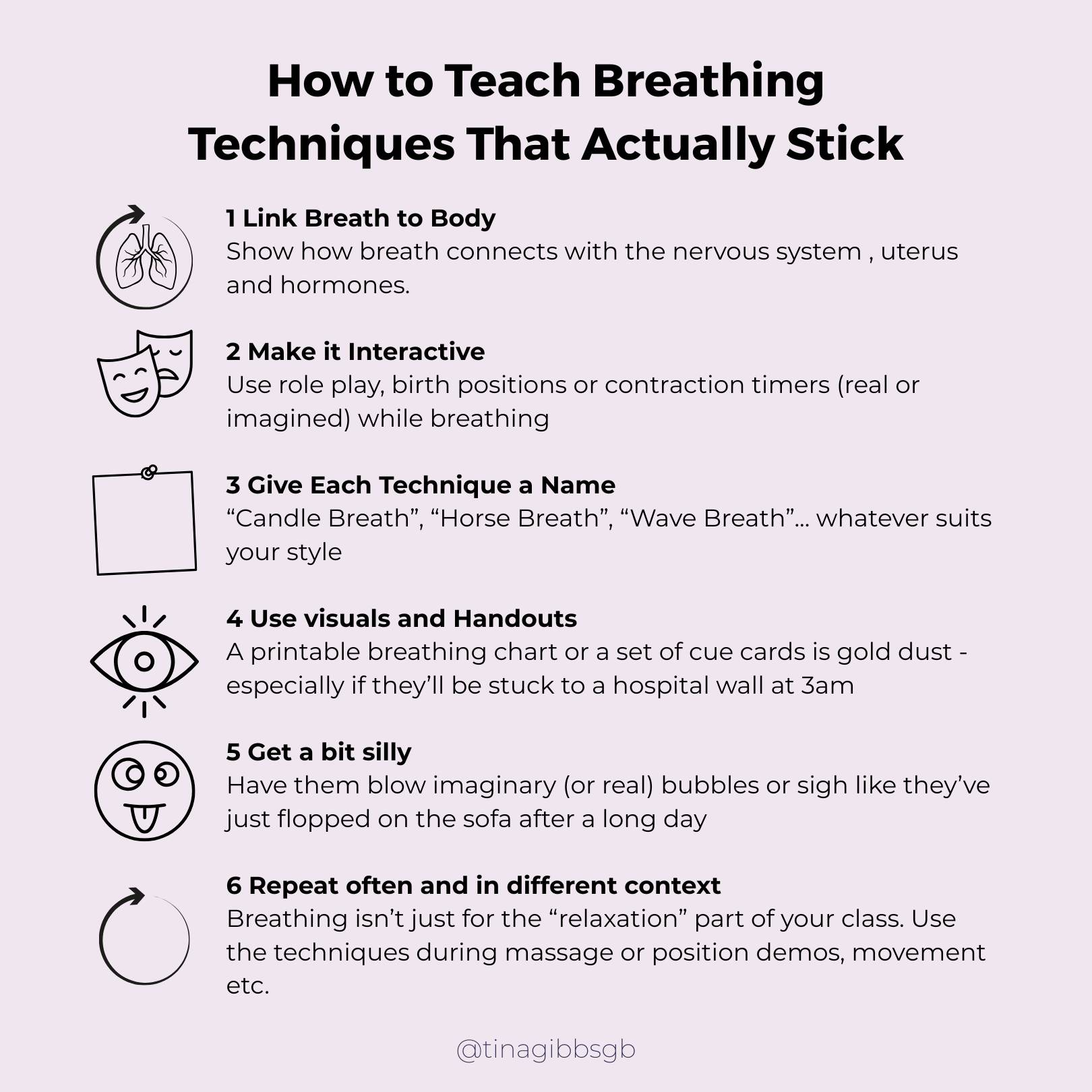
quick visual guide to how to teach breathing techniques that actually stick

How to teach breathing techniques that actually stick is a practical guide for antenatal teachers, birth workers, and perinatal educators

Let’s face it—telling someone in labour to “just breathe” is a bit like shouting “stay calm!” during a fire drill. Great idea in theory, but not super helpful unless they’ve practised it beforehand.

Teaching breathing techniques is one of the most powerful tools in your antenatal toolkit—but it has to be taught in a way that’s simple, practical, and memorable.

Here’s how to make sure the breathing techniques you teach don’t just float away like a stray balloon once class ends:


🌀 1. Link Breath to Body

Start with the why. When parents understand that breathing isn’t just about “calming down”—it’s actually affecting their nervous system, their uterus, and their hormone flow—it all starts to click.

You could explain it like this:

“Slow breathing tells your body it’s safe. When your body feels safe, oxytocin flows and labour can progress more smoothly.”

Science meets simplicity = win.


🎭 2. Make It Interactive

Don’t just demonstrate—involve them. Get people to practise each technique while in different positions, using a contraction timer, or during a short movement activity.

Examples:

  • Pretend to ride a contraction “wave” while slow breathing
  • Match breath to a partner massage rhythm
  • Try one-minute breathing while squatting, leaning or on all fours

Movement + breath = muscle memory. They’ll be more likely to remember it when it counts.


🗂 3. Give Each Technique a Name

Humans are much better at remembering “Candle Breath” than “that slow exhale thing we did that one time.”

Try naming them based on imagery or feeling:

  • Flower Breath (gentle inhale through the nose)
  • Candle Breath (long soft exhale, like blowing out a candle without flickering the flame)
  • Wave Breath (riding the peak and drop of a contraction)

It’s fun, it’s sticky, and it helps when birth partners need to offer cues and encouragement later on.


💡 4. Use Visuals and Handouts

Breathing technique cards or printable charts are your best friends. Pop them in your class packs or hang them in your teaching space.

Visual prompts:

  • Help reinforce the technique
  • Can be stuck on a hospital wall or birth centre window later
  • Support birth partners too—they often need reminders in the moment!


🤸‍♀️ 5. Get a Bit Silly (Seriously)

Laughter is a fantastic tension reliever—and relaxed muscles make for more effective breathing. So don’t be afraid to add a playful moment or two.

Try:

  • Pretending to blow bubbles
  • “Sighing like you’ve just flopped on the sofa after a long day”
  • Holding up imaginary hot chocolate and slowly blowing to cool it down

Silly now = soothing later.


🔄 6. Repeat Often and In Different Contexts

Breathing isn’t just for the “relaxation” part of your class. It should be woven through everything:

  • During movement
  • While discussing pain relief
  • As part of decision-making scenarios
  • During massage demos

Repetition builds confidence. They’ll walk away feeling like breathing is their superpower (because it is).


💬 Bonus: Handy Phrases to Use in Class

Here are a few phrases you can sprinkle throughout your teaching to reinforce the message:

  • “Your breath is your anchor.”
  • “Soft breath, soft body.”
  • “You can’t control the waves, but you can learn to surf them.”
  • “Every breath you take helps your baby too.”

Little mantras like these stick—and may pop into someone’s head right when they need them most.


Final Thoughts

Breathing techniques are simple on the surface—but they’re incredibly powerful tools for labour. As educators, it’s our job to move beyond the basics and give expectant parents strategies they’ll actually remember and use.

So go ahead—breathe some fresh energy into your next class. You’ve got this 💪


Want a printable breathing technique card set, activity or visual aid for your classes?
Have a look at my recommended products below! Also check out my Teachers Pay Teachers (TpT) Store here!