The Hypnosis and Mindset Iceberg. The conscious and subconscious mind and the critical faculty. How does that apply to childbirth?
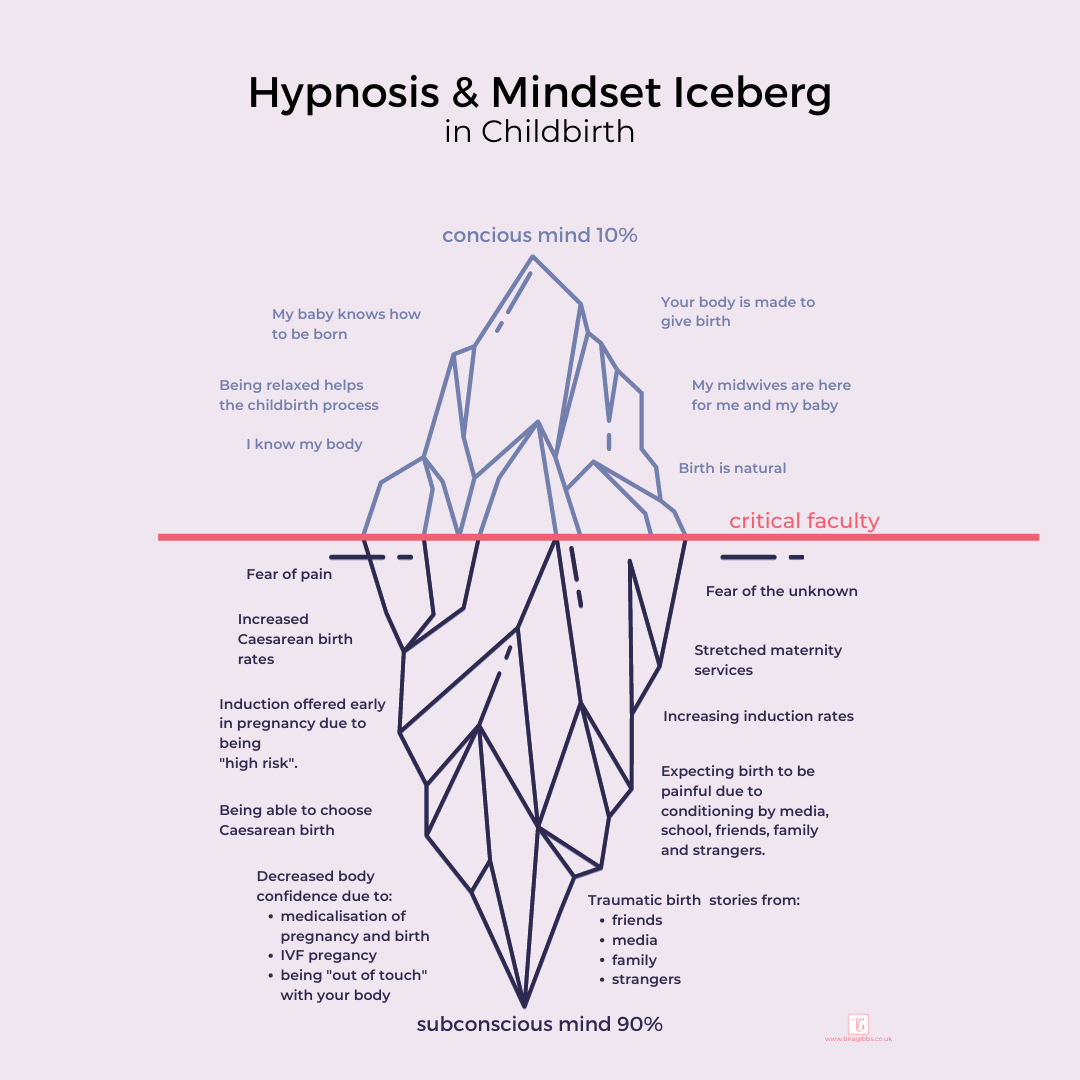
Let’s think about that. When you look at an iceberg and you can see the tip of it, you can only see a small part of it. The majority is hiding underwater. So now how does that apply to hypnosis and your mindset for childbirth?
Consciously you know, that childbirth is a natural process and the majority of babies can be born without assistance. We know that when we relax, more oxytocin flows, which gives helps the birthing process along by giving you strong regular contraction waves. So why do so many expectant parents struggle to relax during the birth or even during their pregnancy? Because throughout our lives we hear and start to believe that childbirth is painful. The media, family or friends are telling us so. When you are pregnant tests, appointments, scans, precautions etc reinforce the believe that birth needs interference. You sometimes even hear a traumatic birth story from a stranger while waiting at the checkout!
So your conscious mind is the tip of the iceberg and your subconscious mind is the base. This is your Hypnosis and Mindset Iceberg:

Overcoming the Iceberg
When you practise self-hypnosis and mindfulness during your pregnancy, you can use these techniques to help to turn down or off your subconscious mind. It’ll help you to focus on the here and now and make the right decisions for and during your birth experience! Remember, practice and reinforcement of the techniques is the key to an empowered birth experience!
Book your 1:1 mindful hypnobirthing experience with me to learn your techniques to combat the Hypnosis and Mindset Iceberg.
Please also check out my online course! No videos, just text and images to learn in your own time. Includes hypnobirthing mp3s, scripts, workbook, handouts, infographics and much more! Lots and lots of information at your fingertips! Includes:
- hypnobirthing mp3s
- hypnobirthing scripts
- written information
- infographics and other imagery
- printable handouts
- printable workbook/journal

For perinatal educators:
The “Hypnosis and Mindset Iceberg” poster shows an image of an iceberg, where you can see the tip of the iceberg as well as the underwater base of the iceberg. Use it in antenatal or parenting classes to explore expectant parents’ feelings. Where they come from and how the subconscious can influence your decision-making, mindset as well as birth, feeding or parenting experience. An excellent resource for your perinatal education setting!
Hypnosis Iceberg Sources and Further Reading
- https://www.selfhypnosis.com/the-conscious-critical-faculty/
- https://www.danielfryer.com/2019/11/03/hypnotherapy-icebergs-and-hidden-depths/
- https://www.faithbouiehypnotherapy.com/the-iceberg-analogy
- https://www.themindfulword.org/2012/hypnosis-deeper-consciousness/
- https://mindfulness-alliance.org/2022/05/23/a-mental-model-for-a-more-mindful-perspective/
- https://www.b-hypnotized.com/hypnosis-blog/hypnosis-where-conscious-and-subconscious-mind-meet
All were accessed on the 24th January 2023.
Please note that I am in no affiliation with the owners of the websites above.