Posted on Leave a comment

Why You Should Teach Breathing Techniques for labour and birth

woman teaching calm breathing techniques

Why You Should Teach Breathing Techniques for labour and birth to expectant parents? If you’ve read my last post, How to Teach Breathing Techniques That Actually Stick, you’ll already know how to help expectant parents master those all-important breathing skills. But today, let’s get into the real juicy bit: why it’s absolutely worth the effort.

(And no, it’s not just so you can feel smug when someone describes you as “life-changing” in a review — although, let’s be honest, that’s a pretty sweet bonus.)

1. Breathing Techniques Aren’t Just Fluffy Extras — They’re Game-Changers

Breathing is one of those things we do all day without thinking. Teaching someone to breathe on purpose, for a reason, in the thick of intense sensations is like giving them a secret superpower.

Good breathing techniques:

  • Activate the parasympathetic nervous system (hello, calm brain).
  • Reduce fear (and as you know, less fear = less tension = less pain).
  • Improve oxygen flow to both parent and baby (which is basically like sending a VIP invitation to your body’s inner superhero team).

In short, solid breathing skills can turn “I can’t do this” moments into “I am doing this!” victories.

2. They Give Parents Something to DO When They Feel Helpless

When birth gets intense (and it will), people don’t often remember every detail from their antenatal classes. They’re not going to think, “Ah yes, time to initiate my complex three-step visualisation of blooming flowers.”

Nope. In those moments, they need something simple, portable, and effective.

Enter: Breathing.

It’s the ultimate in low-maintenance coping tools. No equipment, no yoga mat, no birth ball required. Just a pair of lungs and a little know-how.

3. You’re Building More Than Skills — You’re Building Confidence

Every time a parent practises a breathing technique and feels it working, they store up a little nugget of confidence for the big day. And confidence isn’t just a nice-to-have — it’s a birth-altering resource.

The more they trust their body and their ability to cope, the more they can stay in the driver’s seat during labour. (Or, let’s be real, on the birthing ball, the floor, the side of the bed, or wherever they decide to ride out those surges.)

Confidence built through breathing isn’t just about labour, either. It spills over into early parenting too — where breathing through chaos becomes a daily necessity!

4. Because “Just Breathe” Needs to Be More Than a Throwaway Line

We’ve all heard it. “Just breathe!”
Great advice, truly. But when you’re told to breathe without being taught how, it’s about as useful as telling someone stuck in a hedge to “just walk away.”

Teaching breathing techniques that actually stick means parents will have the all important muscle memory — they’ll know exactly what “just breathe” looks, feels, and sounds like under pressure.

5. Birth Workers (That’s You!) Deserve Tools That WORK

You pour your heart into your work. You are passionate about empowering parents-to-be. You deserve to teach techniques that don’t float away the second the first strong contraction hits.
You deserve to hear your clients say, “I just focused on my breathing, and it carried me through.”

That’s the power of teaching breathing techniques properly: you’re not just giving them information. You’re giving them transformation.


In Short:
Breathing techniques aren’t an optional extra — they’re a birth worker’s Swiss Army knife.
Teach them well. Practise them often. Make them stick.
You’ll be setting parents up not just for a better birth — but for a better start to their whole parenting journey.

(And possibly earning that “life-changing” review along the way. No biggie.)

To find some printables for your antenatal classes, check out my Teachers Pay Teachers shop or my product recommendations below:

Posted on 1 Comment

How to Teach Breathing Techniques That Actually Stick

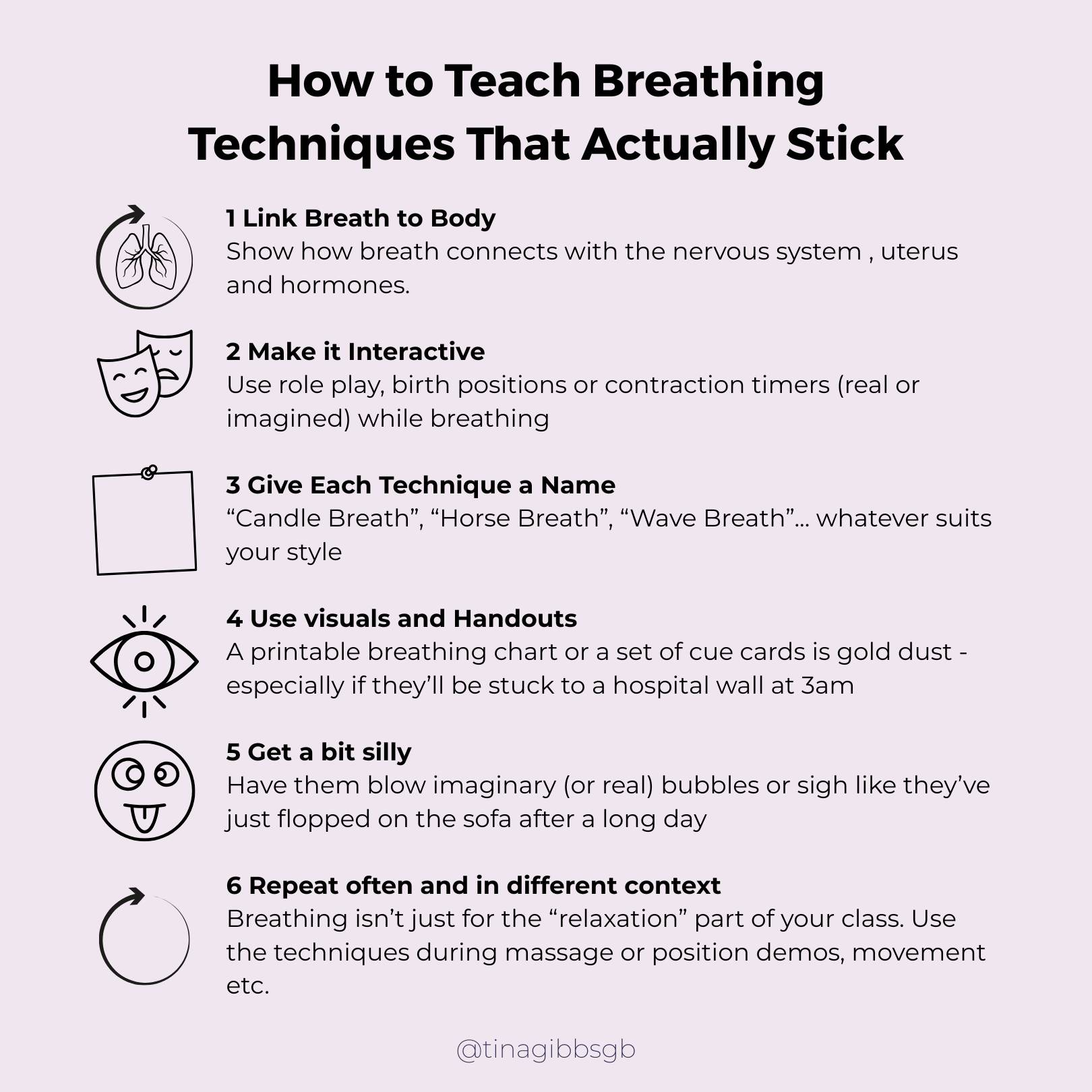
quick visual guide to how to teach breathing techniques that actually stick

How to teach breathing techniques that actually stick is a practical guide for antenatal teachers, birth workers, and perinatal educators

Let’s face it—telling someone in labour to “just breathe” is a bit like shouting “stay calm!” during a fire drill. Great idea in theory, but not super helpful unless they’ve practised it beforehand.

Teaching breathing techniques is one of the most powerful tools in your antenatal toolkit—but it has to be taught in a way that’s simple, practical, and memorable.

Here’s how to make sure the breathing techniques you teach don’t just float away like a stray balloon once class ends:


🌀 1. Link Breath to Body

Start with the why. When parents understand that breathing isn’t just about “calming down”—it’s actually affecting their nervous system, their uterus, and their hormone flow—it all starts to click.

You could explain it like this:

“Slow breathing tells your body it’s safe. When your body feels safe, oxytocin flows and labour can progress more smoothly.”

Science meets simplicity = win.


🎭 2. Make It Interactive

Don’t just demonstrate—involve them. Get people to practise each technique while in different positions, using a contraction timer, or during a short movement activity.

Examples:

  • Pretend to ride a contraction “wave” while slow breathing
  • Match breath to a partner massage rhythm
  • Try one-minute breathing while squatting, leaning or on all fours

Movement + breath = muscle memory. They’ll be more likely to remember it when it counts.


🗂 3. Give Each Technique a Name

Humans are much better at remembering “Candle Breath” than “that slow exhale thing we did that one time.”

Try naming them based on imagery or feeling:

  • Flower Breath (gentle inhale through the nose)
  • Candle Breath (long soft exhale, like blowing out a candle without flickering the flame)
  • Wave Breath (riding the peak and drop of a contraction)

It’s fun, it’s sticky, and it helps when birth partners need to offer cues and encouragement later on.


💡 4. Use Visuals and Handouts

Breathing technique cards or printable charts are your best friends. Pop them in your class packs or hang them in your teaching space.

Visual prompts:

  • Help reinforce the technique
  • Can be stuck on a hospital wall or birth centre window later
  • Support birth partners too—they often need reminders in the moment!


🤸‍♀️ 5. Get a Bit Silly (Seriously)

Laughter is a fantastic tension reliever—and relaxed muscles make for more effective breathing. So don’t be afraid to add a playful moment or two.

Try:

  • Pretending to blow bubbles
  • “Sighing like you’ve just flopped on the sofa after a long day”
  • Holding up imaginary hot chocolate and slowly blowing to cool it down

Silly now = soothing later.


🔄 6. Repeat Often and In Different Contexts

Breathing isn’t just for the “relaxation” part of your class. It should be woven through everything:

  • During movement
  • While discussing pain relief
  • As part of decision-making scenarios
  • During massage demos

Repetition builds confidence. They’ll walk away feeling like breathing is their superpower (because it is).


💬 Bonus: Handy Phrases to Use in Class

Here are a few phrases you can sprinkle throughout your teaching to reinforce the message:

  • “Your breath is your anchor.”
  • “Soft breath, soft body.”
  • “You can’t control the waves, but you can learn to surf them.”
  • “Every breath you take helps your baby too.”

Little mantras like these stick—and may pop into someone’s head right when they need them most.


Final Thoughts

Breathing techniques are simple on the surface—but they’re incredibly powerful tools for labour. As educators, it’s our job to move beyond the basics and give expectant parents strategies they’ll actually remember and use.

So go ahead—breathe some fresh energy into your next class. You’ve got this 💪


Want a printable breathing technique card set, activity or visual aid for your classes?
Have a look at my recommended products below! Also check out my Teachers Pay Teachers (TpT) Store here!

Posted on Leave a comment

Supporting the Childbirth Process

Supporting the childbirth process

A Guide to Helping Parents Bring New Life into the World

Supporting the childbirth process: A Guide to Helping Parents Bring New Life into the World

Childbirth is one of the most significant moments in a parent’s life. While it is a natural process, it can also be physically and emotionally challenging. Support during labour and birth plays a crucial role in making the experience more positive and manageable. Whether you are a partner, family member, friend, or birth worker, knowing how to offer the right support can make all the difference.

Understanding the Childbirth Process

Labour typically unfolds in three stages:

  1. First Stage – This is the longest phase, where contractions gradually open the cervix. It includes early, active, and transition phases.
  2. Second Stage – This is when the baby is born as the parent pushes through contractions.
  3. Third Stage – The placenta is delivered, and medical staff ensure the parent’s well-being.

Knowing what to expect at each stage helps supporters provide reassurance and encouragement.

Emotional Support: The Power of Reassurance

A calm and confident presence can ease a labouring parent’s stress. Encouraging words, holding hands, and offering gentle reassurance help them feel safe and supported. Simple phrases like “You’re doing amazingly” or “I’m right here with you” can be powerful.

It’s also important to respect their preferences. Some may want quiet, while others benefit from verbal motivation. Being attentive to their needs ensures they feel in control and cared for.

Physical Comfort Measures

There are many ways to provide physical comfort during labour:

  • Massage and Touch – Gentle back rubs, counter-pressure on the lower back, or a warm hand on the shoulder can relieve tension and discomfort.
  • Breathing Techniques – Encouraging slow, deep breaths helps manage pain and anxiety. Practising these beforehand can be helpful.
  • Position Changes – Movement and different positions (such as squatting, standing, or leaning) can ease pain and help labour progress.
  • Hydration and Nutrition – Small sips of water and light snacks (if permitted) help maintain energy levels.

Advocating for the Labouring Parent

In the intensity of labour, communication with medical staff can be overwhelming. A supportive birth partner can help by ensuring the parent’s preferences are respected. This includes reminding healthcare professionals of their birth plan and asking for explanations about medical procedures if needed.

Advocacy does not mean making decisions on their behalf but rather ensuring they feel informed and empowered. Respecting their choices is essential for a positive birth experience.

Managing Pain: Options and Encouragement

Pain relief choices vary for every person. Some prefer natural methods, while others opt for medical pain relief such as gas and air, pethidine, or an epidural. Supporting their decision, without judgement, is crucial.

If they choose to avoid medication, distraction techniques such as music, dim lighting, warm baths, or hypnobirthing practices can help. If they decide on medical pain relief, encouraging them through the process and reminding them that every birth journey is unique can be reassuring.

If you are a birth worker reading this, you might find some of my printable activities helpful for your childbirth education classes and session. Below you’ll find my latest offers:

The Importance of Post-Birth Support

Supporting the childbirth process doesn’t end once the baby is born. The postnatal period is a time of physical recovery and emotional adjustment. Encouraging rest, helping with newborn care, and offering emotional support are just as important after birth as they are during labour.

Small actions, like bringing a meal, holding the baby while the parent naps, or simply listening to their experiences, can make a huge difference. Reassure them that it’s normal to feel a mix of emotions and encourage them to seek support if needed.

Final Thoughts

Supporting someone through childbirth is a privilege and a responsibility. Being informed, compassionate, and adaptable allows you to provide meaningful help. Every birth experience is different, but the right support can make it a more positive and empowering journey for the parent bringing new life into the world.