Posted on Leave a comment

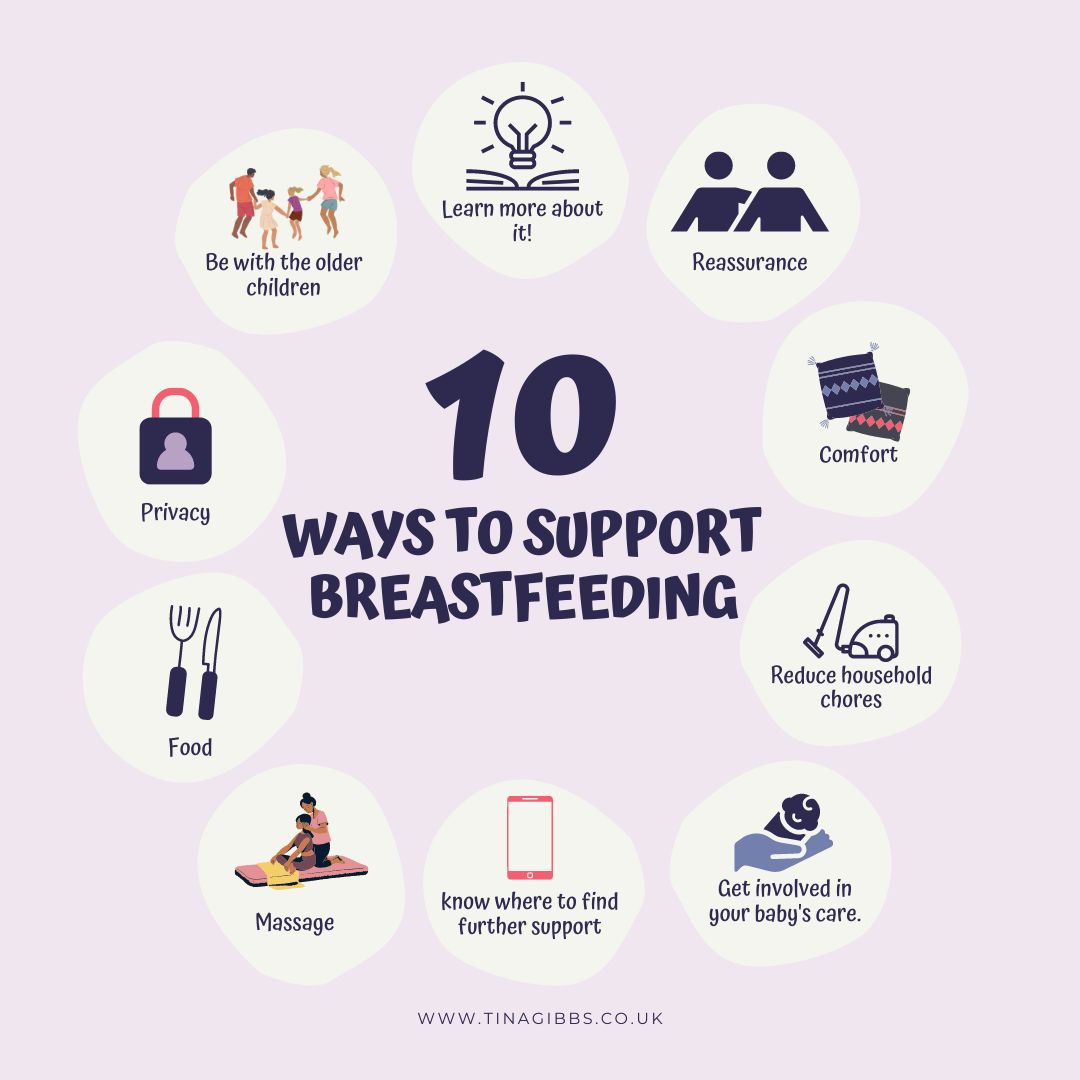
10 ways for partners to support breastfeeding

Fathers/Partners support breastfeeding

10 ways for partners to support breastfeeding. You are a new parent and your partner is breastfeeding/nursing/chestfeeding your baby or they are planning to. During antenatal classes I often get ask how partners, dads, friends and family members can support the breastfeeding/nursing/chestfeeding mother/parent.

Knowledge – Learn about breastfeeding

The first step to support someone who is nursing is to have some [basic] knowledge about how it works. Put in some time and effort to learn about the physiology of breastfeeding/nursing/chestfeeding, then you’ll be the best support your partner can hope for. An interesting and fun to read book is Kate Evan’s “Food of Love” (amazon affiliate link). For further websites and books, please see the sources and further reading section at the bottom of this page.

Reassurance

Reassuring your partner that you are there for support, encouraging words and being positive about their progress, will help your partner on their breastfeeding/nursing/chestfeeding journey. Like with every new skill a person is learning, reassurance and praise are a great help!

Comfort

Your partner may be feeding your baby for quite some time. That there is a comfortable, relaxing space for them is important. Ideally help set up a nursing nest with cushions, snacks, remote control, a book, muslin squares, a drink! (hydration is important for the milk production and flow) etc… A lot of parents chose to have a little basket that they keep nearby when they are feeding their baby.

Reduce household chores

Help and support by reducing household chores. Take on more than your usual household chores and/or get help such as a doula, cleaner, dog walker… The more your partner can focus on feeding your baby the more successful the journey will be.

Get involved in your baby’s care in other ways

Other than feeding, your baby will need a lot more than that. Get involved in their care by playing with them, reading stories, bathtime, changing nappies, taking them for a walk, cuddles…. That way your partner will be able to find some time for themselves to recharge, have a shower etc. and you can bond with your baby also.

Know where to find further support

It is important to know where you can get further support. Many places in the UK run regular breastfeeding peer support groups in-person and online. It is a good idea to find out about them while your partner is still pregnant. Encourage your partner to go along to one or more while you are waiting for your baby to be born. You can also find lots of valuable support and information on the Breastfeeding Network’s website!

Massage

Offering a massage can be really helpful to encourage milk flow and increase comfort. The hormone oxytocin lets the milk flow. Not everyone is a fan of massages but if you are, it’s a great way to support the milk flow!

Food

Feeding the breastfeeding/nursing/chestfeeding mother/parent is feeding your baby. Ensuring that there are plenty of nutritious food and some treats available is key to comfort, milk production and a rewarding feeding experience. Top tip: food that can be eaten with one hand and without cutlery is the most practical while feeding a baby. A pizza cutter, to cut any food can be helpful, as you can operate it with just one hand!

Privacy

Too many visitors in the first few weeks as a new parent can negatively influence the baby feeding experience. Help by keeping visitors to a bare minimum or inviting them for after breastfeeding/nursing/chestfeeding is established.

Other/older children

If you have older children, look after them while your baby is being fed. It can be incredibly helpful to be able to just focus on feeding your baby without having to worry about the wellbeing of the older siblings.

Posted on Leave a comment

5 must-haves for every antenatal educator

5 must-haves for every antenatal educator include visual and tactile learning aids to encourage active engagement and participation and promote the retention of information.

Pelvis model

A pelvis model to explain the mechanics of childbirth and explore beneficial positions for labour and birth. I like to pass the pelvis model round in the class. Asking parents to point out things they notice and why they might find that upright positions can be helpful for the birthing process.

Uterus model

A uterus model to explain how the uterus works. A knitted uterus and a soft ball works really well for this, however some educators also use a balloon and ping pong ball. The soft ball I use is one like this (amazon affiliate link!).

Placenta model

A placenta model to explain how the placenta works and what happens during the third stage of labour. It is also a useful discussion prompt for what to do with your placenta after the birth.

Childbirth Timeline

A timeline of labour to explore what happens when and how to support the birth process. You can either use a timeline banner, a beadline or create your own. These also work really well to explore induction and augmentation of labour, the birth partner’s role etc. I tend to use more than one type of timeline to help stress that every labour and birth experience is unique! See my other blogpost for teaching ideas using your labour and birth timelines. To create your own childbirth timelines, I have seen birthworkers draw one on the back of a roll of wallpaper and I have also seen some very impressive and intricate work in fabric! If you have made your own timelines, please share your pictures! I’d love to see yours!

Positions for labour and childbirth images

Positions for labour & birth images. These could be either photos or drawings like my childbirth positions cards or it could be a poster.

These are my top 5 must-haves as a perinatal educator & doula. What are your top 5s you cannot facilitate without?

Posted on Leave a comment

Birth Bag – Teaching Ideas

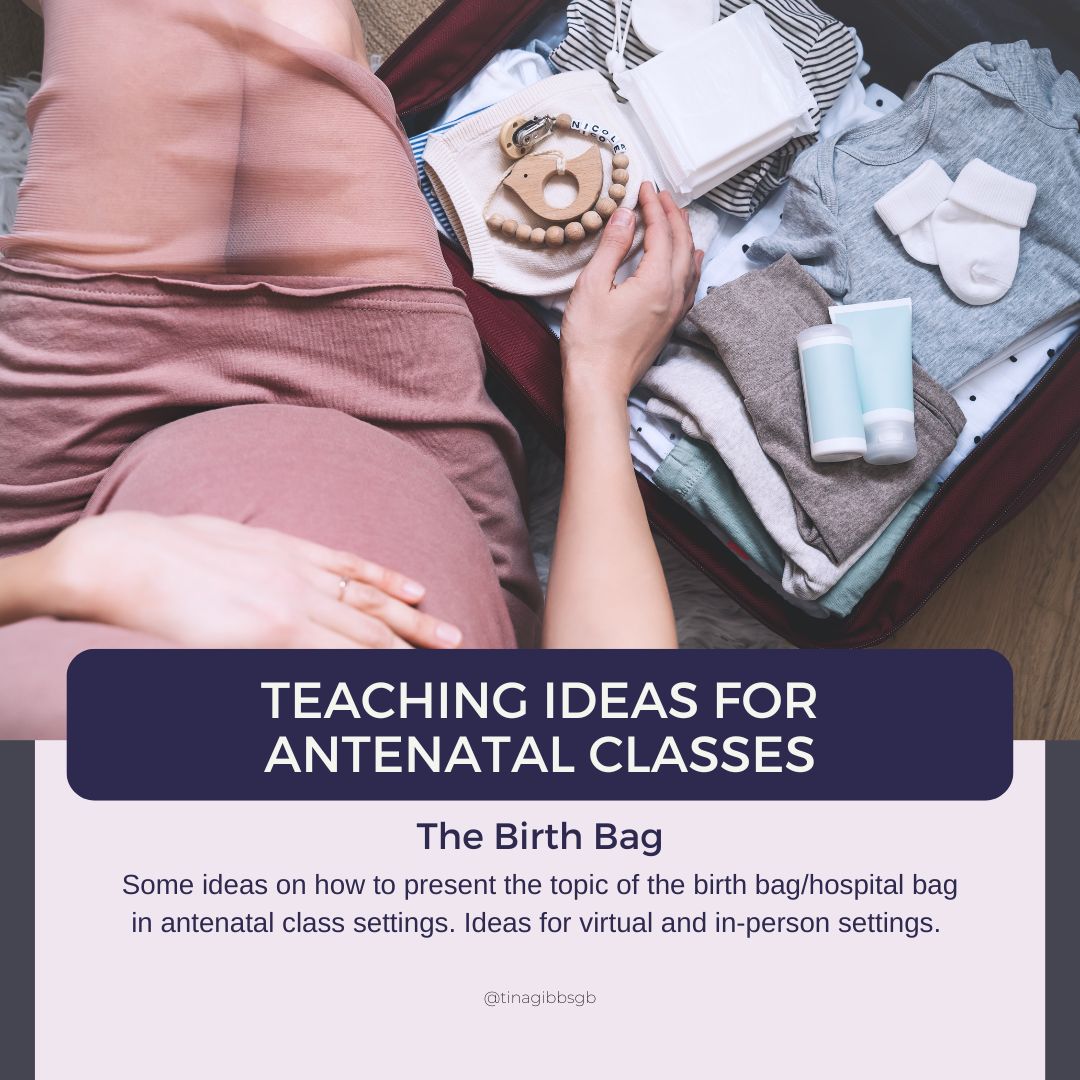
The Birth Bag – Teaching ideas for your antenatal classes. As a birth worker, doula, midwife, student midwife or perinatal educator we aim to prepare expectant parents for their birth experience. Part of their birth experience is packing their birth bag aka hospital bag.

Birth Bag – Teaching Ideas for in-person Antenatal Classes

Show and tell

Simply ask every family to bring in up to 3 items each for their birth bag to the next class. During the “show and tell” ask them to share their item and why they chose it.

Brainstorm

Split the class into similar-sized groups. If I am facilitating classes for couples, I split into two/four groups separating birthing mothers/parents from their birth partners. I ask them to write down and/or draw items they’d like to take with them for the birth. Then we have a list for birthing mothers and folks as well as a separate list for birth partners! If you prefer not to use paper and pens or would like to use this as a homework or pre-course task, you could use mentimeter (see above) instead.

Paperchase

Do a paperchase. Split the group into three groups. Have three sets of flipchart paper & pens available. I like to draw the outline of a suitcase on mine and add a header i.e. birthing mother/parent, birth partner or baby. Each group will brainstorm for their sheet for x minutes (I give them 2 minutes). Then they move on to the next one and add to it for two minutes and then move again to the last one.

Birth Bag – Teaching Ideas for Virtual Antenatal Classes

Hospital Bag / Birth bag Scavenger hunt

A good old scavenger hunt to explore possible contents of a birth bag! This not only helps your clients think about what they need and what they would like, but also gets them off their seats/butts during a virtual antenatal course! I like to include this as part of the break. Mainly to encourage clients to move… To do so I share my screen with a short list of things which may be useful for their birth experience. I ask my clients to grab a drink, snack and go to the toilet and bring as many things as possible back to the screen within 15 minutes.

You can find my very long birth bag list in one of my other blog posts. Select a few items from this list or write your own short list!

birth bag - teaching ideas

Wordsearch

To create a birth bag wordsearch is another way of creating some engagement during your online classes. I create my wordsearches on my husband’s website. I integrate my wordsearch into my powerpoint slides and ask parents-to-be to annotate the slides with their findings.

birth bag teaching ideas virtual antenatal classes
Wordsearch a teaching idea for virtual antenatal classes

We then discuss what they would add/remove from their birth bag.

Quick competition – show and tell

Similar to the scavenger hunt, I like to integrate this as part of one of my clients’ breaks. It is way too easy to just stay sat where you are while you are on an online course or workshop, so this is another teaching idea to get your clients moving and engaged in the topic!

I like to ask every couple/client/expecting family to think about what they may need during the birth of their baby or babies. Each participants gets ask to bring back 3 items to the screen. Three items per person, items which may be helpful to themselves, NOT their partner.

This is often the first time when birth partners realise, that they need to look after themselves, too and may need some comfort items.

Wordcloud

Set up a wordcloud on mentimeter and ask your clients to add their preferred items/essentials to the list. A very engaging, fun and visual way to create a birth bag/hospital bag list with your clients. It’s anonymous and fun! You can save the results as a picture or pdf afterwards and send them out as a reminder/handout.

an example of mentimeter wordcloud results

How do you facilitate the topic of birth bags during your childbirth preparation classes? Please comment with your ideas or share them in an email with me!

Posted on Leave a comment

Clothes checklist for your summer baby

Clothes checklist for your summer baby. You are having a baby this summer? Congratulations! You are wondering how many and what types of clothes and layering you might need?

When purchasing your baby clothes, make certain that they all are machine washable, non-flammable and made from soft comfortable materials. Choose clothes which open at the front or have wide/enveloped neck openings. This will make it easier for you to do frequent nappy changes!

The layette checklist below should be taken as a minimum and guide only. You may wish to have a few more spares of each item if you can afford to purchase more. Please also check out the guidance from BASIS and the Lullaby Trust.

Clothes checklist for your summer baby

  • 4 body suits/sleepsuits/babygrows
  • 4 vests (check for a wide neck opening) – you may wish to choose long-sleeved ones
  • 2 cardigans or jackets
  • 4 wide-necked cotton t-shirts or dresses
  • 4 pairs of trousers, tights, shorts or skirts
  • 1 summer hat
  • 2 pairs of socks
  • 1 baby blanket

In addition to the layette (set of clothing) your baby will also need nappies (either reusable or single-use) and you’ll want to make sure you have plenty of muslin squares! These are very handy to protect your clothing, mop up sick or clean up other bits and bobs. Muslin squares are also very handy to have as emergency nappy or breast pads 😉

I have created two handouts for you. One is a layering clothing guide and the other one is your summer baby clothes checklist!

How many layers should my baby wear at night? Click on the image to download your guide.
Summer Baby clothes checklist
How many clothes will I need for my summer baby? Click on the image to download your checklist.

Sources and Further Reading: