Posted on Leave a comment

SEO tips for birth workers

As a self-employed birth worker, it is essential that your potential clients can find you. Here are some SEO (search engine optimisation) tips for birth workers to get you started. Some may think that social media will do all the work for you, but does it?

You are a doula, antenatal teacher, hypnobirthing practitioner or other birth worker and have very short window of getting your clients’ attention and to book your services. We do rely on word of mouth, and us in the search results!

Where do you go when you look for a service? Do you check your social media or do you use an internet search engine?

4 out of 5 people use search for local services and businesses using search engines such as Google, Bing or Yahoo. Optimising your website for local search results can make a huge difference to the number of (potential) clients finding out about you and the services you offer. Even better, SEO is free!!

SEO tips for birth workers

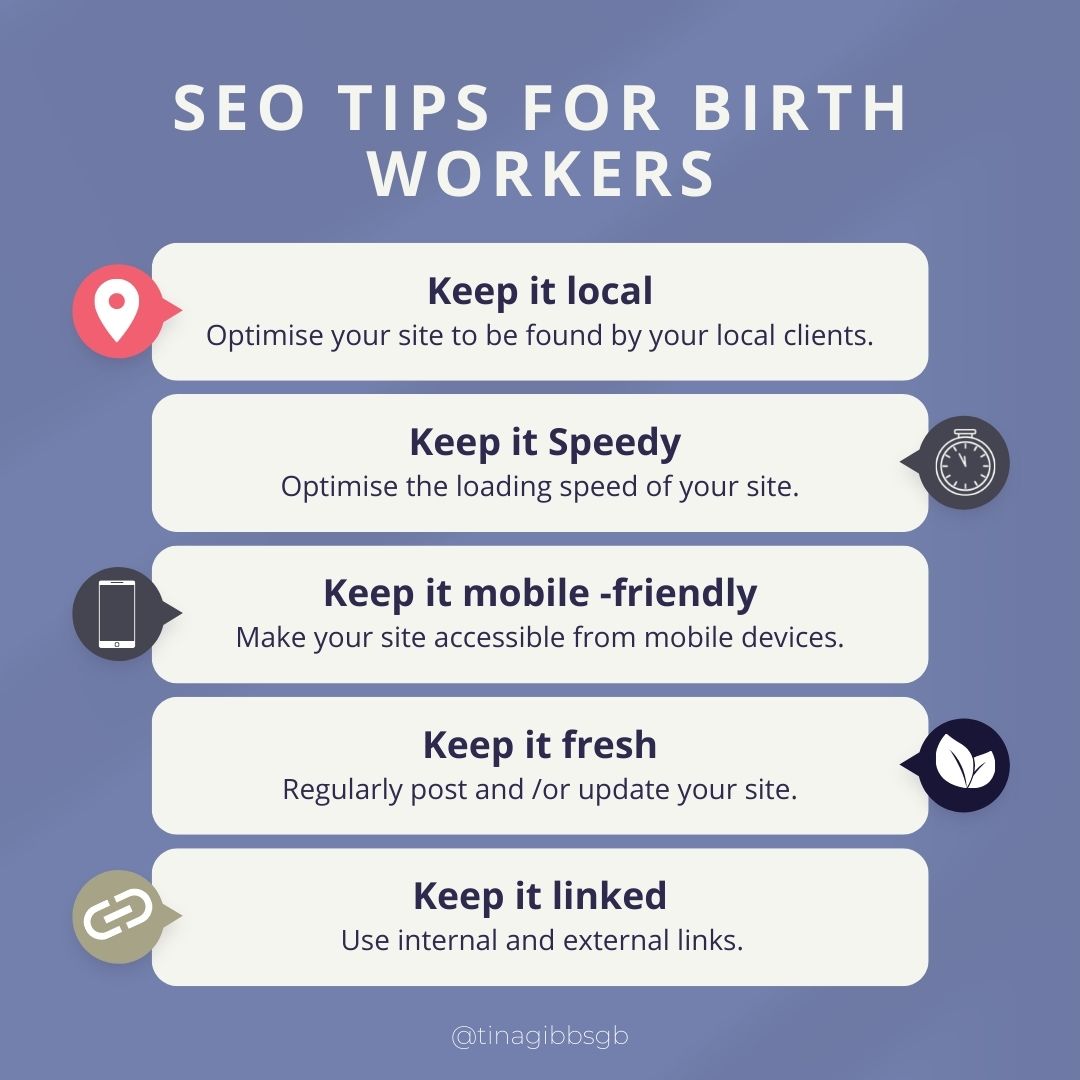
Here are my top SEO tips for birth workers

Keep it local!

Optimise your about and services pages for local searches! Make sure to include your town, city, area you work in in your description.

To display your website to your (potential) clients, search engines need to understand three very important things,

  1. Who you are
  2. What you do
  3. Where you are

You can do that in one or two sentences, ensuring you include this information on your home, about as well as service pages!

Example: Hello I am <Your name >, a <job/role i.e. hypnobirthing practitioner> in <area you are working in>, I offer a local support/services including <add some examples>.

Keep it speedy!

Optimise the speed of your website. Search engines are more likely to suggest your site higher up in the search results when your site is loading faster. Here are some free tools to check the speed of your website:

Use Google’s Page Speed Insights Test to find out how quickly your website loads.

Keep it mobile-friendly!

The vast majority of internet users and your (potential) clients search and access information via their mobile phones or other mobile devices. Make sure, that you website is accessible and user-friendly for mobile phone/devices. Here is a free tool to check what your site looks like on mobile devices:

Use this google tool to find out if your website looks great on mobile devices.

Keep it fresh!

Nobody likes outdated content, so the search engines will check when you have last updated the information/anything on your website. They’ll show ‘fresher’ pages higher up in the results as they are more likely up-to-date. So simply, log on to your site now and again and write a blog post, or change a few things round. Keep it fresh!

Keep it linked!

Creating backlinks, is another important tool. If other local businesses or other birth workers are linking to your content, it is a little star for you. It makes you seem more ‘trustworthy’ in the eyes of a search engine at least! Careful! Use links/linkbacks to and from relevant and natural content. Think about swapping links with other local related businesses with the same or very similar audience, such as family photographers, holistic therapists, perinatal fitness, etc.

Now, get yourself a cuppa and optimise your SEO following my tips for birth workers above!
Posted on Leave a comment

Facilitating Antenatal Classes online

What do I need and where do I start when facilitating antenatal classes online? How can I keep my clients actively engaged in during the classes and how can I make my online antenatal classes more interactive?

What do I need to facilitate antenatal classes online?

When facilitating your antenatal classes online, it’s important that you have reliable equipment:

  • A reliable, stable and speedy internet connection. Test your internet connection with friends and family on a video call first, maybe while other people in your household stream some video content or play online games at the same time.
  • A PC or laptop. Ideally a modern one which can cope with the video and audio streaming content, multiple windows being open etc without overheating – especially during hot summer days!
  • A video conference platform such as zoom, Microsoft teams or similar. There are many different platforms available. My chosen platform is zoom as it (at the time of writing this) is the most flexible and suitable platform for interactive group education. If you are facilitating 1:1 only or use more of a lecture-style approach, any platform will do. When facilitating group antenatal classes online, I like to be able to split my larger group into smaller groups (breakout rooms in zoom) to give my clients some private ‘away from the teacher’ time but also allow for and encourage bonding as a group.
  • Some visual content such as powerpoint slides, google slides or canva presentations. For your visual learners, you ma wish to have some powerpoint slides (or similar) that you can share from time to time.
  • Some good lighting in the room so that your clients can see you.
  • A good camera and microphone so that your clients can see and hear you properly.
dress the baby (move the appropriate clothes onto the baby).

Where do I start?

Practise – Before you start facilitating online with/for paying clients, you may wish to practise with family members, friends or colleagues first. Alternatively or in addition to that, you could record yourself and watch it back.

Set expectations – set expectations with your clients. Let them know what to expect in advance. i.e. ‘please keep your cameras and microphones on, this is an interactive class’. or ‘mute yourselves’ for a lecture etc.

How do I keep/make my online antenatal classes interactive and fun?

Mix it up! Rather than having a full-on presentation going on, use your slides as visual aids. Use the breakout rooms (zoom) to create smaller groups. Use free* additional online tools such as mentimeter, kahoot, jamboard for wordclouds, quizzes and more.

wordsearch to annotate online on zoom

I have been using virtual

  • quizzes
  • card sorts
  • scavenger hunt
  • annotations
  • wordsearches
  • escape room
  • word clouds
  • polls
  • breakout rooms

and more in my virtual classes and workshops.

If you would like to learn more about some of the tools you can use and how to use them, book an empower hour with me. You can practise your approaches with me, get feedback on your activities and content or we can create your teaching plan and activities together. Any content we create during any of the sessions is yours to keep and use.

*free version available at the time of writing

Posted on

Teaching about breathing techniques for childbirth?

Most antenatal education formats virtual or in-person, include breathing techniques for childbirth. There are a range of different techniques used by different organizations or private facilitators.
Breathing techniques are well known for being helpful in stressful situations and to help people relax. 


Harvard Health Publishing says: “Relaxation techniques: Breath control helps quell errant stress response”. Therefore, breathing techniques may be an excellent option to help mothers and birthing people to stay calm and relaxed during labour and childbirth.

As birth workers we know it’s important, we know it works (when practised) and most parents-to-be have heard about it, too.  However, when I facilitate antenatal education classes, I often get eye-rolling from some parents-to-be when introducing the topic, especially when I ask parents-to-be to join in and give it a go. Therefore, I have come up with a fun activity, that parents-to-be can practise within their couple during the class and at home.

Fortune-Tellers/cootie catchers to practice for labour and birth! 

You can find my fortune tellers here:

You can print all of my activities on standard A4 paper. Every time I have used any of these fortune-tellers with pregnant parents and their birth partners, they were a great success! Parents enjoy playing with the fortune-tellers and reviving some childhood memories at the same time.

Come and visit my TPT store!

Posted on

What is a labour beadline?

A labour or childbirth beadline is such a lovely way to keep track of special moments! It’s a collection of often colourful beads strung together on a strong fishing line or similar thread. You can get creative by using different-sized beads to represent contractions and breaks; some folks even choose different colours or use both! I personally enjoy working with wooden beads, but really, any material can work beautifully. I love using shiny new beads along with pre-loved treasures from broken jewellery or charming finds from charity shops. #labourbeadline #labourbeadlines

Labour beadline for childbirth education

How do I use a labour beadline?

Labour beadlines are a fantastic way to create a visual and tactile learning aid of the stages of childbirth/labour! During an antenatal class or a doula 1:1 you might invite your participants to label the different stages and even chat about the variations they notice. Adding pictures of positions and self-help tools along the timeline can spark discussions about the best techniques to try at each stage.
For those teaching students who are visually impaired, using these beadlines serves as a wonderful tactile teaching aid in your classes. Just imagine how effective it can be to use different-sized beads to represent contractions versus breaks!

labour beadline childbirth education

​What do the beads mean? 

Each larger bead, or those of different colours, stands for a contraction. The smaller beads at the beginning stand for mild contractions and will appear in an irregular order initially. As we progress, the gaps or breaks between these beads will shorten, and the contractions will become stronger, shown by larger beads. Knots or specially shaped rigged beads symbolize the transition phase. A larger special bead, like a heart-shaped one, beautifully represents the birth of the baby, while a smaller special bead at the end stands for the placenta.

labour beadline childbirth education

When can I use a labour beadline?

A labour bead line is a wonderful resource for use in large groups, smaller gatherings, or one-on-one sessions. When working with larger groups, it can be advantageous to set up two or three labour bead lines, allowing parents-to-be to explore, interact with, and engage in hands-on learning. I’m pleased to share that most of my labour bead lines are designed with accessibility in mind, making them particularly suitable for visually impaired parents-to-be, as all the contraction beads are larger than the pause/break beads!

Where can I get a labour beadline?

You can absolutely create your own labour/childbirth beadline! It takes just 1-2 hours to design one, and if you prefer, you can also check out the ready-made options or even order a customized one from my website. We have a variety of lovely labour beadlines available for both singleton and multiple pregnancies. If making your own sounds like fun, I also offer…

  • labour beadline kits with everything you need to start beading!
  • Lesson plan how to incorporate your labour beadline or beaded childbirth timeline in your classes.
labour beadline kit childbirth education