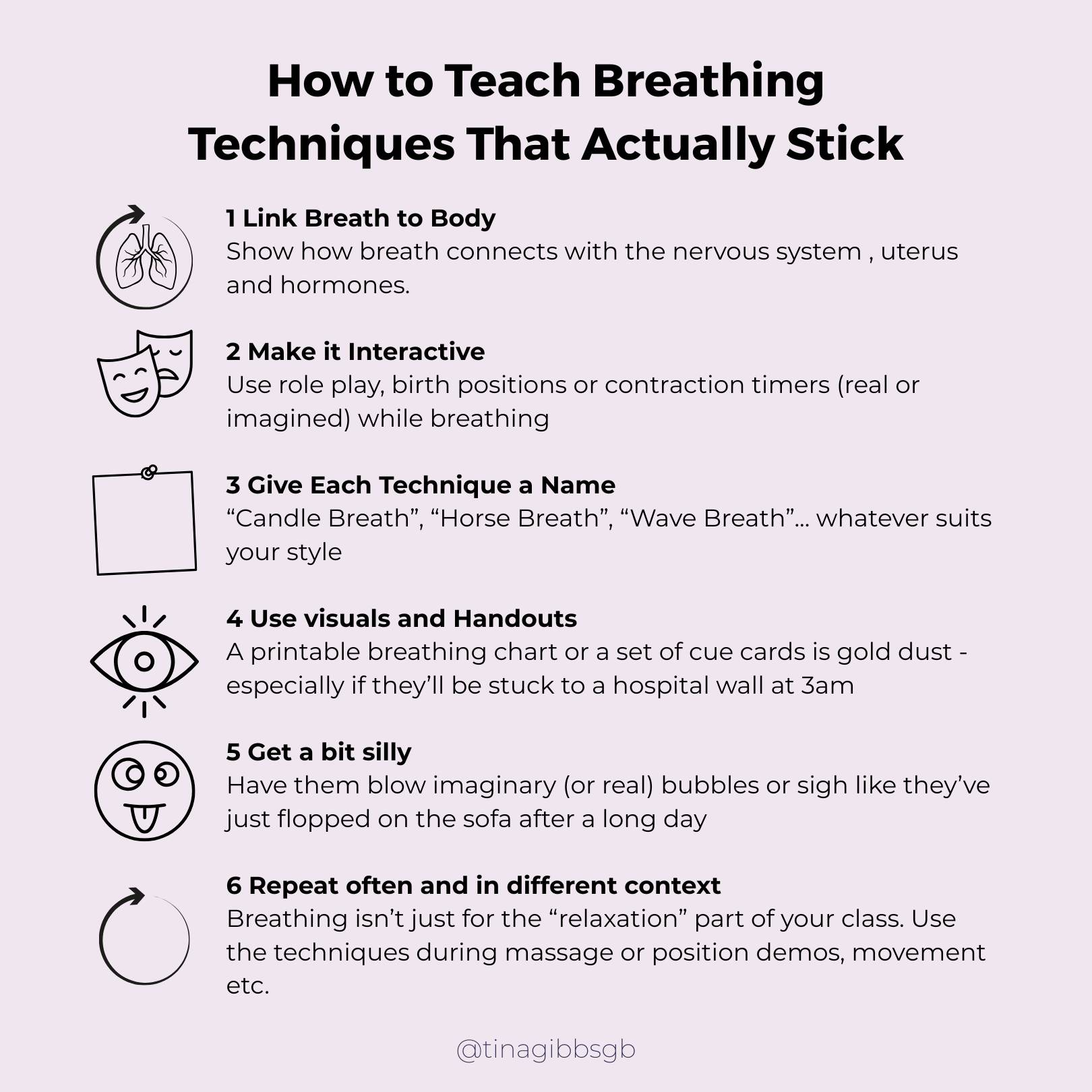
How to teach breathing techniques that actually stick is a practical guide for antenatal teachers, birth workers, and perinatal educators
Let’s face it—telling someone in labour to “just breathe” is a bit like shouting “stay calm!” during a fire drill. Great idea in theory, but not super helpful unless they’ve practised it beforehand.
Teaching breathing techniques is one of the most powerful tools in your antenatal toolkit—but it has to be taught in a way that’s simple, practical, and memorable.
Here’s how to make sure the breathing techniques you teach don’t just float away like a stray balloon once class ends:
🌀 1. Link Breath to Body
Start with the why. When parents understand that breathing isn’t just about “calming down”—it’s actually affecting their nervous system, their uterus, and their hormone flow—it all starts to click.
You could explain it like this:
“Slow breathing tells your body it’s safe. When your body feels safe, oxytocin flows and labour can progress more smoothly.”
Science meets simplicity = win.
🎭 2. Make It Interactive
Don’t just demonstrate—involve them. Get people to practise each technique while in different positions, using a contraction timer, or during a short movement activity.
Examples:
- Pretend to ride a contraction “wave” while slow breathing
- Match breath to a partner massage rhythm
- Try one-minute breathing while squatting, leaning or on all fours
Movement + breath = muscle memory. They’ll be more likely to remember it when it counts.
🗂 3. Give Each Technique a Name
Humans are much better at remembering “Candle Breath” than “that slow exhale thing we did that one time.”
Try naming them based on imagery or feeling:
- Flower Breath (gentle inhale through the nose)
- Candle Breath (long soft exhale, like blowing out a candle without flickering the flame)
- Wave Breath (riding the peak and drop of a contraction)
It’s fun, it’s sticky, and it helps when birth partners need to offer cues and encouragement later on.
💡 4. Use Visuals and Handouts
Breathing technique cards or printable charts are your best friends. Pop them in your class packs or hang them in your teaching space.
Visual prompts:
- Help reinforce the technique
- Can be stuck on a hospital wall or birth centre window later
- Support birth partners too—they often need reminders in the moment!
🤸♀️ 5. Get a Bit Silly (Seriously)
Laughter is a fantastic tension reliever—and relaxed muscles make for more effective breathing. So don’t be afraid to add a playful moment or two.
Try:
- Pretending to blow bubbles
- “Sighing like you’ve just flopped on the sofa after a long day”
- Holding up imaginary hot chocolate and slowly blowing to cool it down
Silly now = soothing later.
🔄 6. Repeat Often and In Different Contexts
Breathing isn’t just for the “relaxation” part of your class. It should be woven through everything:
- During movement
- While discussing pain relief
- As part of decision-making scenarios
- During massage demos
Repetition builds confidence. They’ll walk away feeling like breathing is their superpower (because it is).
💬 Bonus: Handy Phrases to Use in Class
Here are a few phrases you can sprinkle throughout your teaching to reinforce the message:
- “Your breath is your anchor.”
- “Soft breath, soft body.”
- “You can’t control the waves, but you can learn to surf them.”
- “Every breath you take helps your baby too.”
Little mantras like these stick—and may pop into someone’s head right when they need them most.
Final Thoughts
Breathing techniques are simple on the surface—but they’re incredibly powerful tools for labour. As educators, it’s our job to move beyond the basics and give expectant parents strategies they’ll actually remember and use.
So go ahead—breathe some fresh energy into your next class. You’ve got this 💪
Want a printable breathing technique card set, activity or visual aid for your classes?
Have a look at my recommended products below! Also check out my Teachers Pay Teachers (TpT) Store here!


[…] Breathing Techniques for labour and birth to expectant parents? If you’ve read my last post, How to Teach Breathing Techniques That Actually Stick, you’ll already know how to help expectant parents master those all-important breathing skills. […]